
Quick answer: ELEHEAR sells OTC hearing aids tuned for the classic high-frequency, mild-to-moderate loss pattern — and the honest buying rule is match the tier to the room you struggle in. The Beyond ($399) is the workhorse: the deepest field history and a 50-year wearer’s “best OTC you can buy” verdict. The Beyond Pro ($599) adds the background-noise suppression owners call life-changing — and carries a documented left-device charging failure pattern. The Beyond 2 Pro ($799) fixes the v1’s feedback and fit complaints at the cost of a 38-rating early pool and no iPhone MFi. Get the hearing test first; buy the tier that matches it.
The three-product lineup
One platform, three levels of noise management. Prices are feed values at time of writing.

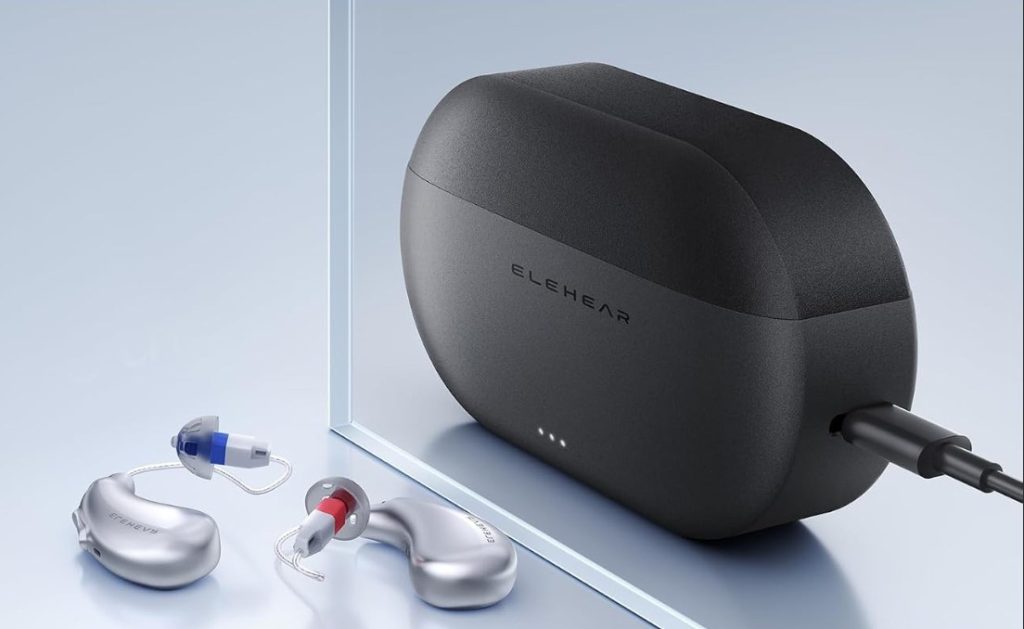
ELEHEAR Beyond 2 Pro
The newest and most refined tier, with the small-review-pool caveat attached: 38 ratings, 4.6 stars. What the early adopters document is a genuine generational fix over the Beyond Pro — feedback (the Pro’s worst complaint) reported eliminated over days of use, separate mid/mid-low frequency tuning, both shorter and longer receiver wires in the box, color bars so you can tell left from right, and sound that’s “less skreechy and more natural,” with the honest note that bass remains weak. The boundary reviews matter more than the score: the 2 Pro is not Made-For-iPhone certified (Bluetooth audio only, no hands-free call streaming), and the audiologist- customization service covers only about 15 states at $99 a session. An 82-year-old lifetime hearing-aid wearer calls the family “by far the best OTC you can buy.” Buy early, buy informed.
- feedback fixed vs Pro — the v1’s signature flaw, eliminated per multi-day owners
- two receiver lengths in box — the fit problem that drove v1 returns, addressed
- 4.6 stars on 38 ratings — early-adopter pool — promising, not proven
- not MFi-certified — audio-only Bluetooth on iPhone; no call streaming; 15-state audiologist support
ELEHEAR Beyond Pro
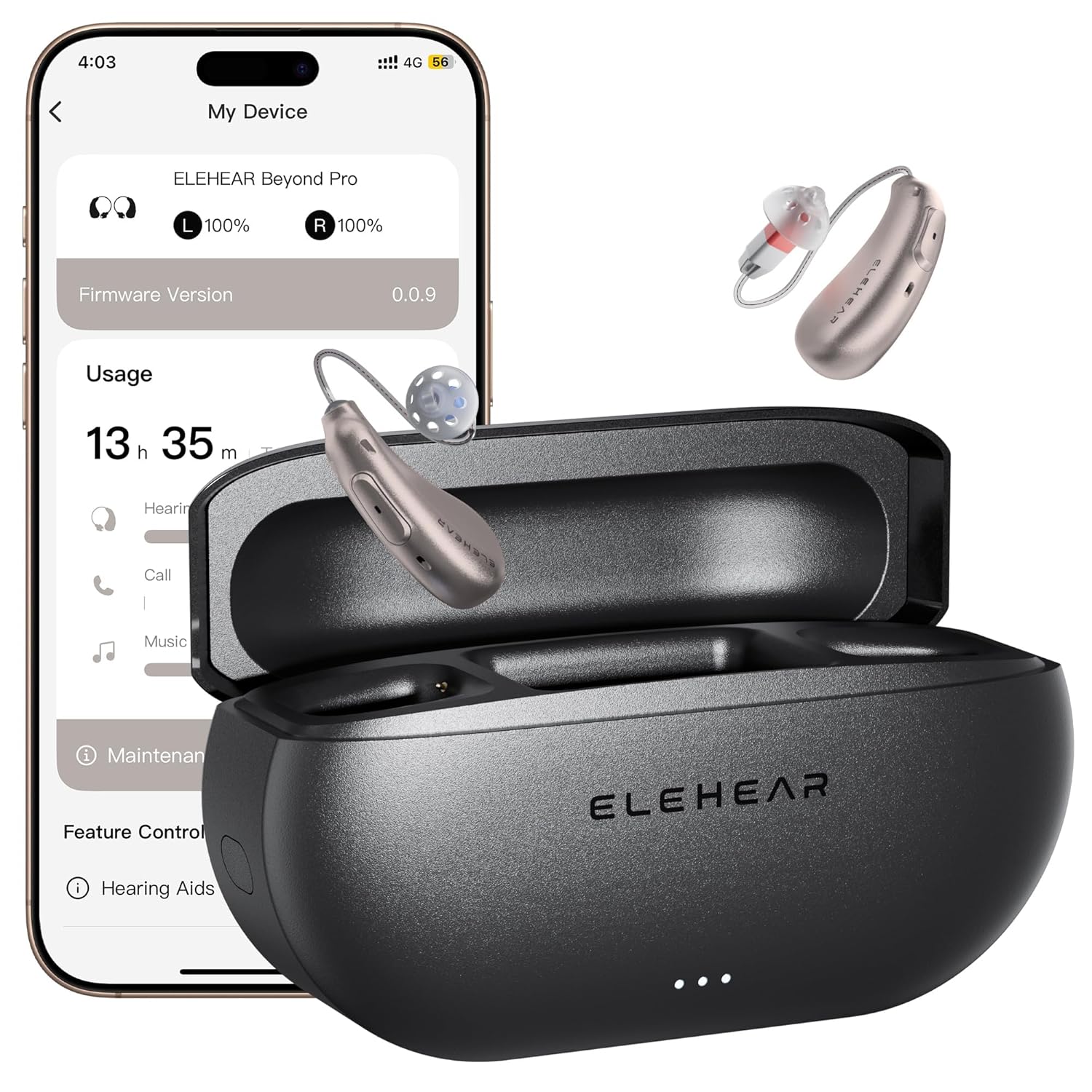
The tier with the most review depth and the most honest aggregate: 344 ratings, 3.7 stars. The 5-star side is genuinely strong — a birth-defect 30dB high-register loss owner calls the adjustable background-noise suppression “life changing” in restaurants and airports; another reports speech problem areas “eradicated” versus a $4,000 prescription pair. The 3-star side is where the score comes from, and the pattern is specific: left devices that stop charging within months (one owner is on her third pair), squeal in small rooms, glasses-fit conflicts, music with no bass (tuned for high-frequency loss), microphones that can’t be disabled for sleep, and a tech-savviness requirement that defeated a 91-year-old’s setup. Support gets consistent praise — replacement pairs shipped with your hearing test re-loaded.
- background noise suppression — the feature 5-star owners call life-changing
- bluetooth calls and music — verified working, with bass-light tuning as the honest limit
- 3.7-star aggregate — left-aid charging failures and squeal are the documented pattern
- support replaces + re-programs — new pairs shipped with your hearing test loaded, repeatedly verified

ELEHEAR Beyond
The tier that made the brand’s reputation, with the deepest pool (738 ratings). The strongest endorsement in this whole article comes from a wearer since 1976 who has owned Siemens, Beltone and Signia: “for $400 is it the latest technology? Probably not. But you won’t notice” — adjustable modes, phone app, and the price gap to $5,000-each prescription aids in plain language. A severe-loss comp-case owner reports them outperforming his obsolete audiologist pair out of the box. The durability legend: one owner ran them through a full wash cycle and the dryer, and both units powered back on and re-paired. The 3-star honesty: “this is an amplifier and not a hearing aid” for real frequency-specific loss, only medium receiver wires in the box (others by order), and a 30-foot Bluetooth re-pairing ritual.
- wearer-since-1976 endorsement — the best OTC value verdict in the entire pool
- wash-and-dryer survival — both units powered back on and re-paired — documented
- deepest review pool (738) — the tier with the most field history
- amplifier physics — high-frequency-loss tuning; wrong tool for severe or low-frequency loss
Who each ELEHEAR is for
These are amplification devices tuned for high-frequency loss — the classic age-related pattern — sold at OTC prices with app tuning.
The budget pragmatist — Beyond ($399)
Mild-to-moderate, mostly high-frequency loss; a backup pair; or the price of prescription aids making you go years without. The deepest field history and the legendary durability story.
The feature buyer — Beyond Pro ($599)
Restaurants, family gatherings, background noise as the enemy. The noise-suppression tier with Bluetooth calls — bought with the left-aid failure pattern known and a protection plan considered.
The early adopter — Beyond 2 Pro ($799)
The v1 annoyances (feedback, fit, wire lengths) fixed in hardware, for buyers who read footnotes: no MFi on iPhone, and audiologist support in 15 states only.
Side by side
Prices and ratings from the brand’s affiliate feed at time of writing.
| Beyond | Beyond Pro | Beyond 2 Pro | |
|---|---|---|---|
| Job | Reliable amplification + app | Noise suppression + Bluetooth | The refined flagship |
| Best documented win | 1976-veteran’s value verdict; wash survival | Restaurant/airport clarity, “life changing” | Feedback eliminated, both wire lengths |
| Documented weakness | Amplifier physics, medium wires only | 3.7★: left-aid charging failures | No MFi; 38-rating pool |
| Price | $399.00 | $599.00 | $799.00 |
| Rating history | 3.9 · 738 | 3.7 · 344 | 4.6 · 38 |
Not the right pick if… your loss is severe, low-frequency, or anything an audiogram would call complex. The pool’s own 3-star language: “this is an amplifier and not a hearing aid.” A 12-year wearer tried them as a backup and found frequency-specific tuning missing; a comp-case severe-loss owner is the exception that proves the rule. OTC rules exist for a reason — if you haven’t had a hearing test, get one first.
Not the right pick if… you’re an iPhone owner who expects hearing-aid integration. The 2 Pro’s own 4-star review documents it: not MFi-certified, audio playback only, no hands-free calls, and the audiologist-programming service limited to about 15 states at $99 a session. Android users report the full experience; iPhone users should read the footnote twice.
Not the right pick if… you wear glasses and wire routing is already a fight. Beyond Pro 3-stars specifically cite glasses conflicts — even the longer wires leave a difficult fit — and beyond-the-ear housings run bulky against temples. Multiple returns were fit-only, sound praised.
Not the right pick if… you want set-and-forget hardware. The left-aid charging failure pattern is real and repeated across Pro reviews — one owner on her third pair. Mitigations that work: keep the case contacts clean (one “failure” was dirt), buy the protection plan the regretful reviewer skipped, and lean on the support channel that ships replacement pairs with your hearing test re-loaded.
Not the right pick if… the wearer can’t manage an app. These are phone-tuned devices — a 91-year-old’s family returned them as “too complicated,” Bluetooth version compatibility bit another family, and the sleep feature can’t disable microphones without the phone in range. The simplest tier still demands a smartphone ritual.
What verified buyers say
Six verified Amazon reviews, paraphrased and attributed — weighted toward the boundary-setting reviews this category needs most.
A hearing-aid wearer for five decades across all the major brands — Siemens, Beltone, Signia — bought the Beyond tier when Amazon pointed him at the newer 2 Pro. His framing is the article’s anchor: for $400 it’s not the latest technology, “but you won’t notice,” with 10–12 modes from restaurants to street to TV, adjustable, at a price that ends the years he went without aids because prescription pairs cost thousands each.
The durability accident nobody plans: left in a pocket through a full wash cycle, then the dryer. He “honestly shed a tear,” put both units back in the charging case “more out of hope than expectation” — and both powered on, re-paired to the app, and sound exactly as they did the day he got them. A data point no lab test would have produced.
A birth-defect 30dB upper-register loss that decades of audiologists said could only be made louder, not clearer. What changed with the Beyond Pro: adjustable background-noise suppression through the phone — restaurants, airports, the car, softly spoken voices. “It doesn’t quite fill in a whisper unless I crank the volume, but I have that option.” The feature claim, delivered.
The failure pattern that explains the 3.7: pair one — left device wouldn’t charge. Pair two — right ear “squealing and static, LOUD… absolutely unusable.” Pair three — six months in, the left device quits charging again, no sign of damage. She wanted to leave 4 or 5 stars for the sound; the hardware lottery made it a 1. No protection plan, and she regrets it — that’s the buying lesson this review exists to teach.
A Beyond Pro daily wearer for almost a year (whose v1 issue turned out to be a dirty case contact) bought the 2 Pro as a spare and found the upgrade real: smaller and more comfortable, both shorter and longer receivers included, color bars for left/right, more frequency options, and a “wise decision” verdict. The generational-fix review the new flagship’s early reputation rests on.
The boundary a buyer can’t learn from the listing: they pair and play audio, but lack MFi certification — so on an iPhone they work only as headphones, without the hands-free call and streaming integration MFi aids provide. He’d also checked the audiologist customization option: available in about 15 states, $99 a session, and his state wasn’t one. “I wish I hadn’t had to return these” — the fit and sound were great.
Three listeners these devices serve
The restaurant table
Family dinners, tile floors, everyone talking at once. The documented win: noise suppression tuned from a phone turning incomprehensible tables into conversations — the Pro tier’s signature story.
The TV-and-phone household
Streaming calls, podcasts, the evening news at a sane volume. The documented win: Bluetooth call and music quality that surprised owners coming from $4,000 prescription pairs — with bass-light music as the honest limit.
The budget escapee
Years of going without because prescription aids cost thousands. The documented win: a 50-year veteran’s verdict — $400, adjustable, “you won’t notice” the difference in most rooms. The reason this category exists.
FAQ
Can OTC hearing aids really replace prescription ones?
For the classic mild-to-moderate, high-frequency, age-related pattern — the pool says often yes: multiple owners report ELEHEAR units matching or beating $4,000–7,500 prescription pairs for conversation clarity, at a tenth of the price. For severe, low-frequency or medically complex loss, no — the same pool’s 3-stars say plainly that these are amplifiers with app tuning, not frequency-specific medical devices. The honest protocol: get the hearing test first (many are free), then match the purchase to the audiogram.
What's the left-ear failure I keep reading about?
A repeated hardware pattern in the Beyond Pro pool: left devices that stop charging within months, sometimes with no visible cause, across replacement pairs — one owner documented three consecutive pairs. Two mitigations from the same pool: check the case contacts first (one ‘failure’ was dirt, found after ‘a lot of fiddling’), and buy the protection plan — the regretful third-pair owner wishes she had. Support’s track record of shipping replacements with your hearing test re-loaded is the reason the aggregate is 3.7, not lower.
Do they work with my phone?
Both, with an asterisk on iPhones. Android owners report full pairing, calls and music. iPhone owners get audio playback — but the 2 Pro’s own review pool documents that these are not MFi-certified: no hands-free call streaming, no hearing-aid integration, and no footnote in the listing to warn you. There’s also a Bluetooth-version floor: one family’s older iPhone simply wouldn’t pair. Check your phone’s Bluetooth version against the listing before buying.
How do the three tiers actually differ?
Features and refinement, roughly: the $399 Beyond is the reliable amplifier with app tuning and the deepest field history; the $599 Pro adds the noise suppression and Bluetooth-call tier owners call life-changing (and carries the charging-failure pattern); the $799 2 Pro fixes the v1’s feedback and fit complaints in hardware and includes both wire lengths — at the cost of a 38-rating early-adopter pool. Sound quality jumps most at the Pro tier; reliability reputation is strongest at the base tier.
What about music?
Honest answer: functional, not musical. Owners consistently report weak or absent bass — these are tuned for speech frequencies, which is the job. One Pro reviewer put it as ‘don’t expect the music option and get decent results.’ If music listening is a primary use case, earbuds for music and hearing aids for conversation is the split the pool itself models.
How was this page put together?
We are an independent review site. Specs, prices and coupon states come from the brand’s official affiliate feed; review summaries are paraphrased from the public Amazon review history of each product, negative reviews included. If you buy through our links we may earn a commission — it does not change which reviews we quote or what they say.