
Quick answer: Teslong sells the same 5-inch screen behind three different probe geometries, so buy the probe, not the box. The NTS500 ($269.99) puts a replaceable 0.21-inch dual-lens probe through spark-plug holes and was this brand’s biggest October commission. The 16.5-foot dual-lens ($159.99) is the 3,659-rating homeowner unit that finds wall and drain leaks plumbers charge $300 to miss. The articulating 5.5mm ($139.99) is the only one that looks around corners — and the one with the roughest durability record (4.1, with documented display and light deaths). The multi-scope owner on this page says what the listings do not: the connector, not the camera, is what you are buying.
The three-product lineup
50 products in the US feed, split between industrial borescopes and a rifle-borescope line. These three are the conversion leaders in October’s affiliate data.

Teslong NTS500 Dual Lens Borescope
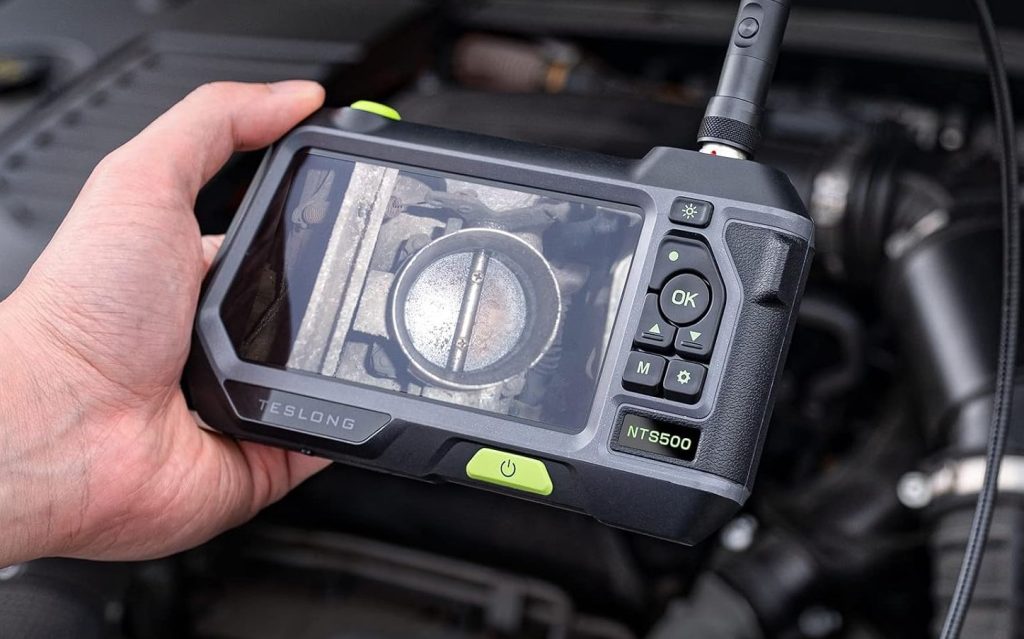
The top of the range and the biggest single commission in this brand’s October data. What you are buying is a 0.21-inch dual-lens probe (front camera plus side camera, one button toggles) on a 9.8-foot semi-rigid cable, feeding a 5-inch 720P IPS screen, IP67, in a hard case — and, critically, a probe that detaches at an aerospace connector. The owner with three Teslongs and an Autel makes the case better than the listing: on fixed-probe scopes, damage or a wish for a different diameter or length means buying a whole new borescope; on this family, you buy a probe. HVAC techs and mechanics in the pool compare the image quality favorably to shop units that cost twice as much, and the NTS500 was this brand’s top October converter at $33 in a single commission.
- 0.21in dual-lens probe, 9.8 ft — passes spark-plug holes; side lens replaces mirror attachments
- probe is replaceable at the connector — the upgrade path that fixed-probe competitors do not have
- 5" 720P IPS + SD card + video with audio — shows homeowners the problem; no phone, app or WiFi
- IP67, hard case — wet environments, field storage

Teslong 5" Dual Lens Borescope
The volume seller: 4.6 over 3,659 ratings, $60 cheaper than the NTS500, with the longer 16.5-foot cable and a wider 8mm probe. This is the wall-and-plumbing scope: an owner found a clawfoot-tub drain leak his plumber could not localize for $300 per visit; another fished a stuck power cable out of an RV ceiling cavity without dropping the headliner. The trade is diameter — 8mm will not pass a spark plug hole the 0.21-inch NTS500 walks through — and maneuverability: several owners note the semi-rigid gooseneck is hard to steer past three feet inside a sewer line or wall. Includes hook, magnet and mirror tips in the case.
- 16.5 ft semi-rigid cable — the length that reaches sewer blockages and wall cavities
- dual lens, 6+1 adjustable LEDs — front and side views without swapping attachments
- hook / magnet / mirror accessories — the retrieval kit that saves the $300 plumber visit
- 5000 mAh, ~4.5 h runtime — all-day intermittent use; 5 h recharge

Teslong 5.5mm Two-Way Articulating Borescope
The different instrument: instead of two fixed lenses, one camera on a 180° joystick-articulated tip that sweeps left and right and holds position. 5.5mm slim probe, 5-foot cable, 5-inch IPS screen with 1.3×/1.5× digital zoom, SD card, foam-lined case. For engine diagnostics this is the tool: an owner looked around pistons and behind valves — views a fixed front lens physically cannot produce. It is also the unit with the roughest review record on this page: 4.1 over 445, with documented failures (a display that developed hundreds of vertical lines inside ten uses; a light module dead in two months) and a support line that answered a defective unit with a recall confirmation and a replacement. One owner points out the articulation moves in a single plane — you twist the whole unit for the other axis.
- 180° articulating tip, joystick control — looks around cylinders and behind valves — the fixed lenses cannot
- 5.5mm slim probe — fits almost all spark plug holes; 5 ft cable is shorter than the others
- 1.3× / 1.5× digital magnification — for cracks and wear patterns on the 720P screen
- one articulation plane only — rotate the whole unit for the second axis — read before buying
Which scope, for which hole
Three instruments, three geometries. The decision is the hole diameter and the distance — everything else is packaging.
Engine cylinders and spark-plug holes — NTS500 ($269.99)
0.21in probe through the plug hole, side lens for cylinder walls, replaceable probe at the connector for when you want a different size later. The mechanics’ pick.
Walls, drains, ducts, RV cavities — 16.5 ft dual lens ($159.99)
The homeowner’s pick: reach over 16 feet, retrieval accessories in the case, 3,659 ratings of leak-and-blockage stories. 8mm will not enter spark-plug holes.
Looking around corners on purpose — articulating ($139.99)
The 180° tip is the only way to see behind valves and pistons without a mirror. Highest capability, roughest reliability record, single articulation plane — twist the unit for the other axis.
Side by side
Prices, ratings and rating counts from the brand’s affiliate feed at time of writing.
| NTS500 dual lens | 5″ dual lens 16.5 ft | 5.5mm articulating | |
|---|---|---|---|
| Price | $269.99 | $159.99 | $139.99 |
| Rating history | 4.7 · 644 | 4.6 · 3,659 | 4.1 · 445 |
| Probe | 0.21in fixed dual-lens, replaceable | 8mm fixed dual-lens | 5.5mm, 180° joystick tip |
| Cable | 9.8 ft | 16.5 ft | 5 ft |
| Screen | 5″ 720P IPS, SD card, audio | 5″ IPS, ~4.5 h battery | 5″ IPS, 1.3×/1.5× zoom, SD |
| Documented weakness | Price; bracket of accessories sold separately | Gooseneck hard to steer past ~3 ft | Display/light failures; one articulation plane |
| October conversions | 1 ($33.34, brand’s largest) | — | 1 ($16.37) |
Not the right pick if… your inspections are inside engine cylinders and you buy the 16.5-foot unit for the price. The 8mm probe does not pass spark plug holes — that is the NTS500’s 0.21-inch job, and the mechanics’ reviews are all on the slim probes. The 16.5-footer is a wall, drain, duct and cavity scope; buying it for engines is the documented disappointment.
Not the right pick if… you need to steer more than about three feet through pipe. The semi-rigid gooseneck’s own owners describe it as hard to turn and maneuver once you are more than three feet inside a sewer line or wall — one wants it more flexible, another notes it is not suited to tight bends at all. For long straight runs it is fine; for bends, plan on fishing technique rather than steering.
Not the right pick if… zero failure risk is the requirement. The articulating model’s pool contains a display that died inside ten uses, a light module dead in two months, and a confirmed bad sensor batch the company recalled — against a 4.1 rating. The fixed-lens models fail too (a six-month power fault, warranty-replaced in days), but the failure modes are simpler. If this scope is your business’s only diagnostic tool, carry the backup or buy the warranty — the owner who did wished he had earlier.
Not the right pick if… you expect the manual focus to be manual. One owner bought the articulating model specifically for its focus capability, read the listing as manual focus, and discovered the focus is fixed — the sharpest range is about 1.5 to 6 inches, which covers most inspection work but is not adjustable. The zoom buttons are digital, not optical. If adjustable focus is the reason you are paying up, verify the current listing states it before ordering.
Not the right pick if… you wanted app-free operation to mean screen-free. All three are phone-free — the 5-inch screen is the whole interface, which is exactly what mechanics and homeowners in the pool praise (no glitchy app, in one owner’s words). But if your use case wanted the image streamed to a laptop or shared live, that is a different product category entirely; these record to SD cards you carry to the computer.
What verified buyers say
Six verified Amazon reviews, paraphrased and attributed — the four-scope owner’s buying rule, the $300 plumber visit replaced, a display dead in ten uses, a light dead in two months, the single-plane surprise, and the warranty that actually replaced a unit.
The most valuable review on this page for a first-time buyer, because it is written by someone who owns four scopes. His rule, paraphrased: many borescopes have a fixed probe — damage it, or want a smaller diameter or a longer cable, and you are buying the entire borescope again. The Teslong NTS300/NTS500 family and the Autel MV400 let you change or replace the camera probe instead, which he calls a big plus that saves you money. He also ranks the Teslongs among the most user-friendly and affordable he has used. If you are choosing your first scope, this is the review to read before the five-stars: the connector is the feature.
Why the 16.5-foot unit has 3,659 ratings: it finds things trades charge hundreds to localize. He had subtle leakage behind a clawfoot tub dripping into the floor below; his plumber could not get to the root cause. The camera showed progressive corrosion around the underside of the drain and a nearly hidden shower pipe whose sealing ring was never tightened — and turned on the shower to show the leak spurting at a particular spot, immediate cause-and-effect evidence in his words. Picture very clear, photos and video both recordable. This is the scope for water, not engines.
The articulating unit’s worst documented failure, worth quoting in full context: bought December 1, 2025, used fewer than ten times across two diagnostic projects, and under a year later the display developed hundreds of thin vertical lines plus horizontal bands and distorted colors — the camera image almost completely obscured, unusable. He calls it completely unacceptable durability for a diagnostic tool barely used, and expected years. Read together with the two-star and three-star light failures in the same pool: the articulating mechanism is the mechanically complicated one, and the failure records concentrate there. The fixed-lens models’ worst cases are power and charging faults, not imaging death.
Short and surgical. The scope was great when it worked — two projects’ worth of value — but the light failed inside two months, and a borescope without a light is pretty useless, in his words. He is replacing it with a different brand and, notably, bought the insurance this time, which he never bothers with. Combined with the recall story on the same model (a second-use camera failure the company attributed to a bad sensor batch), the honest read for the articulating line is: excellent when working, elevated failure risk, factor the extended warranty into the price comparison.
A buyer who read the listing and still got surprised, usefully. Pluses: small insertion hole needed, the head folds backwards inside a restricted cavity of roughly one inch, camera stationary means a clear picture. The catches he names: the main tube is not stiff enough to support itself, the manufacturer says it is not suited to tight bends, the articulating end is sensitive to control and took getting used to, and — the one to know — it only moves in one plane, which he had not realized when ordering; you fix it by twisting the whole unit. That last point applies to the articulating model at full price just as much as his unit.
The failure-and-recovery arc that explains why the ratings stay high. His NTS300 (the NTS500’s smaller sibling) refused to power on after two uses; charging showed solid red and never green. Disappointed, he contacted the company, submitted a warranty claim — easy as could be, in his words — and a new unit shipped. A mechanic on the same page replaced a broken scope with the NTS500 and calls it in love after the first day of work; another owner’s controller issue was met with a same-day replacement part and instructions. The pattern in this pool: hardware failures happen at normal rates, and Teslong’s answer is an actual replacement rather than a script.
Three trades these were made for
The mechanic’s bench
Spark plug hole to combustion chamber: 0.21 or 5.5mm probe, side lens or articulating tip, SD card to show the customer the carbon on the valve. The pool’s mechanics compare the image quality to shop Snap-on units at twice the price, and the NTS500’s replaceable probe means the next different diameter is a cable, not a borescope.
The homeowner’s wall
The $159.99 unit and 16.5 feet of cable: drain leaks, groundhog burrows, ground wire runs, the space behind finished renovation. One owner’s story — the tub leak the plumber could not find for $300 a visit, visible on the screen in minutes with the shower running. The hook, magnet and mirror tips are for retrieving what you find.
The HVAC and industrial rounds
16-year HVAC veteran replaced a broken scope with the NTS500 and calls the picture quality incredible; a mill uses theirs to see inside pipes daily. Photos and video for the homeowner’s file, IP67 for wet work, a hard case that survives truck drawers — the pool’s pros treat these as consumable professional tools with warranty backup, which is how the ratings stay at 4.6 and 4.7 despite individual failures.
FAQ
What is the actual difference between dual-lens and articulating borescopes?
A dual-lens scope has two fixed cameras at the tip — one pointing forward, one at 90 degrees — and you toggle between them. An articulating scope has one camera on a tip that physically bends up to 180 degrees under joystick control. Dual-lens is more robust (no moving camera parts) and cheaper per feature; articulating can look around pistons and behind valves at angles no fixed camera reaches, but the mechanism is the documented failure point, and it moves in one plane only — you rotate the whole unit for the other axis. Engine work favors articulating or the 0.21-inch dual; walls and pipes favor the big fixed dual.
Can I replace the probe if it breaks?
On the NTS300/NTS500 family, yes — the probe connects at an aerospace-style waterproof connector, and the multi-scope owner on this page names that as the deciding feature: a different diameter, length, or a damaged camera is a new probe, not a new borescope. The 16.5-foot dual-lens and the articulating models are fixed-probe instruments. A company review also notes replacement probes can be bought separately for the fixed models but are a little costly as spares — still cheaper than the whole unit. If you expect to grow into different inspection types, buy the connector family first.
Do these need a phone or an app?
No — all three have their own 5-inch IPS screen, which the review pool treats as a major selling point (no glitchy or hacked app required, no WiFi, no phone). Photos and video record to an SD card, and several models include one. The trade is screen size: one owner notes he has not tested reviewing images on a larger display. If you need live streaming to a laptop or a customer’s tablet, look at USB borescopes instead — and expect the app problems these avoid.
How durable are they, honestly?
The pool contains real failures and real recoveries. Failures: a display dead inside ten uses and a light module dead in two months on the articulating model, plus a confirmed bad sensor batch the company recalled; a power fault at six months on an NTS300. Recoveries: the power fault was warranty-replaced within days, easy as could be per that owner; the recall case was answered by a knowledgeable human on the first call; a controller failure on another unit drew same-day parts. Overall ratings of 4.6–4.7 over thousands of reviews say the base rate is fine — but if the tool is business-critical, the extended warranty exists for a reason one owner learned the cheap way.
Which one found the actual money-saving diagnosis?
The 16.5-foot dual-lens, repeatedly: a clawfoot-tub drain leak and unsealed shower pipe the plumber could not localize at $300 per visit, visible in minutes with the shower running; a stuck power cable in an RV ceiling cavity that would otherwise have meant dropping the headliner; an 11-foot sewer blockage located from the cleanout. The NTS500’s wins are professional — coolant leak confirmation between the block and the firewall while still under warranty, timing-chain debris in the oil pickup. October’s affiliate data matches: the two conversions in this brand were the NTS500 ($33.34) and the articulating unit ($16.37), both to trade users.
How was this page put together?
We are an independent review site. Specs, prices and coupon states come from the brand’s official affiliate feed at the time of writing; ratings are the public Amazon rating history of each parent product. Review summaries are paraphrased from verified Amazon customer reviews of the three products above, one-star and three-star included — every quotation is attributed to the reviewer name shown and the month it was posted. If you buy through our links we may earn a commission; it does not change which reviews we quote or what they say.