
Quick answer: with filters, the part number is the product — match the label inside your appliance, then argue about price. The LT1000PC three-pack ($29.99) and the Samsung DA97-17376B three-pack ($25.99) do the same job as OEM cartridges for roughly a quarter of the money, and the Samsung one has the quietest review history of anything here. The GFRVWP03 RV system ($269.99) is the only product in the lineup where the box matters more than the cartridges — and where the pool’s complaints are about plumbing: leaking quick connects, missing o-rings, and flow cut in half.
The three-product lineup
One RV system and two refrigerator cartridges. Prices are feed values at time of writing.

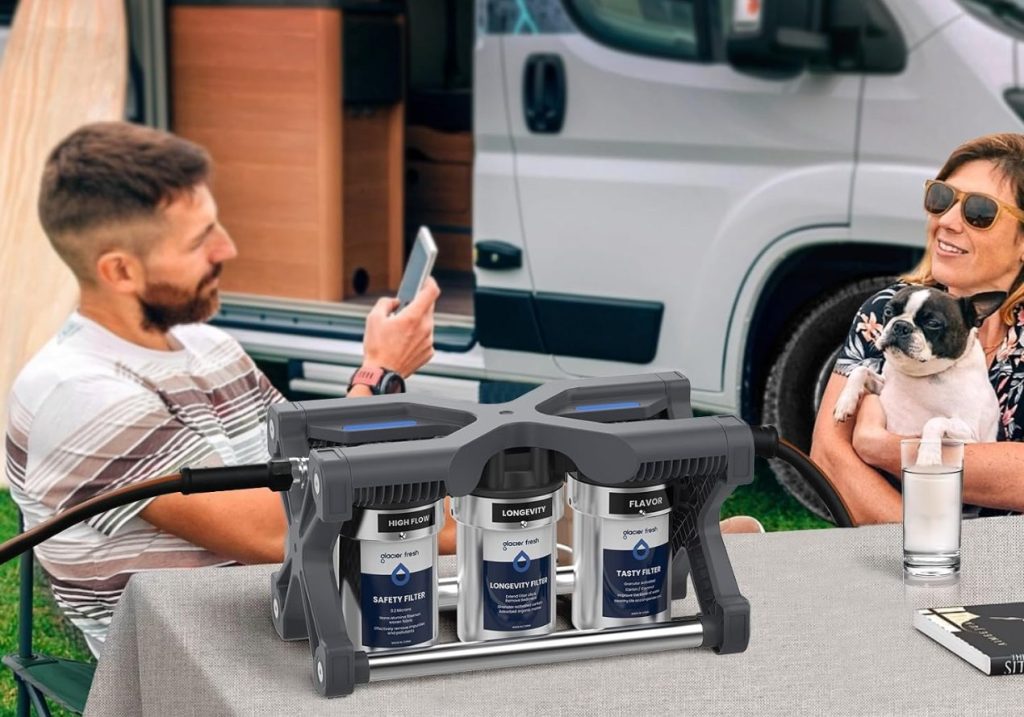
GLACIER FRESH GFRVWP03 3-stage RV filtration system
The expensive item and the one with the most to say. A four-year full-time RVer’s review sets up the economics: the system costs more than a single-cartridge canister, but the replacement cartridges cost far less than competing three-stage systems — and the point of a three-stage system is that you keep buying cartridges. The pool’s wins are taste, a firm footprint on the ground, filters arriving pre-installed, and easy swap-outs. The failures are all plumbing: quick-connect fittings leaking at both couplings regardless of pressure, missing o-rings on several units, flow cut roughly in half, no drain valves for winterising, and inlets smaller than a garden hose, which one owner could not adapt at all. It filters sediment and chlorine taste. It will not fix sulphur — one buyer learned that after the fact.
- cheap cartridges, expensive box — the whole reason to buy a three-stage system
- quick-connect fittings leak — the pool’s single most repeated complaint — check your o-rings
- flow drops by half — matters if you have a tankless heater or low campground pressure
- no drain valves — winterising means pulling the cans, not opening a tap

GLACIER FRESH LT1000PC replacement for LG refrigerators, 3-pack
The volume product: three filters for the price of one OEM cartridge, 2,329 ratings at 4.6, and the review pool reads like a household survey — fits the LG French-door fridge, water tastes right, half the price of the branded part, and the box includes a small tool for adjusting the nozzle that one owner only discovered after nudging the old filter on removal. The complaints are the ones this category always has, and they are worth reading as a checklist: the fridge not recognising the filter so the replace light stays on, a filter that does not seat easily, a chemical taste that made one family go back to OEM, cloudy water, and black carbon specks that need two or three gallons flushed before the first glass.
- 3 for the price of 1 OEM — the entire value proposition, and the pool confirms it
- nozzle tool in the box — a nicety nobody expects at this price — owners mention it twice
- filter light may stay on — the fridge can reject a non-OEM part; reset or live with it
- flush before drinking — black carbon specks are normal on first install, per the pool

GLACIER FRESH replacement for Samsung DA97-17376B, 3-pack
The quiet one. 3,327 ratings at 4.6 and a review pool with almost no conflict: it fits, it costs a fraction of the Samsung part, the water tastes the same, and installation is a twist. That absence of drama is the endorsement — in a category where cross-reference parts routinely fail to seat, this one has the lowest complaint density of the three products here. The honest caveat is that ‘low complaint density’ is not ‘no complaints’: the failures that exist are the standard ones, a filter the fridge refuses to acknowledge and the occasional odd taste. Buy the part number that matches your fridge’s label, not the one that matches your fridge’s brand.
- $25.99 for three — one of the cheapest ways to keep a Samsung fridge filtered
- quiet review pool — mostly fives and fours — no recurring failure story
- twist-in install — no tools, two minutes, per multiple owners
- verify the part number — DA97-17376B is not universal across Samsung models
Buy the part number your appliance was built for
Two different jobs hide under one brand: an RV system where flow and fittings decide everything, and refrigerator cartridges where the risk is a filter the fridge refuses to recognise.
Full-time RV or cabin — GFRVWP03 ($269.99)
Three stages, cheap refills, real sediment capacity. Check your fittings and your water pressure before ordering, and buy two spare o-rings. This is not the box for a sulphur well.
LG French-door fridge — LT1000PC 3-pack ($29.99)
Three for the price of one OEM cartridge and the pool confirms the fit. Accept that the indicator light may never reset, and flush two gallons before the first glass.
Samsung fridge, DA97-17376B — 3-pack ($25.99)
The least dramatic product here: fits, tastes right, no recurring complaint. Confirm the part number against the label inside the fridge before you order.
Side by side
Prices, ratings and rating counts from the brand’s affiliate feed at time of writing.
| GFRVWP03 RV | LT1000PC (LG) | DA97-17376B (Samsung) | |
|---|---|---|---|
| Price | $269.99 | $29.99 / 3-pack | $25.99 / 3-pack |
| Job | Whole-rig sediment + taste | Fridge cartridge | Fridge cartridge |
| Recurring cost | Cartridge set, roughly yearly | ~$10 per filter | ~$9 per filter |
| Documented win | Refills far cheaper than rivals | Half OEM price, fits, tool included | Fits perfectly, no drama |
| Documented weakness | Quick-connect leaks; flow halves | Indicator light may not reset | Occasional odd taste |
| Rating history | 4.4 · 333 | 4.6 · 2,329 | 4.6 · 3,327 |
Not the right pick if… your water smells of sulphur. None of these remove hydrogen sulphide — one buyer discovered this after installing the RV system and being told, correctly, that he needed an $800-900 air-injection filter instead. Sediment and chlorine taste are what a carbon block handles. If the water smells like rotten eggs, fix the smell first and filter after.
Not the right pick if… you have low pressure or a tankless water heater. Three cartridges in series halve the flow in one owner’s rig and the same complaint recurs in others. Campgrounds already run 35-45 psi; a system that costs you half of that turns a shower into a negotiation and can starve an on-demand heater into a fault code. A two-stage or a single high-flow canister is the better answer for those rigs.
Not the right pick if… you will not verify the part number. Fridge filters are matched by model, not by brand: LT1000PC and DA97-17376B are different cartridges for different fridges, and this brand sells dozens of them. Read the label inside your fridge door, not the brand on the front, and check the listing’s compatibility list before ordering three of anything.
Not the right pick if… a warning light you cannot clear will annoy you. Multiple LG owners report the fridge not recognising a non-OEM cartridge, leaving the replace-filter indicator lit. The water is fine; the icon is not. Some fridges let you reset it, some do not. If that light is going to bother you every time you open the door, buy the branded cartridge and consider the difference a convenience fee.
Not the right pick if… you expect OEM filtration data. No third-party cartridge publishes NSF certification numbers for every model the way the appliance makers do, and one reviewer’s honest position is that he cannot tell whether the filtration matches OEM — only that it is cheaper. For healthy adults on municipal water this rarely matters. For immunocompromised households or well-water supplies, it might.
What verified buyers say
Six verified Amazon reviews, paraphrased and attributed — the full-timer’s arithmetic, the leaking fittings, the pressure drop, and the two fridge-fit boundaries.
The economics review from four years on the road: he has run single-canister and multi-stage systems, and what sold him here was the cartridge price relative to the Nuvo H2O and other three-stage boxes — the system is not the cheapest, the refills are. Seven months of full-time use on the original set with consistently clear water. For someone deciding between a $90 canister and a $270 system, this is the argument: the second purchase is the one that matters.
The most useful negative in the pool because it is specific: connected through the quick-disconnect fittings — the only connection provided — water leaked at both couplings at every pressure he tried. The inlets are smaller than a standard garden hose, so he could not bypass the fittings either, and by the time he had the adapters the return window was gone. Refunded after he pushed, review moved to three stars. His advice is the practical one: test the fittings in the driveway, not at the campground.
The flow review, and it matters more than it sounds: a three-stage system puts three cartridges between the tap and the shower, and this one cut his water pressure by half the moment it went inline. If your rig has a tankless water heater, low campground pressure, or a shower you actually look forward to, this is the specification that decides the purchase — more than micron ratings. The same complaint appears in other reviews worded differently: ‘reduces the flow of our water pressure, not good if you have on-demand tankless.’
The install detail that saves an afternoon: while removing the old filter she twisted the nozzle slightly, and the small adjustment tool included in the box — with a simple diagram on the instruction sheet — fixed it in a minute. Water tastes like water again, the price is a fraction of the branded part, and she could not work out how to reset the filter indicator, which is a fridge manual problem rather than a filter problem. Two useful facts in one review.
The compatibility boundary, stated without drama: the filter physically fits his LG, installation is easy, the water tastes fine with no chlorine smell, and the two-pack beats OEM pricing. But the fridge does not register the part, so the replace-filter light stays lit. And his larger point is fair — he cannot tell whether the filtration is the same as OEM, only that it is cheaper. If a persistent warning light on your fridge door would bother you, buy the branded cartridge; if not, this is the same water for a third of the money.
The boring review that sells the product: good quality, does the same job as the big-box replacements that cost substantially more, and it is a direct replacement that fits perfectly with no adapters or persuasion. No story, no workaround, no support ticket. Across this pool that is the highest compliment available — the failures in this category are all about fit and recognition, and this unit had neither problem.
Three water problems these solve
The campground with gritty water
Sediment clogs the aerators and the coffee tastes of the hose. The documented win: three stages and cheap refills, with seven months of clear water on one full-timer’s original set.
The $59 fridge cartridge
Your LG wants an OEM filter every six months. The documented win: three that fit for $29.99, plus a nozzle tool in the box for the mistake everyone makes during removal.
The Samsung that tastes of the tap
Ice cubes carrying chlorine into every drink. The documented win: a direct replacement at $25.99 for three, with the lowest complaint density in this article.
FAQ
Will a Glacier Fresh filter fit my fridge?
Only if the part number matches, and that is the whole risk of this category. LG’s LT1000PC and Samsung’s DA97-17376B are different cartridges for different fridges; Glacier Fresh makes dozens of cross-references and the model number is on a label inside the door or on the old cartridge itself. The pool’s experience is that matching cartridges fit and seat normally. The recurring failure is not physical fit but recognition: some fridges do not register a non-OEM part and leave the replace-filter light on. Read the label before ordering three of anything.
Why does my water taste strange after installing a new filter?
Two causes, both documented. First, carbon fines: new cartridges shed black specks and a slightly flat or chemical taste for the first few gallons, so run two to three gallons through before drinking — multiple owners report exactly this and it clears. Second, genuine dislike: one reviewer says the filtration was fine but the taste was ‘strange and unpleasant’ and went back to the LG brand. If your water is heavily chlorinated, a new carbon block can also make the change more obvious than you expect. Flush first, then judge.
Does the RV three-stage system really cut water pressure?
Yes, and the pool is unanimous enough that you should plan for it. One owner measured it at half his previous pressure immediately after going inline; another names the tankless water heater as the casualty. Three cartridges in series is three restrictions, and the finer the sediment stage the more it costs. Mitigations that actually work: use the system on the cold line only, keep the sediment stage at 5 micron rather than 1, and do not stack it behind a pressure regulator set below 40 psi. If flow is your priority, buy a two-stage.
Is it cheaper than OEM in the long run?
For fridge cartridges, clearly: roughly $9-10 per filter against $40-60 for the branded part, and the pool consistently reports the same water. One counterpoint worth hearing: a few owners say the third-party filters do not last as long as OEM, so the saving is smaller than the sticker suggests — you may change them more often. For the RV system the economics flip: the box costs more than a canister, and it only pays back if you keep replacing cartridges at Glacier Fresh prices rather than switching systems.
What micron rating do I need for RV water?
Five micron for the sediment stage in most rigs, and do not chase 1 micron unless the water is already clean. The finer the stage, the faster it clogs and the harder it is on flow — and a clogged 1-micron cartridge behaves like a closed valve. The pool’s pressure complaints line up with systems run at fine ratings on mediocre supply. If you move between campgrounds of unknown water quality, carry a spare sediment cartridge and change it before it loads up.
How was this page put together?
We are an independent review site. Specs, prices and coupon states come from the brand’s official affiliate feed; review summaries are paraphrased from the public Amazon review history of each product, negative reviews included. If you buy through our links we may earn a commission — it does not change which reviews we quote or what they say.