
Quick answer: every Casabrews here uses a 51 mm basket and a single boiler, so buy the basket and the boiler behaviour, not the “20 bar” on the box. The CM5418 ($139.99) is the default: eight thousand ratings, a pressure gauge that teaches you, and a café owner’s endorsement at a third of Breville money. The 5418 PRO ($177.05) buys four-second heat and pre-infusion — the fastest, best-specced machine of the three, with the shortest track record. The 3700 Essential ($98.99) is the cheapest entry and the most demanding: the pool’s one-star there is a consistency complaint, and it is fair.
The three-product lineup
One 51 mm ecosystem, three price points. Prices are feed values at time of writing.
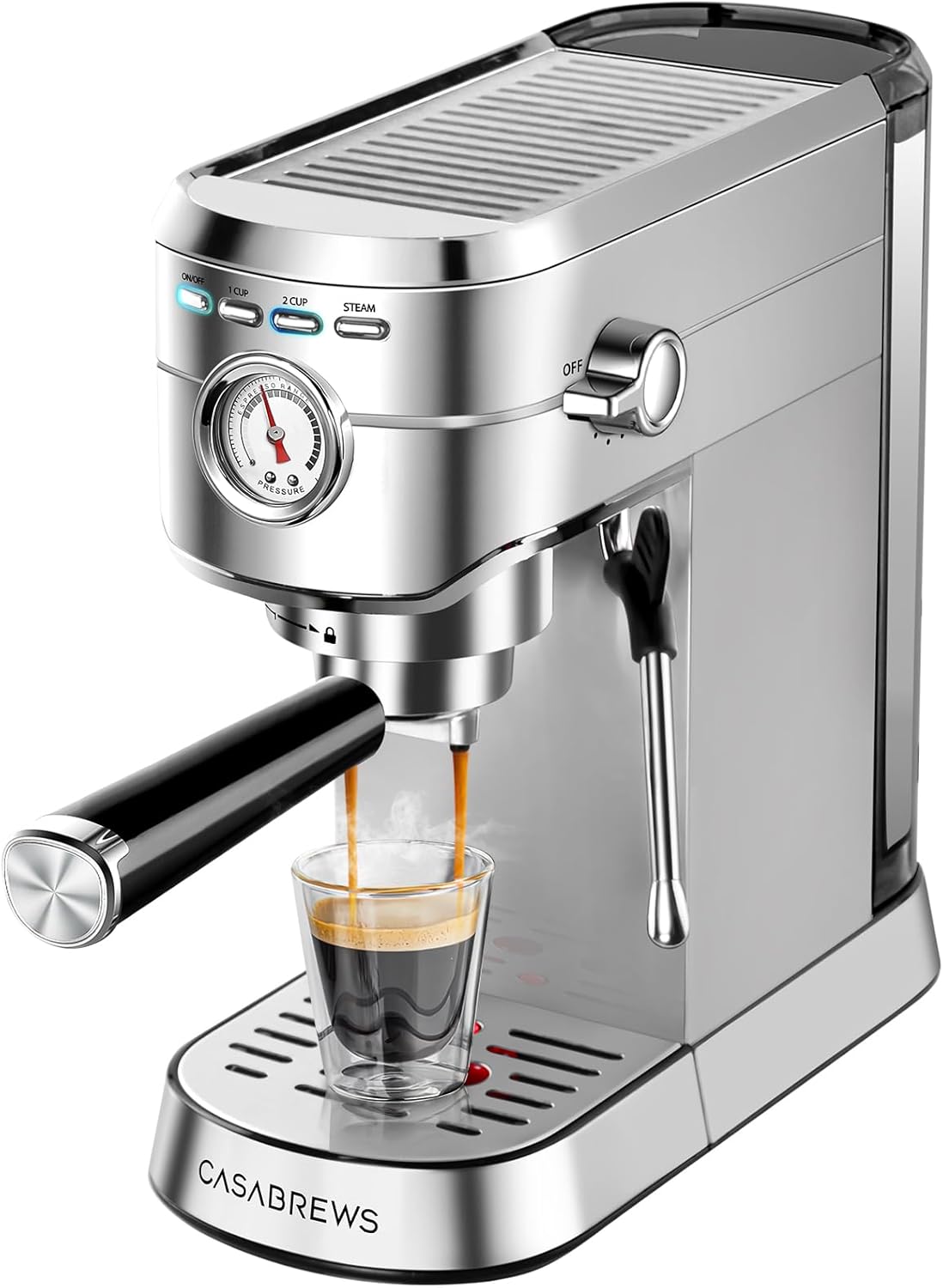
CASABREWS CM5418 compact espresso machine
The one that built the brand’s reputation, and the pool explains why it keeps winning: a café owner who runs a La Marzocco Linea says this unit “performs right there” with a Breville costing three times more, and a two-year owner says the learning curve is short because single and double shots are pre-programmed with a labelled pressure gauge to tell you whether the extraction went right. The trade-offs are physical: it is a single boiler, so you wait a few seconds between pulling a shot and steaming milk; the included tamper is plastic and almost everyone replaces it; and you will buy your own pitcher, cup and knock box. First-gear complaints in the pool are about support latency and a double-shot programme that needed a phone call to reset, not about the coffee.
- 51 mm basket, not 58 — third-party 51 mm accessories fit, 58 mm ones never will
- pre-programmed single/double — shortest learning curve in the pool — press and watch the gauge
- plastic tamper in the box — budget $25 for a real tamper and a steel pitcher on day one
- single boiler — a few seconds between brew and steam — fine at home, not a café

CASABREWS 5418 PRO
The upgraded body and the highest rating of the three, with the shortest review history — 559 ratings against the CM5418’s eight thousand, which is the first thing to understand about the 4.4. What the pool documents: heat-up under four seconds, pre-infusion that owners say visibly improves the shot, programmable one- and two-cup buttons, a steam wand strong enough to texture milk, and 51 mm compatibility with other brands’ portafilters. What it also documents: a basket that can fall out of the portafilter when you knock the puck because the retaining clip is missing on some units, wet sloppy pucks that leave a slurry in the knock box, one unit that leaked, and one pump that died at five months on two lattes a day. Faster and better specced — not automatically longer-lived.
- under 4 seconds to ready — the fastest heat in this lineup, confirmed by multiple owners
- pre-infusion + programmable doses — the two features that separate it from the CM5418
- basket can drop out — no retaining clip on some units — knock gently, or fit a bottomless
- wet pucks, messy workflow — the pool’s recurring cleanliness complaint on this model

CASABREWS 3700 Essential
The cheapest way into the brand, and the model where the pool splits hardest: 4,458 ratings at 4.3 alongside a one-star teardown from a user who made two hundred drinks in six weeks and found the extraction “extremely temperamental and inconsistent” even with identical doses. The happy half says the same things as the other two — good crema, easy steaming, compact, cheap enough that paying for itself against a coffee-shop habit is a matter of weeks. The cautionary half is about longevity and temperature: multiple owners report roughly two years before the pump or the electronics give up, and one says the water is not hot enough unless you pre-heat obsessively, which is exactly what the manual tells you to do.
- $98.99 stainless body — the lowest entry price, with the same 51 mm basket family
- 20 bar on the box — marketing number; the pool cares about the basket and the dose
- ~2-year lifespan reports — several units fail at the two-year mark — price it per year
- pre-heat ritual required — the manual’s own instruction, and the pool’s main 3-star reason
Buy by basket and boiler, not by bar count
All three are 51 mm single-boiler machines with steam wands and plastic tampers. The differences that change your daily routine are speed, pre-infusion, and how much the body is allowed to leak.
First machine, lowest risk — CM5418 ($139.99)
Pre-programmed doses and a pressure gauge do the teaching. Eight thousand ratings mean the failure modes are known. Add a $25 tamper and a steel pitcher on day one and it behaves.
You already know how to dial in — 5418 PRO ($177.05)
Four-second heat, pre-infusion, programmable buttons. The premium buys speed and shot quality, not longevity — the pump-failure report at five months is on this model.
Lowest entry, highest variance — 3700 Essential ($98.99)
Same ecosystem, stainless body, $99. The pool’s one-star is a consistency complaint, not a defect: if you weigh doses and can read a gauge, it will reward you; if you want forgiveness, spend more.
Side by side
Prices, ratings and rating counts from the brand’s affiliate feed at time of writing.
| CM5418 | 5418 PRO | 3700 Essential | |
|---|---|---|---|
| Price | $139.99 | $177.05 | $98.99 |
| Basket | 51 mm | 51 mm | 51 mm |
| Heat-up | Standard, pre-heat advised | Under 4 seconds | Standard, pre-heat advised |
| Pre-infusion | No | Yes | No |
| Dosing | Pre-programmed single/double | Programmable single/double | Single/double buttons |
| Documented weakness | Slow support; plastic tamper | Wet pucks; basket clip; pump at 5 months | Consistency; ~2-year lifespan |
| Rating history | 4.3 · 8,261 | 4.4 · 559 | 4.3 · 4,458 |
Not the right pick if… you already own 58 mm accessories. Every machine here is 51 mm, and that is the ecosystem decision, not a spec detail: 58 mm baskets, distribution tools, and most tampers simply do not fit. The pool confirms third-party 51 mm portafilters work — one owner runs a bottomless one successfully, another could not get consistent extraction with it — but the accessory market at 51 mm is a fraction of the 58 mm one. If you plan to upgrade machines later, buy 58 mm now.
Not the right pick if… you expect café-speed milk. The single boiler means a pause between shot and steam, and even the café-owner reviewer says the steam wand is weaker than a commercial one and takes longer. Making two lattes back to back is a five-minute job, not a ninety-second one. For one drink a morning, irrelevant. For a family of four on a schedule, it is the whole experience.
Not the right pick if… you drink two milk drinks a day and expect five years. The pool’s usage-numbered failure reports are consistent: roughly two years on the CM5418 and 3700, five months on one 5418 PRO at two lattes daily. Cheaper internals, more heat cycles, shorter life — price the machine per year rather than per purchase, and buy where the return window is generous.
Not the right pick if… you will not pre-heat. The manuals instruct running hot water through the group before brewing, and reviewers read that correctly as a component compromise: cold starts produce flat, under-extracted shots on the 3700. If a machine that is ready from cold is the requirement, the 5418 PRO’s four-second heat is the only one here that answers it.
Not the right pick if… you need fast support. The pattern across reviews is a month of silence followed by a replacement — it arrives, but not in a week. One owner got a new unit after posting a public review; another had calls unanswered during business hours. Keep the box and the receipt, and start the ticket the day something misbehaves.
What verified buyers say
Six verified Amazon reviews, paraphrased and attributed — including the café owner, the two-latte pump failure, and the one-star teardown that keeps the averages honest.
The credibility review: trained barista, owns a café with a Linea and Mahlkonig grinders, and still rates this unit for home use. His honest framing — the steamer is not café-powerful and takes much longer, but the espresso itself is right there, and he prefers the plain body to the gizmo-shaped competition. He also owns a Breville and calls the Casabrews better in several ways at a third of the price. Read the 4.3 with this review in hand: the ceiling is real, the ceiling is above what most people need.
The support story, told completely. Great crema, right size for the counter, and then a double shot that started and produced only a few drops — so she pulled the single twice and lived with it. Two emails went unanswered and the site’s videos did not fix it, so she posted a one-star. One support call later the water volumes were reset and it worked. She moved the review to four stars and left the timeline in place, which is the useful part: the machine can be fixed remotely, the response is not always fast.
The longevity warning, with the usage numbers that make it meaningful: at least two double-shot lattes every day, the previous Casabrews 20 Bar managed fifteen months, and this 5418 PRO lasted about five. His conclusion is not that the coffee is bad — “when it works, it made a decent latte” — but that the pump is the failure point and frequent use is what exposes it. If you drink two milk drinks a day, price this as a two-to-five-year machine and keep the receipt.
The build-detail review: fast from power-on to shot, fast between brew and steam, and then the thing that ruins the ritual — the baskets have no secure retaining clip, only dimples that drop into a groove, so every time he knocks the puck out on the bin edge the basket comes with it. Add pucks wet enough to arrive as slurry and you have a machine that needs cleaning after every shot or the next coffee tastes of the last one. Fixable with a bottomless portafilter and a dosing routine; not fixable by hoping.
The most detailed negative in the pool, and the reason the 3700’s 4.3 has an asterisk. Six weeks and roughly two hundred cappuccinos and flavoured lattes later: the same dose, weighed, ground the same, produces different shots — pack slightly tight or grind at true espresso fineness and the machine stalls or channels. He is not guessing; he lists the variables he controlled. If you want a machine that forgives a bad grind, this is not it. If you want to learn dialling in on a $99 body, the ceiling is part of the deal.
The warranty story worth reading before you decide the brand is disposable: machine acted up, emails went unanswered for about a month, then a call came, proof was requested, and a new unit shipped. Two years of daily use since. He gives four stars because the espresso and the frother are genuinely good at this price and because the company did eventually make it right — while noting the month of silence. That is the realistic expectation to carry into a purchase: budget for one support cycle somewhere in year one.
Three kitchens these fit
The cappuccino habit that costs $9 a day
Two milk drinks daily, a small counter, no interest in becoming a barista. The documented win: the CM5418 pays for itself in weeks, and the pressure gauge tells you when the grind is wrong.
The ex-Bambino owner
A $500 machine died at two years plus a day. The documented win: the 5418 PRO heats in four seconds, pre-infuses, and costs a third — with the honest caveat that the pump may not outlast the machine it replaced.
The $99 experiment
You want to learn espresso without committing. The documented win: crema, a working steam wand, stainless body — and a one-star in the pool proving it will punish a careless grind.
FAQ
Casabrews CM5418 or 5418 PRO?
Buy the PRO if speed and shot quality are what you notice; buy the CM5418 if you want the safest purchase. The PRO adds four-second heat-up, pre-infusion, and programmable doses — three things owners say they can taste or feel — at about $37 more. Against that: its review base is 559 ratings versus 8,261, its recurring complaints are wet sloppy pucks and a basket that drops out of the portafilter, and one pump died at five months on heavy use. The CM5418 is slower and plainer but its failure modes are documented across thousands of owners. Neither is a five-year machine; both make espresso a café owner respects.
Is 51 mm portafilter a problem?
It is a limit, not a defect. Third-party 51 mm portafilters, baskets and tampers exist and the pool confirms compatibility — one owner runs a bottomless 51 mm successfully, another bought one and could not get a consistent shot, which is a puck-prep issue as much as a hardware one. What you lose is the 58 mm ecosystem: distribution tools, most fancy tampers, and the second-hand market. If this is your forever machine, 51 mm is fine. If you plan to move up to a $1,000 machine later, every accessory you buy here becomes dead stock.
How long do these machines last?
The pool’s honest answer is two to five years, and it correlates with how often you brew. Reports: two years on a CM5418 before electrical trouble (replaced under support), almost two years on another before the power started acting up, fifteen months on a previous Casabrews 20 Bar, and five months on a 5418 PRO used for at least two double lattes daily. The failure point reviewers name is the pump. Treat the price as cost-per-year: $139 over two years is $6 a month, which still beats a coffee shop — but do not expect a decade.
Why do reviewers say the water isn't hot enough?
Because the manuals tell you to pre-heat with hot water, which is a workaround for a small thermoblock. Owners who follow it get good shots; owners who skip it get flat, sour ones, especially on the 3700 Essential. One reviewer’s summary is the fair one: for the price, they cheaped out on the components that would brew hot from cold, and the pre-heat ritual is how you compensate. Practical rule: run a blank shot into your cup, then pull — the cup temperature matters as much as the boiler.
What accessories do I actually need on day one?
Four things, and the pool is unanimous about three of them: a real tamper (the included one is plastic and undersized), a stainless milk pitcher, an espresso cup you have pre-heated, and a knock box. Optional but frequently mentioned: a bottomless 51 mm portafilter to see channeling, a scale that reads 0.1 g, and a WDT tool if your grinder clumps. Do not buy a 58 mm anything. Total realistic accessory spend: $60-90, which is why the $99 machine and the $139 machine end up costing about the same to run.
How was this page put together?
We are an independent review site. Specs, prices and coupon states come from the brand’s official affiliate feed; review summaries are paraphrased from the public Amazon review history of each product, negative reviews included. If you buy through our links we may earn a commission — it does not change which reviews we quote or what they say.