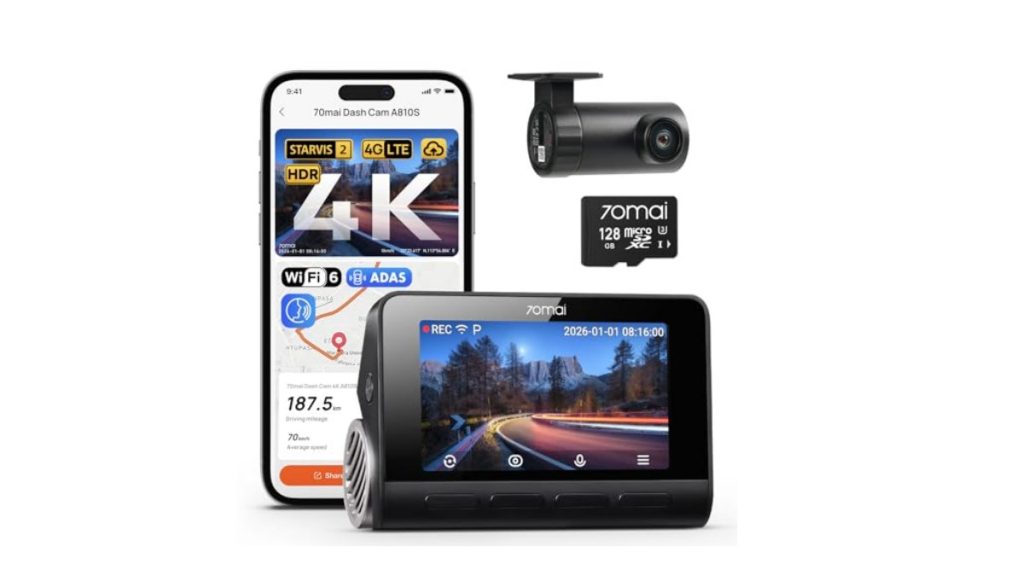

Quick answer: all three of these record 4K at the front, so the front camera is not the decision. The rear one is. The A810 Lite ($149.99) records 1080P behind you. The A810S ($169.99) also records 1080P behind you, but with a Sony IMX662 STARVIS 2 sensor and 2,038 ratings of track record. Only the T800 ($359.99) records 4K at both ends, and its 212-rating sample includes a shutdown at 110 degrees and a power cable that failed inside six months. A dash-cam veteran who bought the A810S for himself put the trade-off in one sentence: the rear is not as good as you would expect, because it is HD only.
The three-product lineup
Every model in this brand’s US feed is an on-dash camera — there is no side product line to get distracted by. Three units, one decision: how much rear resolution you need.

70mai A810 Lite
The cheapest way into 4K, and the honest place to start this comparison: the front records 3840×2160, the rear records 1080P. That is not a knock on the Lite specifically — it is what every unit below $300 in this range does. What you get for the money is a supercapacitor instead of a battery (survives heat better), F1.55 aperture with HDR, dual-band Wi-Fi 6 rated up to 25MB/s so you can pull a clip without removing the card, 3-mode GPS, voice control, and 24-hour parking mode with G-sensor and time-lapse options. What you do not get is any ability to aim the lens sideways after the mount is stuck to the glass.
- 4K front, 1080P rear — the front is the marketing number; the rear is what people complain about
- F1.55 + HDR + supercapacitor — heat tolerance over a battery, which matters if the car lives outside
- Wi-Fi 6 at up to 25MB/s — clip transfer to the phone without pulling the card — when it connects
- no horizontal adjustment — once the mount is on the glass, the lens aims where the glass points

70mai A810S
The middle of the range and the one with the longest track record: 4.4 over 2,038 ratings. Sony STARVIS 2 on both ends — IMX678 up front, IMX662 at the rear — F1.7 aperture, 5-mode positioning including QZSS, Wi-Fi 6, ADAS alerts and voice control. It is the camera a reviewer who has tested several dash cams bought for himself. His verdict is the useful part: the front is excellent day and night, 4K drops the frame rate to 25fps which he says does not matter, and the rear is not as good as he expected because it records HD only. He wanted 1440p at the back and put that in writing.
- IMX678 front, IMX662 rear — both STARVIS 2, which is why night footage holds up at both ends
- 4K drops to 25fps — documented by an owner who says it makes no practical difference
- rear is 1080P, not 1440p — the specific thing a dash-cam veteran wanted changed
- 5-mode positioning + Wi-Fi 6 — GPS, BDS, Galileo, GLONASS, QZSS — plus fast phone transfer

70mai T800 3-channel
The only unit here whose rear camera is also 4K: 3840×2160 front and rear from dual IMX678 sensors, plus a 1080P interior camera with four 940nm infrared emitters for darkness. A 256GB card is included, which is not nothing at this price. Treat the 4.3 rating with care, though — it is 212 ratings, an order of magnitude fewer than the A810S, and the negative ones are unusually specific: a unit that shut down at 110 degrees, a power cable that failed inside six months, an accident clip that recorded a sound but was not in the emergency album, and a rear camera that does not trigger on motion in parking mode while the front one does.
- 4K rear, not 1080P — the entire reason this costs $190 more than the A810S
- dual IMX678 + 256GB card included — two 4K sensors and storage in the box
- 4 infrared cabin emitters — back-seat detail in darkness, aimed at rideshare drivers
- 212 ratings only — a thin sample — read the one-stars before you spend $360
Three drivers, three different reasons to pay more
All three cameras record 4K at the front. The price difference is almost entirely about what happens behind you, and about how much of the parking and remote hardware is included.
You want 4K front and nothing more — A810 Lite ($149.99)
Supercapacitor, F1.55, HDR, Wi-Fi 6, 3-mode GPS, voice control, 24-hour parking mode. The rear is 1080P like everything at this price. You cannot aim it sideways once mounted, so plan the position before you peel the adhesive.
You want the best-documented camera here — A810S ($169.99)
4.4 over 2,038 ratings, dual STARVIS 2 sensors (IMX678 front, IMX662 rear), 5-mode positioning. The extra $20 over the Lite buys the sensor generation and the track record, not rear resolution. An owner who has tested several dash cams wanted 1440p at the back and did not get it.
You need a 4K rear camera or a cabin view — T800 ($359.99)
Dual IMX678 front and rear at 3840×2160, plus 1080P interior with four infrared emitters and a 256GB card in the box. This is the only way to get a 4K rear from this brand. It is also the thinnest rating sample here — 212 — with failures that deserve reading before you spend the money.
Side by side
Prices, ratings and rating counts from the brand’s affiliate feed at time of writing.
| A810 Lite | A810S | T800 | |
|---|---|---|---|
| Price | $149.99 | $169.99 (was $199.99) | $359.99 (was $409.99, $20 coupon) |
| Front camera | 4K 3840×2160 | 4K, IMX678 STARVIS 2 | 4K, IMX678 STARVIS 2 |
| Rear camera | 1080P | 1080P, IMX662 STARVIS 2 | 4K, IMX678 |
| Interior camera | — | — | 1080P + 4 infrared emitters |
| Aperture / HDR | F1.55 + HDR | F1.7 + HDR | F1.7 + HDR |
| Storage in box | none | none | 256GB card |
| Documented weakness | No horizontal lens adjustment after mounting | Rear is 1080P; 4K drops to 25fps | Shutdown at 110°F; cable failures; ADAS calibration |
| Rating history | 4.3 · 602 | 4.4 · 2,038 | 4.3 · 212 |
Not the right pick if… your RV has no rear window. This is the clearest unfilled gap in the range and an owner states it directly: he wanted a waterproof exterior camera, because his motorhome has nothing to look through at the back, so the rear unit would have to live outside in the weather. None of these three is that product. If you need an exterior rear camera, you are shopping in a different category — usually a wired commercial kit — and buying a dual-channel dash cam will not solve it unless you are willing to mount the interior camera behind glass and accept the view you get.
Not the right pick if… you expect to move the camera between cars. Two separate owners describe the same limitation from different angles. On the A810 Lite, once the mount is on the windshield there is no flexibility to adjust, remove or share it with a rental. On the base unit, the lens cannot be adjusted horizontally at all, so the mount position is your only chance to aim it. A dash cam that cannot be re-aimed is effectively glued to one vehicle. If you swap cars, buy a second mount and a second cable rather than planning to move one.
Not the right pick if… you plan to use a generic parking-mode hardwire kit. One owner had a generic adapter that worked on two other cameras and was not recognised by his, forcing him to buy the brand’s own. That is a $20 lesson in how these systems are wired: the 3-wire parking kits carry an accessory signal the camera has to interpret, and not every camera interprets every kit. Buy the kit the manufacturer sells for the model you chose, and check that the kit is the one named for your exact unit rather than the brand generally.
Not the right pick if… you are buying the T800 for its ADAS. The only buyer who tested the driver-assist deliberately got poor results outside a freeway: calibration needs five continuous minutes above 25mph, two-lane roads failed to recognise lane markings until recalibrated, and after recalibration it caught less than half of his intentional departures across the centreline. If your car already has lane assist, this feature is a second opinion you did not ask for. If it does not, this is not a substitute for the system a modern car ships with.
Not the right pick if… you need the phone to connect reliably the first time. Wi-Fi pairing is the second-most-reported problem across this range: one owner could not connect even after a factory reset and now pulls the SD card to view footage on a computer, and another could not get the Wi-Fi to work at all so could not view video without removing the card. Both said the recordings themselves were excellent. The wired path always works — a card reader is $10 and never fails to pair — so treat the app as a convenience, not the way you retrieve footage after an incident.
What verified buyers say
Six verified Amazon reviews, paraphrased and attributed — the reviewer who explained why the rear is 1080P, a returned T800 with four separate failures, a dead power cable, ADAS measured on a freeway, a mount that cannot be re-aimed, and a rear channel that never worked.
He had tested several dash cams before settling here, which makes his four stars worth more than a five. His summary of the front camera: very good, day and night. Then the sentence that decides this whole article — the rear camera is not as good as you would expect, because it supports HD resolution only, and he wished it did 1440p. He links that directly to the processor: 4K already drops the frame rate to 25fps, and running ADAS on top of it is what leaves the rear channel at 1080P. He also notes that ADAS on a car without native ADAS can get annoying, because it has no way to know what your vehicle is already doing. Read this as a design trade-off explained by someone who worked it out himself.
The most useful four-star on the T800 because it is a list of failures rather than impressions. The camera shut down completely at 110 degrees. It drained his car battery once while he was travelling, to the point of needing a jump start from a hotel. He was rear-ended in a minor accident: the camera made the sound that says it is recording, and the clip was not in the emergency album — he had to hunt for it manually. In parking mode the rear camera does not detect motion while the front one works normally. And the optional 4G box cuts out when battery voltage reaches 11.7V. He returned it, while saying he liked how compact and easy to install it was, and that support was helpful. That combination is worth reading twice: good support, four real failures, money back.
One failure, stated plainly, and it is the failure mode that makes the others on this page matter. Inside six months the power cable began losing contact while driving: the camera would shut off, then come back on. A dash cam that reboots at random is a dash cam that misses the thing you bought it for. He also found support slow to respond with no resolution offered. He bought through Amazon expecting that a replacement would be easy and reports that it was not. If you buy any of these, check the cable connection at both ends after a few months of heat cycles — this is the part most likely to fail first, and it is cheap to replace yourself.
The only buyer here who bought the T800 for its driver-assist features instead of its cameras, and he measured what he got. Calibration requires five or more minutes of continuous driving above 25mph, which is nearly impossible in suburbia where there is a stop sign every quarter mile; he had to get on a freeway to complete it. On freeways it detected better than 85% of his intentional lane departures, with multiple false warnings. On two-lane roads it failed to recognise the centreline and fogline, had to be recalibrated on a rural road, and then detected less than half of his deliberate departures across the centreline and fewer across the fog line. He tried straightaways, curves and hills and found no pattern. If ADAS is why you are looking at this model, this review is your answer.
A month of use, no major issues, and a clear list of what the cheaper unit does and does not do. The phone app connected easily and runs every function of the camera. Voice commands were useful while driving. GPS was written into the recording automatically and one tap in the app set the local time. His longest single recording was about five hours and it held up. Then the two limitations, both about mounting: options are limited, so once it is on the windshield there is no flexibility to adjust, remove or share it with another car such as a rental. And the camera cannot be adjusted horizontally — you have to position the mount very carefully at install time, because that is the only chance you get.
The one-star that proves the thesis of this page. He was not impressed with the quality, considered returning it, decided at this price it was get-what-you-pay-for, and installed it — running all the wiring — only to find that the rear camera does not work. He was going to troubleshoot for a couple of days and return it if that failed. Whatever the outcome, the sequence is the point: the rear channel is the part that requires the most installation effort, it is the part that most often does not work, and on a dual-channel system it is the channel nobody advertises. Test the rear camera on the bench, before the cable goes under the headliner.
Three cars these were built for
The commuter who wants 4K and a rear view, cheaply
Front 4K for plates, 1080P at the back to prove who hit whom, supercapacitor so a hot dashboard does not kill it. The documented win: 4K and HDR at $149.99 with Wi-Fi 6 transfer and five hours of continuous recording. The documented catch: position the mount carefully the first time, because you cannot re-aim it later.
The driver who wants the camera that has already been tested by someone else
2,038 ratings at 4.4, dual STARVIS 2 sensors, five-mode positioning. The documented win: a dash-cam reviewer who had tried others bought this one for himself and called the front footage very good day and night. The documented limit: 1080P at the rear, which he specifically wanted upgraded.
The rideshare or family car that needs the back seat on camera
Three channels: 4K forward, 4K rear, 1080P inside with four infrared emitters for darkness, and a 256GB card included. The documented win: nothing else here records 4K at both ends. The documented risk: a 212-rating sample that includes a shutdown at 110 degrees, a cable failure inside six months, and an accident clip that was not in the emergency album.
FAQ
Is the rear camera really only 1080P on the cheaper models?
Yes, on both the A810 Lite and the A810S, and it is the single fact that should decide your purchase. The Lite records 4K at the front and 1080P at the rear. The A810S does the same, with a Sony IMX662 STARVIS 2 sensor at the back instead of a generic one — better night footage, same resolution. Only the T800 records 4K at both ends. A reviewer who had tested several dash cams worked out the reason himself: 4K already drops the frame rate to 25fps, and running ADAS on top of it is what leaves the rear channel at HD. If you have ever needed to read a plate from behind your car, this is the number that matters.
Do I need the 4G module, and what does it cost?
The 4G hardware is sold separately on every model here — 4G LTE is listed as a feature, but it runs through an optional hardwire kit (UP05 on the A810S) or a separate 4G box on the T800. Without it you get local recording and Wi-Fi transfer to your phone when you are near the car. With it you get live view, vehicle location and alerts. One T800 owner reports the 4G box cuts out when battery voltage reaches 11.7V, which is the correct behaviour for protecting your starter battery but does mean remote monitoring stops when the car sits a long time. Price the kit into the comparison before you decide a model is cheap.
Why does the camera lose power while driving?
The cable, almost always. The clearest report is a T800 whose power cable began failing inside six months — the camera shut off and came back on repeatedly while driving. The second is an owner of the base unit whose adhesive mount loosened in hot weather. Both are installation problems rather than firmware, and both are cheap to fix: check that the connector at the camera end is fully seated after a few months of heat cycles, and route the cable so it is not under tension at either end. A dash cam that reboots at random is worse than no dash cam, because you assume it recorded.
Can the camera be moved between vehicles?
Not practically. On the A810 Lite the mount offers no flexibility to adjust, remove or share the camera once it is attached, and the lens cannot be adjusted horizontally — so the mount position is a one-time decision. If you drive two cars or rent regularly, buy two mounts and two cables rather than planning to move one camera. The alternative is the base unit plus a second mount kit, which costs less than a second camera and takes ten minutes to install.
Which model should most people buy?
The A810S at $169.99, for three reasons that are all in the review history rather than the spec sheet: it has 2,038 ratings at 4.4 instead of 602 or 212, its rear sensor is a STARVIS 2 unit rather than a generic one, and it was bought by a reviewer who had already tested several dash cams and kept it. You are paying $20 over the Lite for a better rear sensor and a much deeper track record. Buy the T800 only if a 4K rear channel or a cabin camera is a real requirement, and read its one-stars first.
How was this page put together?
We are an independent review site. Specs, prices and coupon states come from the brand’s official affiliate feed at the time of writing; ratings are the public Amazon rating history of each parent product. Review summaries are paraphrased from verified Amazon customer reviews of the three products above, one-star and three-star included — every quotation is attributed to the reviewer name shown and the month it was posted. If you buy through our links we may earn a commission; it does not change which reviews we quote or what they say.