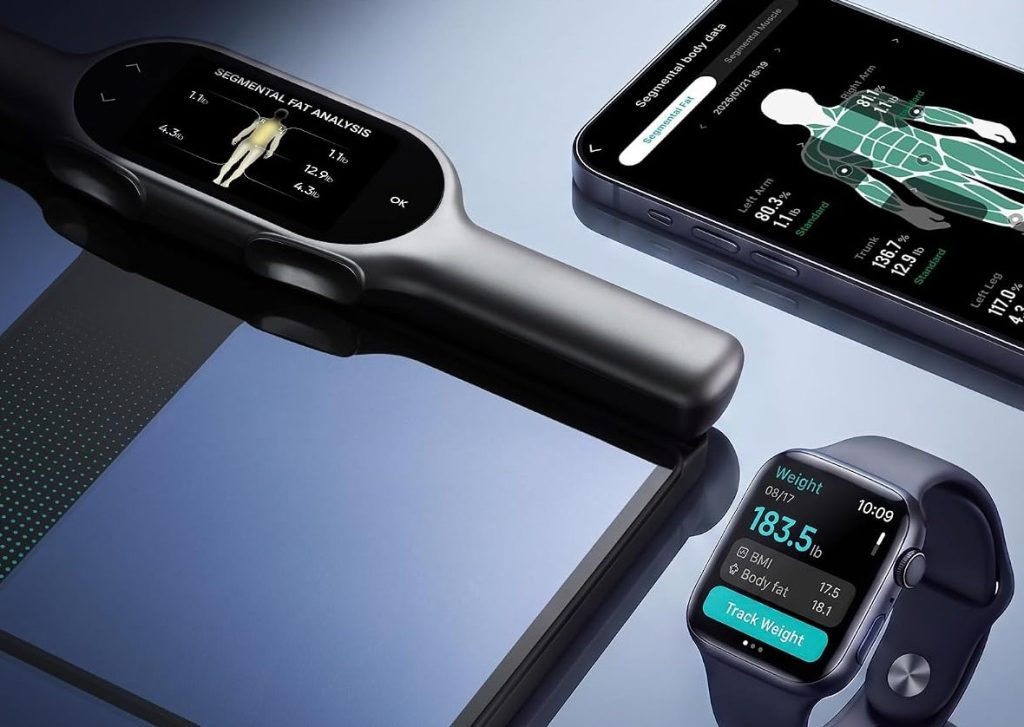

Quick answer: every scale in this range weighs you accurately — owners check them against their doctor’s office scale — and every body-fat number is an estimate. That is not a dodge, it is the documented result of the most rigorous review on this page, which put the 8-electrode scale ($169.99) on the floor next to a calibrated physician scale and found weight reading 0.2-0.6 lbs high. What you are actually buying at each step: the 8-electrode’s handle bar buys segmental fat and muscle per arm, per leg and trunk — the tool for cutting while lifting; the TFT model ($63.99) buys an on-scale color display and Wi-Fi sync; the entry scale ($23.99) buys the same weight measurement and nothing you will miss. The numbers are trends. Buy the trend, not the precision the box implies.
The three-product lineup
All three of these converted real October commissions — $50.97 on the 8-electrode alone — and all three sit at 4.7 on rating histories between 153k and 187k. The differences are electrode count, display and sync, not measurement quality.

Etekcity WiFi 8-electrode smart scale
The scale that actually earned this brand’s October money, and the only one here that measures where your body carries it. The handle bar adds four electrodes to the four under your feet, so current runs through your whole frame instead of just your legs — that is what makes per-arm, per-leg and trunk readings possible, across more than fifty metrics on a dual-frequency system. Etekcity states its composition algorithm was calibrated against DEXA scans; one careful owner on this page disputes that claim with his own calibration rig, and both positions are documented below. What is not in dispute: the app is the best-regarded part of the product, the trend charts are what people actually use, and FSA/HSA eligibility applies.
- 8 electrodes, feet + handle bar — segmental fat and muscle for each arm, each leg and the trunk — the 4-electrode scales cannot do this
- DEXA-validated claim — the listing says the algorithm was validated against DEXA; one owner’s home calibration test disputes parts of it
- 50+ metrics, dual-frequency BIA — muscle, subcutaneous fat, visceral fat, water, protein, metabolic age
- FSA/HSA eligible — pay with pre-tax health dollars where your plan allows it

Etekcity smart scale with color TFT display, Wi-Fi + Bluetooth
The middle child, and for most households the right one. Four electrodes under your feet give you fourteen body metrics — weight, BMI, body fat, muscle, water and friends — without any handle to hold, and the color TFT screen shows up to nine of them right on the scale instead of burying them in an app. It syncs over Wi-Fi and Bluetooth to Apple Health, Fitbit, MyFitnessPal and Samsung Health, and answers Alexa questions about your month. The documented limits are honest ones: the heart-rate reading is the metric owners trust least, first-time setup took one owner multiple tries, and every BIA number besides weight is an estimate. You are paying $106 less than the 8-electrode for no segmental data and a slightly smaller metric set.
- 14 metrics, no handle — feet-only measurement — easier habit, no segmental breakdown
- color TFT on the scale — nine metrics readable without opening the app
- Wi-Fi + Bluetooth sync — data lands in the cloud even when your phone is across the house
- heart rate is the weak metric — one owner’s readings were off when they worked at all — treat it as decoration

Etekcity entry smart scale, Bluetooth, 13 metrics
The $24 option, and the highest-value honest purchase in this feed. Same 4-electrode measurement as the TFT model, thirteen metrics in the same VeSync app, Apple Watch support, and a zero-current mode that weighs without electrical contact — useful for pets, babies and packages. There is no color screen and no Wi-Fi auto-sync; the app pairs over Bluetooth when you step on. Owners consistently rate its weight accuracy against their doctor’s office scale, and the reviews that dock a star dock it for the flimsy-feeling glass, not the numbers. If your goal is a trend line and a weight number you can trust, this is the floor of the range.
- 13 metrics via Bluetooth — same VeSync app and same BIA math as the expensive models
- zero-current mode — plain weight for pets, babies and luggage without body contact
- $23.99 — less than a quarter of the 8-electrode, same weight measurement
- glass feels light — one owner calls it flimsy-feeling; accuracy reports are still consistent
Which scale, for which goal
All three scales weigh the same way and share the same VeSync app; what changes is how much the body-composition claim costs. Pick by the goal, not by the metric count.
Body recomposition — 8-electrode ($169.99)
Segmental fat and muscle per arm, per leg and trunk — the tool for cutting while lifting. The documented caveat is the calibration review: treat the segment numbers as trends, dampen hands and feet, and expect weight to read a fraction high. FSA/HSA eligible.
Weight-loss trend line, no handle — TFT Wi-Fi model ($63.99)
Fourteen metrics from feet-only contact, nine of them readable on the color screen, Wi-Fi sync even when the phone is in another room. Documented weak point: the heart-rate metric, which owners trust least. Setup took one owner several tries.
Just the weight, honestly — entry Bluetooth ($23.99)
Same weight measurement, thirteen app metrics if you ever want them, zero-current mode for pets and babies. Owners verify it against their doctor’s office scale. If you never open the app, this is the correct purchase and everything above it is a metrics subscription.
Side by side
Prices, ratings and rating counts from the brand’s affiliate feed at time of writing.
| 8-electrode Wi-Fi | 4-electrode TFT Wi-Fi | Entry Bluetooth | |
|---|---|---|---|
| Price | $169.99 ($2 coupon) | $63.99 (was $79.99) | $23.99 |
| Electrodes | 8 (feet + handle bar) | 4 (feet) | 4 (feet) |
| Segmental data | Per arm / per leg / trunk, 50+ metrics | None — 14 composite metrics | None — 13 composite metrics |
| On-scale display | Interactive color + guided | Color TFT, 9 metrics | Basic LCD |
| Sync | Wi-Fi + Bluetooth | Wi-Fi + Bluetooth | Bluetooth |
| Documented weakness | Weight reads 0.2-0.6 lb high vs physician scale; damp hands/feet required | Heart-rate metric unreliable; setup fiddly first time | Light glass, feels flimsy |
| FSA/HSA | Eligible | Eligible | Eligible |
| Rating history | 4.7 · 153,271 | 4.7 · 187,495 | 4.7 · 153,271 |
Not the right pick if… you expect the body-fat number to be a measurement. The most rigorous test on this page put the 8-electrode scale on the floor next to a factory-calibrated physician scale and a Renpho Nova: weight read consistently 0.2 to 0.6 lbs high, the body measurements defied what the mirror said, and no published DEXA validation of a real population backed the algorithms. The owner’s conclusion — that you are being sold a trend instrument while the marketing implies precision — is the correct frame for every BIA scale at any price. Buy one to watch direction, not to audit reality.
Not the right pick if… your body is not evenly proportioned and you want the segment numbers to be meaningful. A five-star owner says it plainly: current takes the path of the legs, so skinny legs with a fat belly (or the reverse) skew the reading toward the legs. The 8-electrode handle improves the path but does not repeal the physics. If you want clinical-grade composition data, that is a DEXA scan at a clinic, not a bathroom scale at any price point.
Not the right pick if… you want dry hands and feet to be enough. The calibration reviewer lists the consistent need to dampen hands and feet as one of his three serious flaws on the 8-electrode model — the handle contact needs conductive skin, and winter bathrooms are dry. The 4-electrode models avoid the handle but lose the segment data. Factor the ritual into whether you will actually use the scale daily.
Not the right pick if… the heart-rate metric is on your list. The TFT model’s four-star owner reports the heart-rate reading was off when it worked at all, and the composite stats seemed skewed — while confirming the weight itself matched her doctor’s office scale. Treat heart rate on a bathroom scale as a novelty output everywhere in this category, not a reason to choose between models.
Not the right pick if… first-run setup patience is not your thing. The same four-star reviewer describes going through setup twice — once initially, once after a router change — with several attempts each time before the Wi-Fi path settled. It works smoothly after it is paired, but budget an evening for the first connection rather than five minutes, and know that router changes mean doing part of it again.
What verified buyers say
Six verified Amazon reviews, paraphrased and attributed — the segmental case from a lifter, the home calibration test that found three flaws, the app-hater who converted, the evenly-proportioned caveat, the prompt warranty replacement, and the no-frills case for the cheap one.
He is lifting weights and running a reduced-calorie, high-protein diet at the same time — the exact situation where plain weight is a bad metric, because you cannot tell whether you are losing fat, water or muscle. The 8-electrode scale measures muscle and fat in each arm, each leg and the trunk, plus the usual totals, and he says it eliminates the guesswork. He bought it on a Prime Day discount of about 25%, charges it over USB every few months, and praises the iOS app. His one review is the cleanest statement of who this scale is for: people whose goal is body recomposition rather than a number on the floor.
The review that every body-fat scale buyer should read, from someone who did the work: he ran this 8-electrode scale alongside a Renpho Nova and a factory-calibrated Health O Meter physician scale with known test weights. His findings: weight reads consistently 0.2 to 0.6 lbs high (he suspects the algorithm compensating for the handle’s downward pull), the body measurements lack published independent DEXA validation of the sort the marketing implies, and readings require consistently damp hands and feet. He also notes the marketing line about only tracking trends, not values, and calls it what it is. This is not a reason to avoid the scale — it is the reason to treat every BIA number, at any price, as a trend instrument rather than a laboratory measurement.
The conversion story for app-averse buyers. She states plainly that she hates downloading companion apps for gadgets — and then describes watching the micro-gains: muscle mass, subcutaneous fat, visceral fat, fat-free weight, all charted after each weigh-in. Her verdict is that for a weight-loss journey the app is genuinely cool, and the Bluetooth connection is painless. Read this together with the calibration review above: the numbers are estimates, but the direction and the deltas are what motivate, and that is the honest use case for every scale in this range.
A satisfied five-star that still contains the most practical physics lesson on the page. She likes the metrics, the history and the multi-user setup, and her weight readout is accurate — then she adds the caveat: bioimpedance readings skew when your body is not evenly proportioned, because the current path through skinny legs and a fat belly weights the reading toward the legs. She has not compared her body-fat numbers to anything medical, and she is fine with that; her goal is the trend. This is the normal owner’s version of the calibration review: know what the number can and cannot mean.
The shortest useful review on the page: her scale had a problem, she contacted Etekcity, and they promptly sent a replacement that has worked as supposed since. It is one data point, and warranty experiences vary, but it is the only warranty report in this batch of reviews and it is positive — worth holding alongside the one brand in this project whose warranty thread ran the other way. For a $170 electronics purchase that lives in a bathroom, responsive support is part of the value proposition.
From the TFT model’s owner, the counterposition worth hearing: she has no interest in her bathroom scale being Bluetooth-connected, wanted something straightforward, and rates this one highly for it — bright display, large numbers, small footprint, honest value. Note the mild irony that the scale she bought does sync to an app; the point she is making is that the hardware works fine as a plain scale for people who never open the app. If your list is just an accurate, readable weight at a fair price, this review is your permission to buy the cheapest model and stop reading comparison tables.
Three routines these scales were made for
Cutting while lifting
The documented case: reduced-calorie, high-protein diet plus weights, where the question is not weight but what the weight is made of. The 8-electrode’s per-limb breakdown showed the owner his deltas directly on the handle bar’s screen, with the app holding the trend. USB charge lasts months.
The weight-loss trend line
Feet-only, morning after the shower, number lands in the app by itself. The TFT model’s Wi-Fi sync means the data is there even when the phone is across the house, and the color screen shows nine metrics without opening anything. The documented annoyance is the first-time setup, not the daily use.
The household that just wants a truthful weight
The $23.99 entry scale, verified by owners against their doctor’s office scale, with zero-current mode for weighing the cat or a package. The one documented downside is the light tempered glass. If the smart features never get used, this is the honest end of the range.
FAQ
Is a body fat scale actually accurate?
Treat every number except weight as an estimate. The best-documented test on this page ran the 8-electrode scale against a calibrated physician scale and a Renpho Nova: weight read 0.2 to 0.6 lbs high, and the body-fat values did not match what the mirror showed, let alone a DEXA scan. What BIA scales genuinely provide is a consistent-enough trend line — same scale, same time of day, same hydration — and that is exactly how the manufacturer’s own advice frames it. Use the trend; doubt the absolute; get a DEXA scan if you need a real number.
What is the real difference between 4-electrode and 8-electrode scales?
The path the current takes. Four electrodes under your feet send current up one leg and down the other, so the reading is dominated by your legs. The 8-electrode adds a handle bar, letting current run through your arms and trunk too — which is what makes per-arm, per-leg and trunk segment readings possible. If you are actively training, the segment data is the reason to pay the $106 step. If you only want a trend line, the 4-electrode models measure the same composites.
Do I need to hold the handle with wet hands?
On the 8-electrode model, yes — the calibration reviewer lists consistently damp hands and feet as a requirement for readings, and it is standard BIA behavior for handle contact. Dry skin is a poor conductor and the measurement will fail or skew. The 4-electrode models only need bare feet, which is easier as a daily habit. Budget the damp-hands ritual into your decision if you are choosing the segmental model.
Which of the three is FSA/HSA eligible?
All three carry the FSA/HSA-eligible designation on their listings — this brand markets it prominently on the whole smart-scale range. That means you can pay with pre-tax health spending account dollars where your plan allows, which effectively discounts whichever model you pick. The 8-electrode at $169.99 with a $2 coupon is the one this feed’s buyers actually spent on in October.
How reliable is the VeSync app and Wi-Fi sync?
The app is the best-reviewed part of the product — even the app-hating five-star owner found it worth using, and it syncs to Apple Health, Fitbit, MyFitnessPal and Samsung Health. The one documented rough patch is setup: one owner needed several attempts initially and again after a router change before the Wi-Fi path settled. After pairing, sync is seamless even across the house. Budget an evening for first setup, not five minutes.
How was this page put together?
We are an independent review site. Specs, prices and coupon states come from the brand’s official affiliate feed at the time of writing; ratings are the public Amazon rating history of each parent product. Review summaries are paraphrased from verified Amazon customer reviews of the products above, one-star and three-star included — every quotation is attributed to the reviewer name shown and the month it was posted. If you buy through our links we may earn a commission; it does not change which reviews we quote or what they say.