
Quick answer: these three machines do three different jobs, and the amp rating on the box tells you almost nothing about which one you need. If your work is thick steel, dirty metal and no outlet nearby, buy the 200A stick welder ($119.99) — 4.6 over 1,413 ratings, verified by a retired professional and by a 70-year-old brush hog that got a new tongue hitch off a generator. If your bottleneck is cutting, the 50A plasma cutter ($179.99) removes the cutoff wheel from your life and runs off a 15-gallon compressor. If you need one box for thin sheet, aluminium and everything else, the MIG205DP Pro ($599.99) does the most — but it is six months old with 21 ratings, and the fabricator who compared it to the older MIG200P preferred the old one’s build.
The three-product lineup
Three processes, three prices. Prices are feed values at time of writing.

ARCCAPTAIN MIG205DP Pro
The machine that earns the most commission here and the one with the thinnest evidence: 21 ratings. Read that number before the feature list. What the 21 say is consistent — a 40-year lapsed welder and a working fabricator both describe the synergic mode as the reason to buy it, the LCD as genuinely readable through a dark helmet, and the 120/240 V switch as the difference between renting a shop and welding in a garage. Two experienced owners also name the trade: pulse settings only adjust inside synergic mode, so the granular control the brochure implies is not there. And the one one-star is a Prime delivery complaint, not a weld.
- synergic mode is the point — pick material and thickness, it dials the rest — two experienced owners agree
- pulse locked to synergic — you cannot fine-tune a pulse programme manually — the documented limit
- 120 V or 240 V — same box, garage circuit or shop circuit
- 21 ratings only — newest machine here; the weld evidence is thin, the spec sheet is not

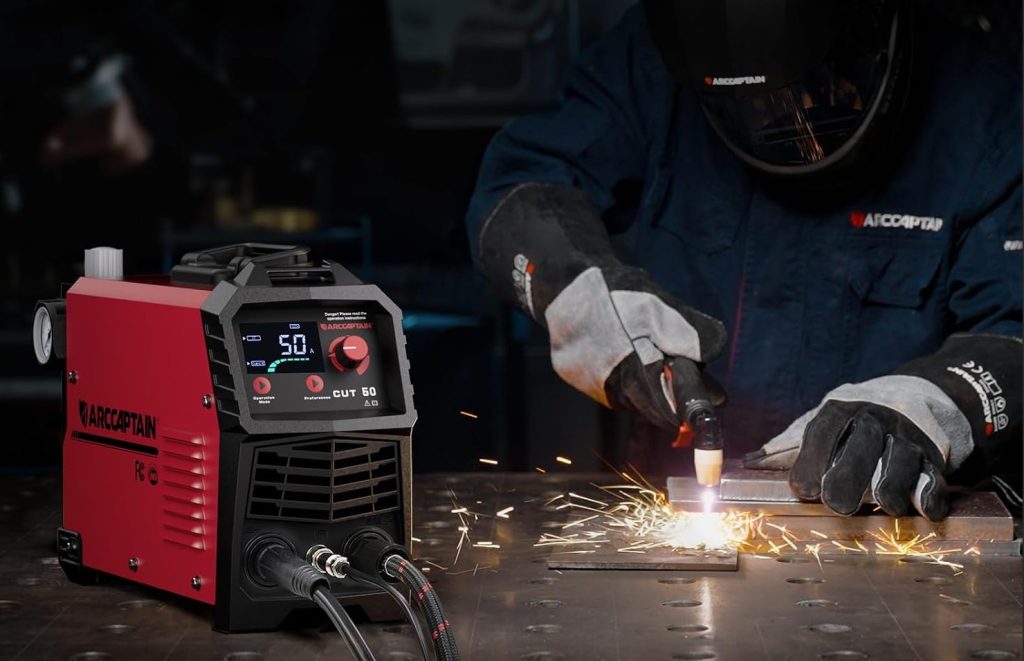
ARCCAPTAIN 50A plasma cutter
The most-reviewed and least-romantic tool here, and the one that changes what you can attempt. A 15-gallon DeWalt compressor at roughly 5 scfm runs it — one owner’s setup, not a spec claim — and the same owner cut 1/2″ plate at 35 A on a 250 V circuit and changed consumables once for a whole project. The complaints are boring and specific: the manual is close to useless, the ground clamp is the first thing to replace, and there is a real learning curve coming from a cutoff wheel. Nobody in 1,385 ratings says it will not cut.
- cuts 1/2" on 240 V — one owner’s project, 35 A setting, one consumable change
- runs on a small compressor — ~5 scfm at 15 gallons — check your tank before you buy
- manual is the weak part — multiple owners learned from YouTube instead
- ground clamp is disposable — everyone upgrades it; budget the $15

ARCCAPTAIN 200A stick welder
The cheapest way into welding and the best-reviewed product in this article — 4.6 over 1,413 ratings, with a review pool full of first-timers and one retired professional. The professional is the one to read: he tests budget welders for fun, confirms the machine uses multiple rod types, and rates the display readable with a helmet down. A 70-year-old brush hog got a new tongue hitch off 110 A and 6011 rods on 1/4″ plate, and the owner’s benchmark is a Lincoln tombstone. Two consistent caveats: it is a different machine on 110 V than on 220 V, and the arc is only as good as your ground.
- 4.6 over 1,413 ratings — the deepest evidence base in this lineup by two orders of magnitude
- hot start + arc force + anti-stick — the three features beginners actually feel, all adjustable
- 110 V is a compromise — owners who tried both say 220 V is where it behaves
- tested against a Lincoln — one owner’s 70-year-old brush hog repair, 6011 rods, 1/4″ plate
Buy the process, then the amps
A welder is not a power rating. It is a commitment to a process, and the process decides what metal you can join, what gas you have to buy, and how much of the work is setup rather than welding. These three cover three different commitments.
You want one box for everything — MIG205DP Pro ($599.99)
MIG, flux-core, lift TIG, stick and spot in one chassis, 120 V or 240 V. The synergic mode dials settings from material and thickness, which is why two experienced owners rate it. The catch: pulse programmes only adjust inside that mode, and 21 ratings is not a track record.
You cut more than you join — 50A plasma ($179.99)
Runs off a 15-gallon compressor, cuts 1/2″ on 240 V. It will not make you a welder, but it removes the cutoff wheel from your life, and 1,385 ratings at 4.5 is the most reliable evidence here.
You are learning, on a budget — 200A stick ($119.99)
Hot start, arc force, anti-stick, and 4.6 over 1,413 ratings. A retired professional and a 70-year-old brush hog both vouch for it. It is a compromise on 110 V — plan for 220 V if you can.
Side by side
Prices, ratings and rating counts from the brand’s affiliate feed at time of writing.
| MIG205DP Pro | 50A Plasma | 200A Stick | |
|---|---|---|---|
| Price | $599.99 (was $719.99) | $179.99 (was $249.99) | $119.99 (was $139.99) |
| Process | MIG / flux / lift TIG / stick / spot | Plasma cutting only | Stick (ARC) + lift TIG |
| Input power | 120 V or 240 V | 110 V or 220 V dual voltage | 110 V or 220 V |
| Consumables | Wire + gas (or gasless), tips | Electrode + shield cup + air supply | Rods only |
| Best documented strength | Synergic setup; readable LCD | Cuts 1/2″ on a small compressor | Arc quality at $120, verified by a pro |
| Documented weakness | Pulse locked to synergic; older MIG200P is tougher | Manual, ground clamp, arc learning curve | Thin performance on 110 V |
| Rating history | 4.4 · 21 | 4.5 · 1,385 | 4.6 · 1,413 |
Not the right pick if… you need aluminium, thin sheet, and clean cosmetic beads. That is MIG territory, and the MIG205DP Pro is the only one of these three that does it — but read the fine print first. Two owners who have run ARCCAPTAIN machines for years put the older MIG200P ahead on build: a heavier drive mechanism and a two-latch door that closes properly. The 205DP is lighter, smaller and better-screened, and its pulse programmes only adjust inside synergic mode. If you want to hand-tune a pulse curve, this machine will not let you, at any price.
Not the right pick if… you only have a 110 V garage circuit and no plans to change that. The stick welder’s own reviewers say it plainly — one has not tried 110 V at all, another used only 110 V and calls it “what it is for the price”, and the brush hog repair that impressed everyone ran 110 A on a machine that behaves better on 220. The plasma cutter needs air as well as amps; a 15-gallon, 5 scfm compressor is the documented minimum and small pancake units will leave you waiting on the tank between cuts.
Not the right pick if… you want documentation. This is the most consistent complaint across all three products and every star rating. The plasma cutter’s manual is called “not very good” by a five-star reviewer who then went looking for how-tos online; a four-star says the instructions “could have been clearer”; a MIG buyer describes the spool holder as more complicated than it needs to be. Budget an evening of YouTube per machine. You are buying hardware, not a curriculum.
Not the right pick if… you are buying the MIG for its rating. It has 21. The stick welder has 1,413 and the plasma cutter 1,385, and both of those numbers mean something — the MIG’s does not yet. The 21 include one one-star that is a Prime delivery complaint about a late parcel, not a weld, which tells you how thin the sample is. The spec sheet on the MIG is genuinely impressive. The evidence behind it is six months old at best.
Not the right pick if… you weld for a living. Nothing here is a production machine, and the reviewers who do this professionally say so — the one who tests budget welders for fun chooses a competitor at $189 on value, and the fabricator who put a clamp meter on two ARCCAPTAIN units found the older, heavier one better built. Buy these for a garage, a farm, a trailer, a first year of learning. Not for eight hours a day.
What verified buyers say
Six verified Amazon reviews, paraphrased and attributed — the clamp-meter comparison against the older machine, the first plasma cut, and the professional’s read on a $120 stick welder.
The single most useful review on the newest machine, because he owns the previous generation and put a clamp meter on both. His finding: both machines hit their stated output, so the amperage claim is not marketing. Where the 205DP wins is the interface — a better screen, easier controls, lighter and smaller. Where the 200P wins is build: a heavier drive mechanism, a door with two latches that closes properly, and a general sense of being built tougher. If you are choosing between generations rather than brands, that trade is the whole decision.
He had not welded in four decades, so he found a working welder to help him set the machine up and judge it — which is more rigour than most reviews here. His conclusion: the automatic synergic settings are what makes the machine approachable for someone returning to the craft, and there is still a deep set of manual adjustments waiting once you outgrow them. His one complaint is mechanical rather than electrical — the spool holder is more fiddly than it needs to be. That is the pattern with this machine: the electronics are praised, the hardware around them is where the corners sit.
The review that tells you what the learning curve actually is. He bought it because he was tired of burning through cutoff wheels, had never touched a plasma cutter, looked up cut parameters online, and was cutting 1/2″ plate the same day. A second owner adds the practical detail: a standard 15-gallon compressor keeps up, 35 A is enough for most work, and one set of consumables lasted an entire project. Neither of them mentions the manual, which is its own review — the people who succeed here go to YouTube first.
The fair-minded four-star that lists what the five-stars skip. It cuts 1/8″ scrap plate without drama and runs fine on a small compressor. Then: the manual is not very good and he spent a long time online looking for how-tos; the ground clamp is weak and gets replaced immediately; and the arc has a learning curve comparable to oxy-acetylene, which is not what a first-time buyer expects from a machine with one trigger. His verdict is still positive on price — but the $180 is the entry ticket, not the total.
He buys budget welders deliberately, tests them, and gives most away — so this is a comparison rather than a purchase review. His summary: a nice machine that handles multiple rod types, with a display readable even with an auto-darkening helmet down, and adjustable arc force, arc start and anti-stick. His caveat is price positioning rather than quality: he rates a competing budget brand better value at $189. If your shortlist is this machine against a no-name at the same price, read this as a recommendation. If it is this against a $189 known quantity, he would take the other one.
The most concrete field report in the pool. A rusted farm implement needed a new tongue hitch for a 2-5/8″ ball; he ran 110 A with 6011 rods on 1/4″ plate, then flipped to 3/16″ for the inside, welded upside down, and later ran the machine off a generator. His benchmark is a Lincoln tombstone he has used for decades, and he rates this better on versatility. His closing line is the one that matters for anyone welding away from an outlet: it weighs about as much as a toaster. That portability is the actual product, not the amperage number.
Three garages these were built for
The farm repair that has to happen today
A rusted implement, no trailer to take it anywhere, and a generator for power. The documented win: 110 A, 6011 rods, 1/4″ plate, welded upside down, off a generator — on a machine that weighs about as much as a toaster.
The trailer and frame work you keep deferring
Cutting is the bottleneck, not joining. The documented win: a 15-gallon compressor and a 240 V circuit turn 1/2″ plate into a five-minute job instead of twenty minutes of sparks and cutoff wheels.
The first year of learning to weld
You do not know which process you will love yet. The documented win: one box covering MIG, flux, stick and lift TIG, with synergic settings that get a beginner laying beads on day one and manual control waiting when they outgrow it.
FAQ
MIG, stick or plasma — which one should I buy first?
Buy the process your projects actually need, not the process with the best review. If you are repairing thick steel outdoors, on rusty or dirty metal, and often away from an outlet, stick wins: no gas bottle, no wire feed to jam, and the 200A machine here is $119.99 with 4.6 over 1,413 ratings. If you are building thin sheet, aluminium, or anything that has to look clean, you need MIG and the entry price is $599.99. If your real bottleneck is cutting plate and tube rather than joining it, the plasma cutter at $179.99 changes more of your week than either welder. Most home shops end up owning a cutter and one welder, in that order.
Is the MIG205DP Pro worth $600 with only 21 ratings?
The specs are real and the small pool agrees with them; the risk is that nobody has owned one for two years yet. What the 21 reviews do establish: both machines in one owner’s comparison hit their stated output on a clamp meter, the synergic mode works well enough that a welder returning after forty years could use it, and the LCD is readable through a dark helmet. What they also establish is the limit — pulse programmes only adjust inside synergic mode. If you need a proven platform, the older MIG200P is the one the fabricator preferred on build quality. If you want the interface and the dual voltage, $599.99 is not unreasonable for an 8-in-1. Just buy it knowing you are an early owner.
How much compressor do I need for the plasma cutter?
Less than the spec sheet suggests, but not nothing. The most detailed owner report in the pool runs it off a 15-gallon DeWalt at roughly 5 scfm and has not hit a problem across a full project at 35 A. What he does describe is waiting — plasma cutting is duty-cycle limited, so a small tank means pauses while it refills. A pancake compressor will technically run the torch and will make you hate the torch. Budget for a 10-15 gallon unit with a real scfm rating, and expect to replace the supplied ground clamp on day one; multiple owners call it the first upgrade.
Will the stick welder really run on 110 V?
It runs, and it is a different machine. One owner used only 110 V and summed it up as fine for the price; another had not tried 110 V at all and reported 220 V handling any task he could ever need. The farm repair that impressed a Lincoln owner ran 110 A on 1/4-inch plate, on 220 V. The honest reading: 110 V will do light work, thin material and small rods, and it will frustrate you on anything structural. If a 240 V circuit is available or can be added, that is the single biggest upgrade you can make to a $120 welder, and it costs less than the welder.
Do these machines come with everything I need to start?
For the stick welder, close enough — owners describe good ground and stinger leads included, and one mentions a 3-year warranty on the MIG. For the plasma cutter, no: you need a compressor, an air drier is wise, and the ground clamp gets replaced immediately by most owners. For the MIG, budget for wire and either gas or a gasless setup, plus a spool gun if you intend to weld aluminium. Nobody in these 2,800 ratings regrets the machine; several regret assuming the box was complete. Read the manual’s contents page before you plan your first project.
How was this page put together?
We are an independent review site. Specs, prices and coupon states come from the brand’s official affiliate feed; review summaries are paraphrased from the public Amazon review history of each product, negative reviews included. If you buy through our links we may earn a commission — it does not change which reviews we quote or what they say.