
Quick answer: Anycubic’s lineup splits by material, and the honest rule is buy the printer for what you print. The Kobra X Combo ($569.99) is the FDM pick — fast multicolor with built-in filament drying and the pool’s best upgrade story. The Kobra 3 Max ($499.99) is a build-volume purchase with a 3.7-star honesty tax: head and filament-path failures, rescued by genuinely excellent support. The Photon Mono 4 ($209.99) is the cheapest credible entry to resin-grade detail — if you bring the ventilation, gloves and wash-and-cure time the box doesn’t warn you about.
The three-product lineup
Multicolor FDM, large-format FDM, or fine-detail resin. Prices are feed values at time of writing.

Anycubic Kobra X Combo
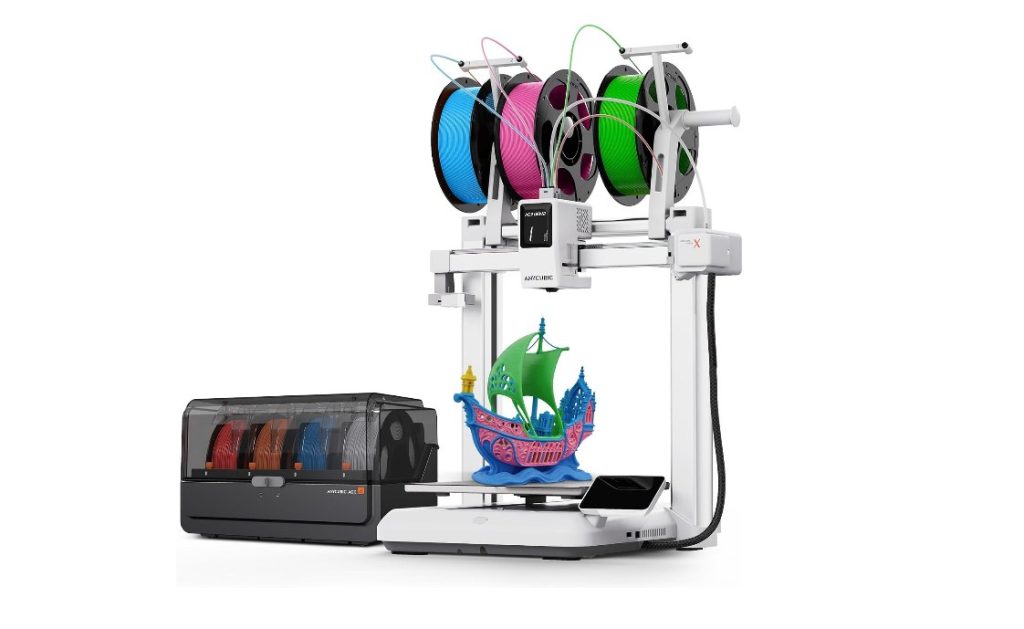
The FDM pick of this lineup: a fast (600mm/s-class) CoreX-style printer bundled with the ACE 2 Pro filament system for native multicolor printing. The 4.3-star pool splits exactly the way a hobbyist needs it to: 5-stars document an Ender 3 owner upgrading and being blown away — easy setup, intuitive menus, print speed “unbelievable,” multicolor working great; a beginner reports it “on overdrive” since arrival. The honest middle: a 4-star owner’s print head stopped extruding mid-print (“it can’t detect that nothing is coming out”) — support shipped a new head in two weeks; TPU printing produces “webs everywhere.” Multicolor costs purged filament and time per change; that’s the physics of every consumer multicolor system, not an Anycubic flaw.
- 600mm/s class speed + native 4-color — documented blowing away Ender-3 expectations
- auto-bed leveling — one-and-done, verified across the pool
- ACE 2 Pro filament drying built in — combo includes the dryer box owners add separately
- no runout/clog detection — a 4-star owner’s head kept ‘printing thin air’ until support replaced it

Anycubic Kobra 3 Max
The printer you buy for one reason: build volume big enough to print a guitar body in one piece — which the pool’s most useful review actually did, in PLA silk and PETG, and it “came out well.” The same owner’s honesty is the 3.7-star score explained: filament breaking inside the ACE unit at first (“not the easiest process to clear broken filament out”), and a print head that overheated and melted its internal wiring — replaced under support, which he praises as “excellent.” That’s the honest profile of large-format consumer FDM: when it runs, it’s fantastic; the failure modes are head and filament-path, and the warranty service is what saves the experience. Multicolor on this unit requires the ACE as an add-on — buy the printer-only SKU if size is the mission.
- huge single-piece build volume — guitar-base prints documented end to end
- PLA silk / PETG verified — the materials large props actually use
- excellent warranty support — replacement parts shipped for documented failures
- 3.7-star aggregate — head overheating and ACE filament breaks are the price of the size

Anycubic Photon Mono 4
The resin path: a 7-inch 10K mono-LCD printer that prints miniatures and jewelry-level detail FDM can’t touch, at the entry price of the resin category. The 4.4-star pool documents the real experience: a client-work buyer prints “within 30 minutes” of unboxing; a miniatures veteran calls the detail world-class; an owner survived a power outage and the print resumed perfectly; one went through a full wash cycle and dryer in a pocket and both units powered back on. The honest costs are resin’s, and this pool says them loudly: a 3-star titled review warns “there were NO warnings whatsoever about how toxic resin is — buy an enclosure, use ventilation”; the wash-and-cure workflow is its own time tax (“too much for me to endure”); and the QC lottery includes dead touchscreens and screens arriving cracked (replaced under support).
- 10K mono LCD detail — razor-sharp minis and jewelry prototypes, verified by pros
- power-outage resume — documented picking up exactly where the cut hit
- $209.99 entry to resin — the cheapest credible route to FDM-impossible detail
- fumes, wash, cure — the resin tax — enclosure + ventilation mandatory; workflow is real time
Who each Anycubic is for
The split is the material you print — colored filament, big parts, or fine detail.
The multicolor maker — Kobra X Combo ($569.99)
Figures, articulated models, colorful functional prints, and the end of painting. Native 4-color with built-in filament drying, at the price competitor combos charge for the printer alone. Accept purge waste and the occasional support ticket.
The big-parts builder — Kobra 3 Max ($499.99)
Cosplay armor, helmet shells, guitar bodies, planters, one-piece props. The volume is the product; the honest contract is head-and-filament-path vigilance plus excellent warranty support when it bites.
The detail specialist — Photon Mono 4 ($209.99)
Miniatures, jewelry prototypes, dental-grade detail. The cheapest credible resin entry — bought with an enclosure, ventilation, and the wash-and-cure time budget the fume warning demands.
Side by side
Prices and ratings from the brand’s affiliate feed at time of writing.
| Kobra X Combo | Kobra 3 Max | Photon Mono 4 | |
|---|---|---|---|
| Technology | FDM, 4-color + dryer | FDM, large format | Resin (MSLA) |
| Detail ceiling | Good FDM | Good FDM at scale | Miniature/jewelry grade |
| Best documented win | Ender-3 upgrade, multicolor working | Guitar body in one print | 30-minute setup, world-class detail |
| Documented weakness | No clog detection; TPU webs | 3.7★: head melt, ACE breaks | Fume safety, wash/cure time |
| Price | $569.99 | $499.99 | $209.99 |
| Rating history | 4.3 · 354 | 3.7 · 172 | 4.4 · 540 |
Not the right pick if… you’re buying resin without a ventilation plan. The pool’s own 3-star safety review says it in caps: fumes filled a house with no warning anywhere in the box. Resin printing needs an enclosure or a garage and gloves for every step. If you can’t give it a room, buy FDM.
Not the right pick if… you expected “multicolor” to mean “cheap color changes.” Every consumer multicolor system purges filament between colors — wasted plastic and added hours on multi-color prints. The Kobra X Combo’s owners accept this as physics; budget-conscious makers paint, or print parts in separate colors and assemble.
Not the right pick if… you want set-and-forget reliability at the large-format tier. The Kobra 3 Max’s 3.7 stars are honest: head overheating that melted wiring, ACE filament breaks, and clearing the filament path as a skill. The saving grace — support that ships parts fast — is a lifeline, not a feature. Tinkerers thrive here; appliance buyers should look smaller.
Not the right pick if… you’re printing TPU as a primary material. “A lot of webs everywhere” is the pool’s phrase for flexible filament on the Kobra X; flexibles demand tuned retraction and slow speeds that consumer-speed printers handle poorly. Rigid materials: excellent. Flexible: expect stringing cleanup.
Not the right pick if… you believed the “fully automatic” marketing covers maintenance. Vats are plastic (no metal scrapers), FEP films scratch, build plates chip under metal tools, settings need per-resin tuning. The pool’s happiest owners are the ones who treat the machine as a maintained tool, not an appliance.
What verified buyers say
Six verified Amazon reviews, paraphrased and attributed — weighted toward the boundary-setting reviews this category needs most.
The upgrade review that sells the machine: loved his Ender 3, wanted multicolor, hesitated at the price being “so much lower than comparable models.” Setup incredibly easy, menus intuitive, print speed “absolutely blows my mind” against what he was used to, print quality excellent, multicolor works great. “I would highly recommend this printer.” The value verdict from exactly the buyer the machine targets.
The honest failure: mid-print the head stopped extruding and kept “printing thin air” — no clog detection, no runout flag. Replacing and reloading filament didn’t help; unclogging didn’t work. Support shipped a new print head within two weeks and it’s been working since. His keep-list: auto leveling good, PLA printing good. His caution list: TPU produces “a lot of webs.” The QC-lottery and the recovery, both documented.
The large-format truth in one title. Filament broke inside the ACE unit early on until he got the hang of it; clearing the break was “not the easiest process but doable.” The reason he bought it — a HUGE print area — delivered: a guitar base printed in one go in PLA silk and PETG, small PLA parts too. Then a print head overheated and melted wiring inside; customer support was “excellent,” new parts shipped, back up and running. The whole 3.7-star experience, from its most useful reviewer.
A professional client job that “required too much detail for a traditional filament printer.” He chose the Mono 4 for easy setup over capacity or frills, and it delivered: printing within 30 minutes, a “heck of a deal” at the price, excellent build-plate adhesion, and speed/quality “what I expected, and both very good.” The resin convert’s business-case review.
The safety boundary review, from a family that fumed up the whole house: great beginner printer, very quiet, very high print quality, “great for miniatures” — and zero warning anywhere about resin fumes. “PLEASE BE CAREFUL WHEN PRINTING!! BUY AN ENCLOSURE AND ONLY USE IN A WELL VENTILATED AREA.” The 3-star the category deserves, attached to the product that needs it most.
A durability review nobody plans to write: hearing aids this is not, but his Mono 4’s replacement parts and — separately — a set of Anycubic-printed pieces went through a full wash cycle. Jokes aside, his actual 3-star complaint is the vat’s plastic body: don’t clean it with the included metal scraper (it will leak — use the plastic spatula), and watch the FEP film. “Great customer service” rounds out the honest field guide.
Three makers these printers serve
The colorful figure printer
Articulated dragons, busts, custom parts in four colors without paint. The documented win: multicolor working out of the box, speed that ruins Ender-3 owners for their old machines.
The big-prop builder
Cosplay, helmets, one-piece functional parts. The documented win: guitar bodies printed whole in PLA silk and PETG — with support’s replacement parts keeping the machine alive through its failures.
The miniatures painter
Tabletop minis with layer lines FDM can’t hide. The documented win: jewelry-prototype detail at $209.99 — in a ventilated room, gloves on, wash-and-cure station on the bench.
FAQ
FDM or resin — which one should I actually buy?
Detail and material answer it. If you print minis, jewelry prototypes or anything where layer lines matter, resin’s 10K LCD detail is a different category — and the Mono 4’s pool proves it at $209.99. If you print functional parts, props, or anything you’ll handle, drop or leave in a car, FDM’s toughness wins — and the Kobra X Combo’s multicolor or the 3 Max’s volume pick your flavor. The serious hobbyists in this pool own both.
Is the Kobra 3 Max reliable enough for a $499 purchase?
Reliably fixable, not reliably flawless. Its 3.7-star aggregate comes from real failures — melted head wiring, ACE filament breaks — but its most useful reviewer documented support shipping parts and the machine printing a guitar body well. The honest framing: you’re buying build volume plus a warranty relationship. If your projects don’t need single-piece large prints, the Kobra X Combo at $70 more is the safer machine with better reviews.
What does multicolor printing actually cost in practice?
Purged filament and time: each color change flushes transition material into a purge tower, so a 5-color print wastes meaningfully more plastic and adds hours. The ACE 2 Pro in the Combo also dries filament — a genuine quality upgrade for hygroscopic materials. The pool’s happy multicolor owners are decorative printers who accept the waste; the pragmatic ones print single-color parts and paint.
What do I need beyond the printer for resin?
The honest list from the pool: an enclosure or ventilated room (the fume review is in caps for a reason), nitrile gloves for every touch, a wash-and-cure station or DIY equivalents (IPA bath plus UV light), plastic scrapers only — the vat is plastic and the metal one will hole it — and FEP film as a consumable. Budget roughly $100–150 of accessories on top of the $209.99, and a health plan that respects the safety sheet.
How is Anycubic's support, really?
The pool’s most consistent positive: replacement parts shipped for documented failures — new print heads, screens, even a whole new set when markers went missing. The pattern across the 3-star columns is failures happen, support fixes them. The English is functional, the pace is weeks not days, and the warranty asks for photos and patience. For a hobby brand at these prices, that’s the recovery story you want attached to a QC lottery.
How was this page put together?
We are an independent review site. Specs, prices and coupon states come from the brand’s official affiliate feed; review summaries are paraphrased from the public Amazon review history of each product, negative reviews included. If you buy through our links we may earn a commission — it does not change which reviews we quote or what they say.