
Quick answer: SimPure sells the same RO science in three form factors, and the stage count is the least important number on the box. The Y7P-BW countertop ($269.99) is the 3,746-rating no-install workhorse — well-water owners measure 849 ppm in, 33 out. The T1-400ALK under-sink ($269.99) is the same price plumbed in: tankless 400 GPD with the alkaline-or-flat-water cartridge swap the careful owners buy it for. The Y9A flagship ($399.99) is the 6-stage side-tank countertop with the thinnest history and the widest support variance. What the pool actually teaches: the machines work when maintained and die when ignored — one owner’s error-storm was fixed by a citric-acid backflush — and October’s conversions were all filter cartridges, which is this catalog’s real business model.
The three-product lineup
33 listings in the US feed — the countertop family, the under-sink tankless family, and the cartridge line that October’s conversions actually ran through.

SimPure Y7P-BW UV Countertop RO
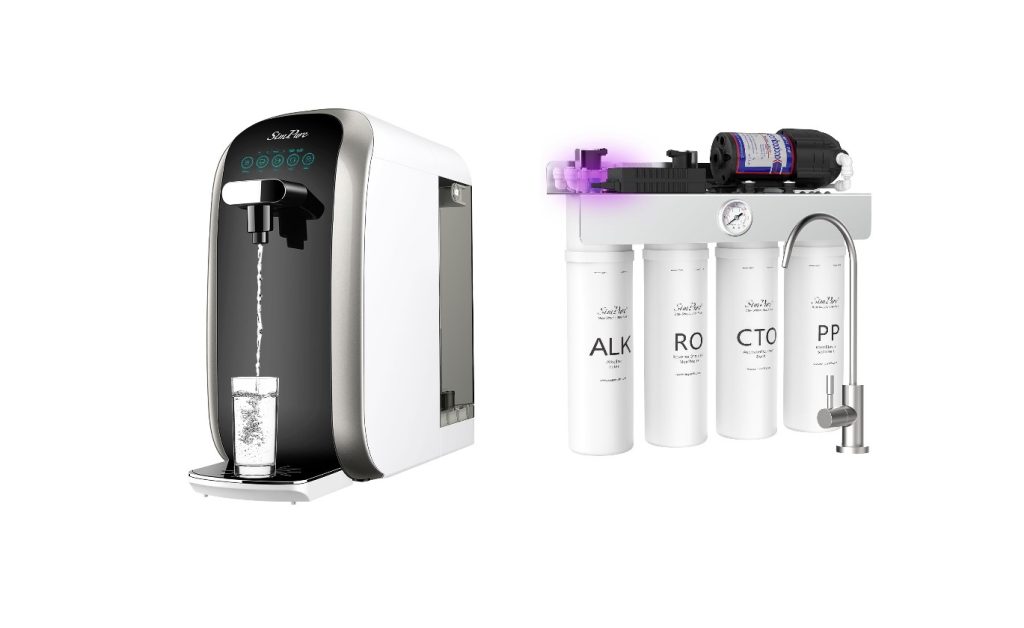
The volume anchor: 4.2 over 3,746 ratings, the deepest pool in this brand. Plug in, fill the tank, dispense — no plumbing, which is the entire countertop pitch, and the reason the pool is full of apartments, RVs and offices. 5-stage RO plus UV, SGS-tested against NSF/ANSI 58, 4:1 pure-to-drain (the brand claims the category’s best water utilization), 418 GPD flow — a cup in about 15 seconds. The two honest running facts: it dispenses room temperature only (no hot/cold, and the listing says so at the bottom), and the filter economics are the real price of ownership — the pool runs 6–8 months per change in normal water, and dramatically less in the failure stories below. October’s SimPure conversions were entirely filter cartridges, which tells you where this catalog’s money is.
- no install, room-temp only — countertop freedom, stated honestly in the listing’s last bullet
- 4:1 pure-to-drain, 418 GPD — the efficiency and speed numbers that beat the category’s 50–75 GPD countertop norm
- 5 stage + UV, SGS to NSF/ANSI 58 — the certification the pool’s careful owners verified independently
- filters are the real cost — 6–8 months normally; the failure reviews tell the other side

SimPure T1-400ALK Tankless Under-Sink RO
The plumbed alternative at the same price point: 400 GPD tankless under the sink, 1.5:1 pure-to-drain, alkaline remineralization (calcium, magnesium, potassium — so the TDS deliberately does not read zero; the listing explains this in a NOTE), and an NSF-verified certification the pool’s careful owners checked on the NSF site. The design flexibility the reviews praise: the alkaline filter can be swapped for a T33 carbon filter if you decide you want 0-ppm water instead — one owner bought it for exactly that optionality. The honest plumbing notes: the valve assembly’s gasket does not fit every shutoff (one owner’s shank was too short and support told him to just not use a gasket, which he rightly refused), and the 1057-gallon filter-life claim met a documented 500-gallon death in one unit. Under-sink buyers get the flow; they also become their own installers.
- tankless, under-sink, 400 GPD — on-demand flow, no storage tank, saved cabinet space
- ALK or T33 filter flexibility — remineralized water or near-0 TDS — swap one cartridge to change your mind
- NSF certification, independently verifiable — the pool’s owners checked the database themselves
- gasket and valve fit are install lottery — one documented shutoff incompatibility; measure yours

SimPure Y9A UV Countertop RO
The flagship countertop: 6-stage with alkaline remineralization, 300 GPD (an 8-oz glass in about 18 seconds, against the category’s 1-minute norm), and the side-placed transparent tank — fill it without pulling the unit out from the wall, and watch the water level. The pool’s newest unit here carries the thinnest history (4.2 over 285) and both the best and the worst stories: an owner whose 6-year-filter-life UV and 2-minute setup earned a glowing year-plus review with same-day customer service, and an owner whose unit broke in under three months, was refused a replacement, and is back on bottled water. The maintenance schedule is the most explicit in the catalog: daily tank swap, monthly flush, and a full storage protocol if you leave it unused for weeks — the listing treats it like the appliance it is.
- 6 stage + UV + alkaline, 300 GPD — the deepest filter stack in this brand, fastest documented countertop dispense
- side tank, visible level — the design detail that separates it from every rear-tank competitor
- 4.2 over 285 — newest, thinnest history — both the glowing year-one reviews and the 3-month warranty fight live in the same pool
- explicit maintenance ladder — daily/monthly/away protocols stated; ignore them and the failure stories follow
Which machine, for which water
Same filter science, three form factors. Start from your water and your plumbing, not from the stage count.
Rented, mobile, or no-plumbing — Y7P-BW countertop ($269.99)
The 3,746-rating workhorse: fill the tank, dispense, no install. Room-temperature only. The right first RO for apartments, RVs and offices — with the maintenance ladder accepted.
Owned kitchen, high daily volume — T1-400ALK under-sink ($269.99)
Tankless 400 GPD under the cabinet, alkaline-or-T33 optionality, verifiable NSF cert. You are the installer; the gasket lottery and the documented 500-gallon death are the risks.
Countertop money, flagship features — Y9A ($399.99)
6 stage, 300 GPD, side tank you can watch. The newest and thinnest history, with the widest support-outcome variance — buy it early inside the Amazon window.
Side by side
Prices, ratings and rating counts from the brand’s affiliate feed at time of writing.
| Y7P-BW countertop | T1-400ALK under-sink | Y9A countertop | |
|---|---|---|---|
| Price | $269.99 | $269.99 | $399.99 |
| Rating history | 4.2 · 3,746 | 4.2 · 1,412 | 4.2 · 285 |
| Install | None — plug and fill | Under-sink plumbing | None — plug and fill |
| Stages / flow | 5 + UV, 418 GPD | 3 + ALK, 400 GPD tankless | 6 + UV + ALK, 300 GPD |
| Water taste profile | Purified (near-0 TDS) | Alkaline remineralized (non-zero by design) or swap to T33 | Alkaline remineralized, 50–80 ppm |
| Waste ratio | 4:1 pure-to-drain | 1.5:1 | Waste water kept in-tank (usable for plants) |
| Documented catch | Filter life collapse without maintenance; room-temp only | Gasket fit lottery; 500-gallon death case | Warranty-refused early failure case |
Not the right pick if… you were not planning to maintain it. The pool’s one-stars are maintenance stories wearing product costumes: reservoir-taste failure a month past the return window with filters dying at two months instead of six, error messages and stoppages fixed only by a citric-acid backflush, and a flushing-and-storage schedule the Y9A listing spells out in daily/monthly/away terms. RO is an appliance you own, not a jug you fill. If the honest answer is that you want tap-adjacent effort, the one-star reviewer’s advice is his own: a plain Brita or store-brand tank will serve you better than an ignored $270 machine.
Not the right pick if… you want hot or cold dispensed water. Every countertop unit here dispenses room temperature only — the Y7P listing states it in its final bullet, and the Y9A reviews confirm the same. Countertop RO feeds kettles and fridges; it does not replace a water cooler. Budget accordingly.
Not the right pick if… your shutoff valve is nonstandard and you are buying the under-sink unit. The documented case: an owner’s cold-water shutoff shank was too short for the T1’s valve assembly — the gasket collapsed into the hole before sealing, and support’s answer was to just not use a gasket, which he rightly refused as a leak waiting to happen. Measure the shutoff, or budget a plumber’s hour, or buy the countertop and skip the lottery.
Not the right pick if… you expect zero TDS and buy the alkaline versions. The remineralization filters deliberately add calcium, magnesium and potassium back — the listings say so, and the pool’s two-year owners defend the taste while explaining why their meters read 10–14 ppm instead of 0. If you want laboratory-flat water, that is the T33 swap on the T1-400, or the Y7P’s plain purified output. Buying the ALK units and complaining about the minerals is the documented way to be disappointed in a machine that is working correctly.
Not the right pick if… the warranty story has to be bulletproof. The pool contains a next-day replacement part with instructions, and a refused replacement on a less-than-three-month-old flagship with the owner stranded on bottled water. The difference between those two outcomes is not visible at purchase time. Buy through Amazon while the return window overlaps the early-failure window — especially on the $399.99 Y9A — and register the product with SimPure’s Seattle-based support line the week it arrives, because the engaged channel is the one that ships parts.
What verified buyers say
Six verified Amazon reviews, paraphrased and attributed — the 849-ppm well-water test, the foul-water month and the filter math, the citric-acid fix from a converted critic, the verified-NSF optionality buyer, the 500-gallon death, and the flagship warranty fight.
The pool’s best data review. He lives on Texas well water, tested it at 849 ppm against the roughly-40 drinkable line, checked his toilet bowl for sand sediment, and bought this rather than keep hauling water. The follow-up owner on the same listing tested Fort Lauderdale’s yellow tap at 193 ppm in, 33 ppm out. That is the product working as specified, measured by owners with meters — and it is the honest benchmark to hold any of these three units to. The one-star below is what happens when the same machine’s maintenance goes wrong; both reviews describe the same hardware.
The counterweight, and the reason filter economics headline this page. A month past the return window the water started tasting foul — the internal reservoir was the culprit — and his filter reality ran two months, not the advertised six, at his water quality. His ledger: two expensive filter replacements at least every six months, constant maintenance against the advertised easy, a hastily translated manual, and his closing recommendation is a plain Brita or store-brand tank for anyone who will not maintain an RO machine. Read that as the honest boundary: RO is a maintenance ownership, and skipping it converts the appliance into a $269 mistake.
The most instructive arc in the pool: he originally left a negative review — repeated error messages, slow filtering, stoppages before the tank emptied, unhelped by filter changes. SimPure reached out with a suggested fix: backflush the unit with a citric-acid solution. That appears to have fixed my problems, he reports, and the revised review now teaches the machine’s normal operating sounds so you can hear when it is not right. Two lessons: the maintenance ladder is real (scale is the failure mode the fix addresses), and this brand’s support, when engaged through the right channel, actually does diagnostics instead of scripts.
Why the under-sink unit earns its spot: he chose it over the field for two reasons and verified both. First, filter flexibility — the alkaline filter can be swapped for a T33 carbon filter if he decided he did not prefer alkaline water long term; one cartridge change, 0-ppm water. Second, NSF certification he checked on the official NSF website — not a one-time lab claim, a maintained certification, unlike some brands he says only pay for a single test. Two and a half years in, the water tastes great, and his TDS expectations are set correctly: remineralized water reads non-zero by design. The careful buyer’s review, on the machine that rewards care.
The under-sink unit’s documented failure: installed mid-March, filled a 3-gallon dispenser daily, and died at about five months — roughly 500 gallons, not nearly the advertised filter life or machine life, he assumed filters, replaced them, still nothing. His original five-star review of the flow rate and tankless design stands edited above the one-star update, which is the honest shape: the design was right, the longevity was not. The pool’s matching case — a controller board losing pressure — was solved by customer service shipping a replacement part next-day with instructions. The variance between those two support outcomes is this brand’s risk profile in one data point each.
The Y9A’s hardest review, and the one that prices the flagship risk. Her previous SimPure broke in under a year; she gave the brand another try and the Y9 broke in less than three months while failing to filter properly. Asurion (the third-party protection plan) declined to replace; SimPure refused to replace the system and sent new filters for the less-than-3-month-old ones; the machine still did not work; she has been on bottled water for over a month on a $350-plus purchase, and cannot reach customer service. Against the same unit’s glowing year-plus owner with same-day service, the Y9A’s support outcomes swing hardest in the catalog. If you buy the flagship, buy it where the Amazon return window overlaps the early failure window.
Three kitchens these were made for
The well-water household
849 ppm Texas well water, yellow Fort Lauderdale municipal water, sulfur-smelling lake supply — the pool’s happiest owners arrive with meters and leave with 33 ppm and Dasani-taste comparisons. The Y7P on the counter, the tank filled daily, the filters changed on the indicator rather than the calendar. That last habit is the difference between the five-star and the one-star columns of the same listing.
The owned kitchen with a fridge line
T1-400ALK under the sink feeding the sink faucet and the refrigerator — the pool’s installer-owners run it to both sides of the kitchen with extra quarter-inch line. Tankless flow for cooking volume, the ALK cartridge for taste, the T33 swap in the drawer for when they want flat water. The gasket lottery is the toll; a plumber hour amortizes over years.
The bottle-free apartment
Y9A or Y7P by the kettle, the waste water kept for the plants (a countertop-specific advantage the under-sink units literally drain away), the pitcher in the fridge. The pool’s owners describe retiring a decade of 5-gallon-jug hauling and vending-machine refills. The monthly flush and the citric-acid backflush are the subscription fee — paid in minutes, not dollars.
FAQ
How often do SimPure filters actually need changing?
The listings say 6 months for PPC/ALK, 9 for the RO membrane, 6–8 per the long-term owners. The pool’s failure cases run shorter: one owner’s Y7P filters died at two months in his water quality, and an under-sink unit died at about 500 gallons against a 1057-gallon cartridge claim. The honest rule: your inlet water sets the calendar. High-sediment wells and hard municipal supplies eat cartridges faster than the chart, and the machines’ indicator lights (present on the Y9A, praised by its long-term owner) are better guides than the manual. Budget filters at the replacement cadence your water demands, not the advertised one — and run the monthly flush.
Countertop or under-sink — which SimPure should I buy?
Countertop (Y7P, Y9A) if you rent, move, or cannot touch plumbing: zero install, and the waste water stays in the tank where you can reuse it on plants. Under-sink (T1-400ALK) if you own the kitchen and drink volume: 400 GPD tankless flow, no tank on the counter, fridge line — and you accept the gasket lottery and being your own installer. The price is the same $269.99 for the Y7P and the T1; the flagship Y9A adds $130 for six stages, the fastest documented countertop dispense, and the side-tank design, on the thinnest review history of the three.
Why does my TDS meter not read zero?
If you bought an ALK (alkaline) model — the T1-400ALK or the Y9A — it is working correctly. The remineralization stage adds calcium, magnesium and potassium back into the purified water, so readings of 10–14 ppm after years, or 50–80 ppm on the Y9A, are the design, not a defect; the listings disclose this in notes and the long-term owners defend the taste. If you want near-zero TDS, the Y7P’s plain purified output or the T1’s T33-cartridge swap are the configurations that deliver it. Test the water before the filter, not after the minerals, if you are checking the machine.
What happens when a SimPure breaks?
The pool documents the full range. Best case: a controller losing pressure, diagnosed from photos and video, replacement part shipped next-day with instructions, working since — customer service a perfect 10/10 in that owner’s words. Middle: a citric-acid backflush prescribed after a negative review, which fixed it. Worst: a flagship dead in under three months, replacement refused, new filters sent for a machine that still did not work, owner back on bottled water. The pattern in the support outcomes: engaged channels with photos and the Seattle support line produce parts; escalation through third-party protection plans and unregistered units produce the bad stories. Register early, buy where returns work.
Did any of these convert in October's affiliate data?
The machines did not — the conversions were the consumables: Y9-series RO cartridges, the Y9A ALK cartridge, and the PPC prefilter, $4–$7.50 each in commission. That is the catalog’s real economics: a 15% commission tier where the machines earn trust and the cartridges earn the recurring revenue, exactly like the ink-printer business model. We feature the machines because that is what a review page is for — but the cartridge line is the honest second purchase, and the pool’s long-term owners treat filter stock as part of the price of ownership.
How was this page put together?
We are an independent review site. Specs, prices and coupon states come from the brand’s official affiliate feed at the time of writing; ratings are the public Amazon rating history of each parent product. Review summaries are paraphrased from verified Amazon customer reviews of the three products above, one-star and three-star included — every quotation is attributed to the reviewer name shown and the month it was posted. If you buy through our links we may earn a commission; it does not change which reviews we quote or what they say.