
Quick answer: every serious complaint about this brand on these three products is a voltage complaint wearing a different costume. The 100W N-Type panel ($89.99) is the strongest part of the range — 25% cell efficiency, 16BB, IP65, 4.6 over 7,030 ratings — and the only thing owners want changed is a bracket that lets them lift the panel off. The 30A DC-DC MPPT charger ($179.99) is the part that makes a van or a boat work, and it carries the one number the listing does not advertise: a PV voltage ceiling low enough that one boater had to replace it when he moved to a normal 36V panel. The P2 1000W inverter ($175.99) is where the 12V ceiling becomes visible — one customer ran a 7,000 BTU air conditioner on a 400Ah 12V bank for two months, and his own review says he should have gone 24V.
The three-product lineup
Panels are 65 of the 110 products in this feed; inverters are 17 and controllers are 13. These three cover one of each, at the stage most people actually buy them.

Renogy 100W N-Type solar panel
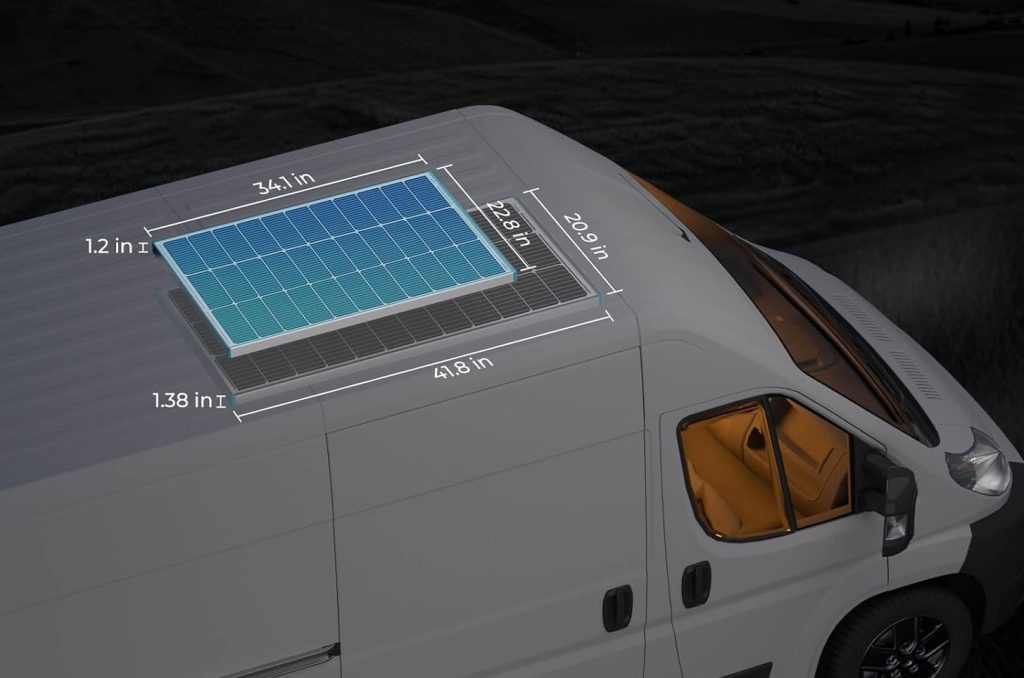
Sixty-five of the 110 products in this brand’s US feed are solar panels, which makes this the actual centre of gravity rather than an accessory. The published numbers are unusually specific for the price: A+ grade n-type cells at 25% conversion efficiency, 16BB busbars, a temperature coefficient of -0.29%/°C, IP65, and a body 11% smaller and 8% lighter than the version it replaced. 16BB is the detail worth knowing — more busbars means current takes shorter paths across the cell, which is how the listing justifies its claim about hot spots and micro-cracks. The one documented annoyance is mechanical and one owner states it plainly: the mounting brackets are designed so that removing the panel means removing the brackets from whatever you bolted them to.
- 25% cell efficiency, 16BB — the busbar count is the honest part of this spec — fewer paths means more heat and more cracking
- -0.29%/°C temperature coefficient — less output lost as the panel heats up, which is most of a summer afternoon
- 11% smaller for the same watts — aimed at van builds where roof real estate is the constraint
- bracket removal is a chore — one owner wants to lift the panel off without unbolting the bracket from the roof

Renogy Smart 30A DC-DC MPPT charger
The part most people skip and then wish they had not. Dual input means solar and alternator can charge the same bank, with solar prioritised; 3-stage charging, eight protections including reverse polarity on both inputs, and a 9.6-inch body that fits where a separate solar controller and a separate DC-DC unit will not. Two things are not in the spec table and both appear in the reviews. The Bluetooth module (BT-2) is sold separately, and the owner who has run a dozen Renogy products says most people will need it to configure the thing. And the PV voltage ceiling is low enough that one owner had to replace it when he moved from a 200W low-voltage panel to a 300W panel with a normal 36V rating.
- solar + alternator, solar first — one box replaces a DC-DC charger and a solar controller
- charging amps in 10A steps — enough for a 20A outboard setup; one owner wants 5A steps for small engines
- BT-2 Bluetooth module sold separately — the app configuration path most owners end up needing
- PV voltage ceiling is the catch — not printed prominently — check it before you match a 36V panel

Renogy P2 1000W pure sine wave inverter
1000W continuous, 2000W peak surge, pure sine wave at better than 90% efficiency, UL 458 and CSA C22.2 certified, with two AC outlets, a 5V/2.1A USB port, an AC terminal block, 3-foot 4AWG cables and a 16.4-foot wired remote in the box. The rating history here is 4.3 over 4,740, and the four-star and three-star reviews are worth more than the average: they describe units that died inside a year, warranty cases that stalled, and — most usefully — a revision where the positive and negative terminals swapped positions without a warning sticker.
- 1000W continuous / 2000W peak — surge headroom for a fridge or a heat gun starting up
- UL 458 + CSA C22.2 — the certification that matters if this goes into anything inspected
- 16.4 ft wired remote — the display can live where you actually look at it
- terminals moved between revisions — check polarity before connecting — one owner’s $60 fuse took the hit
Which part, for which system
These three are not alternatives to each other. They are three stages of one system, and the order you buy them in decides whether the system works. Buy the stage you are actually building.
You have a battery and no way to charge it — 30A DC-DC MPPT ($179.99)
The piece that makes a van or a boat work: solar and alternator into one bank, 3-stage charging, eight protections. Budget for the BT-2 Bluetooth module, check the PV voltage ceiling against your panels, and decide whether 10A charging steps are fine enough for your engine.
You have a charger and no panels — 100W N-Type ($89.99)
25% cell efficiency, 16BB, IP65, and 11% smaller than the previous generation. Run two in series for 24V systems or parallel for 12V; either way, confirm the string voltage sits under your controller’s ceiling before you mount anything. The bracket is the part owners complain about.
You have DC and need AC — P2 1000W inverter ($175.99)
1000W continuous, 2000W surge, pure sine, UL 458. This is the stage where the 12V ceiling becomes visible: an air conditioner or a heat gun will find the limit of a 12V bank long before the inverter does. Check the terminal positions against your old unit before you connect.
Side by side
Prices, ratings and rating counts from the brand’s affiliate feed at time of writing.
| 100W N-Type panel | 30A DC-DC MPPT | P2 1000W inverter | |
|---|---|---|---|
| Price | $89.99 ($16 coupon) | $179.99 (was $199.99, $30 coupon) | $175.99 ($16 coupon) |
| Stage in the system | Generation | Regulation and charging | DC to AC conversion |
| Rated output | 100W, 25% cell efficiency | 30A charging, 12V (24V compatible) | 1000W continuous / 2000W peak |
| What the reviews focus on | Bracket removal for servicing | PV voltage ceiling; BT-2 sold separately | Units dying inside a year; terminal polarity changed |
| Documented weakness | Panel cannot come off without unbolting the bracket | 36V panels exceed the ceiling; 10A steps too coarse for small engines | Warranty cases that stalled; fan not engaging on some units |
| Certification / rating | IP65, -0.29%/°C coefficient | 8 protections incl. reverse polarity | UL 458, CSA C22.2 No. 107.1 |
| Rating history | 4.6 · 7,030 | 4.3 · 517 | 4.3 · 4,740 |
Not the right pick if… you are building a 12V system around an air conditioner, a heat gun or an induction cooktop. This is the single most expensive mistake on this page and a customer made it in writing: eight 100Ah batteries, 400 usable amp-hours, two MPPT controllers, and a 7,000 BTU window unit that worked for two months before the GFCI started tripping. He said himself that he knew 24V would deliver more. The inverter is not the weak link in that story — the decision to stay at 12V is. Add up your AC loads first, then pick the bank voltage, then pick the parts. Doing it in the other order is how you end up rebuilding the system you just bought.
Not the right pick if… your panels are 36V nominal. The DC-DC charger’s PV voltage ceiling is low, it is not printed prominently, and the owner who found out is a boater who had already been happy with a 200W low-voltage panel and moved up to a 300W panel with a normal 36V rating. His charger had to be replaced. He also could not determine whether the 50A model has a higher ceiling because published information conflicts. If your panel string voltage is anything above the very low range, get the ceiling in writing from the seller before you buy, or buy a separate MPPT controller and keep this unit for the alternator side only.
Not the right pick if… you are replacing an existing inverter with the same model. Renogy changed the positive and negative terminal positions between revisions and did not add a warning sticker. One owner swapped a 3000W unit for an identical new one, connected it the way the old one came apart, and blew a $60 fuse — which was the good outcome, because he had fused the positive bus. Photograph your terminals before you disconnect. This costs nothing and it is the only failure on this page you can fully prevent by reading.
Not the right pick if… you expect a warranty claim to be straightforward. Two unrelated owners describe the same pattern: support asked the same basic questions repeatedly, then closed the case. One had a 3000W unit die with no lights, no fan and correct battery voltage at the terminals; the other was told his failing unit was not covered. A third says the specialty shops he contacted refuse to work on Renogy products. That is one person’s regional experience, not a national service network — but if you are installing this in a remote location, price the assumption that you are the service department.
Not the right pick if… you need the Bluetooth configuration to be included. It is not. The BT-2 module is a separate purchase, and the reviewer who has owned the most Renogy gear says most people will need it. The unit does have Modbus RS-485, and one owner found it connected straight to a Renogy One Core even though the documentation only described the Bluetooth path — so there is a wired option, it is just not the one the manual leads you to. Budget the module into the price before you compare it with a competitor that bundles app control.
What verified buyers say
Six verified Amazon reviews, paraphrased and attributed — a 12V system that failed at the compressor, a boater naming the PV ceiling, the terminal polarity change that cost one owner a fuse, a dead MPPT input, four inverters across three years, and a bracket that will not come off.
The most instructive one-star on this page, and not because of the failure. He built an off-grid camp in the Atchafalaya Basin: eight 100Ah 12V flooded batteries in parallel for a usable 400Ah bank, 2/0 gauge throughout, two Renogy MPPT controllers, 4x100W panels on one and 3x240W on the other. It ran Starlink, a camera and a 7,000 BTU window unit for about two months before the GFCI tripped and would not stay reset. His own sentence is the one worth quoting: he knew a 24V system would give him more, and he went with Renogy 12V anyway. That is the entire argument of this page written by a customer who lost the bet. The hardware did not fail because 12V is bad. It failed because he asked a 12V bank to carry an air conditioner.
He has run through about a dozen products from this brand and calls this one his favourite, which is a stronger endorsement than any five-star on the page. His use case is a boat with an outboard: he set the charger to 20A and it detects when the engine is running and charges his LiFePO4 bank, and the wiring layout saves room and complexity. Then the complaint that matters. The PV voltage is ridiculously low, in his words. He moved from a 200W panel with a very low PV voltage, which worked, to a 300W panel with a normal 36V PV voltage, and now has to upgrade the charger. He also could not establish whether the 50A version has a higher ceiling, because the information conflicts. Two smaller points: 10A steps are too coarse for small outboards, and there is no way to stop the unit waking up whenever the sun comes out.
A four-star that reads like a safety notice. He replaced an older Renogy 3000W inverter with a new one of the same model and did not notice that the positive and negative terminals had changed places between revisions. He had fused the positive bus, so the $60 fuse blew and the inverter survived. His verdict is split and fair: shame on him for not checking, shame on Renogy for not putting a warning sticker on the terminals. If you are swapping a unit rather than installing a first one, photograph the old terminals before you disconnect anything. This is the single cheapest mistake on this page to avoid.
The mirror image of the four-star above: a buyer whose alternator charging worked perfectly and whose solar input never reached the battery. He measured 17.65V coming in from a 100W panel and 0V going out to a 100Ah lithium bank. Support ran two days. The update is worse than the original complaint: the unit then stopped isolating the two batteries when the engine was off, so he had to physically disconnect the main ground every time he parked to avoid draining the start battery. His closing advice is to buy Victron instead, and he adds that the specialty shops he contacted refuse to work on Renogy products. Treat that last part as one man’s experience in one region, not a national service map — but take the 17.65V-to-0V measurement seriously if you are buying this specifically for solar.
A locksmith who has now owned four of these inverters, which makes him the most statistically useful reviewer here. The first 700W cut out after a few months and was replaced; the second 700W did the same and he got his money back. He moved to the 1000W. It ran fine, then began losing power under almost no load, then needed two or three power cycles to come back, then started beeping and cutting out mid-job. He noticed the fan never came on during these episodes and suspected overheating at a load that should not have caused it. His replacement 1000W, now carrying more equipment than the failed one, does run its fan. Read this as a batch-quality story rather than a design verdict, and check that the fan spins on your unit in the first week.
Short, specific, and about the only thing you cannot learn from a spec sheet. The panel works. What he wants is a bracket that lets him lift the panel off without unbolting the bracket from the surface it is mounted to. On a van roof or a shed that is a two-person job you have to redo every time the panel needs to come down for cleaning, storage or a repair. If your installation is permanent and never serviced, ignore this. If you take the panel off seasonally, budget for a different mount before you buy the panel — the brackets ship with the panel and they are the part you will fight with.
Three builds these were made for
The van with two panels and an alternator
Two 100W panels on the roof, the stock alternator, one lithium bank. The documented win: solar and alternator into a single charger with solar prioritised, 3-stage charging, and a 9.6-inch body that fits in the space where two separate boxes will not. The documented cost: the BT-2 module, and a conversation about PV voltage before the panels go on.
The boat with a small outboard
Charging amps set to 20A, engine detection that switches charging on when the outboard runs, and a wiring layout the owner describes as saving room, wiring and complexity. This is the exact use case the four-star boater calls his favourite of a dozen Renogy products — with the caveat that 10A steps are too coarse if your engine is smaller than his.
The cabin that needs AC, not just lights
An inverter, a pure sine output for a fridge and a laptop, UL 458 if it is going to be inspected. The documented win: 1000W continuous with 2000W of surge and a 16.4-foot remote so the display lives where you can see it. The documented limit: a window air conditioner will find the ceiling of a 12V bank long before it finds the ceiling of this inverter.
FAQ
Is 12V or 24V the right bank voltage for a Renogy system?
Work it backwards from your AC loads, not forwards from the parts list. The clearest evidence on this page is a customer who built a 400Ah 12V bank, wired it properly with 2/0 cable, ran it through two MPPT controllers, and tried to carry a 7,000 BTU window unit plus Starlink. It lasted about two months. His own conclusion was that he should have gone 24V. As a rule, lights, a fridge, a laptop and a phone charger are comfortable at 12V; anything with a compressor or a heating element is where 12V starts asking for cable you cannot physically fit. If you are already buying an inverter and a charger, price the 24V versions before you commit.
Why does the DC-DC charger's PV voltage limit matter so much?
Because it decides which panels you are allowed to own. One boater moved from a 200W panel with a very low PV voltage — which worked — to a 300W panel with a normal 36V rating, and had to replace the charger. He could not confirm whether the 50A version has a higher ceiling because the information he found conflicted. Before you buy, add up your string voltage (panel Voc multiplied by the number in series, corrected for cold weather) and get the ceiling confirmed in writing. If you want free choice of panels, a separate MPPT controller plus this unit for the alternator side is a cleaner build than fighting the limit.
Do I need the Bluetooth module?
The most experienced reviewer on this page — someone who has run about a dozen Renogy products — says most people will need it for configuration. It is the BT-2 module and it is sold separately. There is a wired alternative: the unit speaks Modbus over RS-485, and one owner connected it directly to a Renogy One Core despite the documentation only describing the Bluetooth route. His experience of that setup was mixed — the charger worked, but the One Core displayed 0V and 0A for the solar input while the battery was visibly charging. Budget the module into the price and treat the app as the normal path.
What is the actual difference between a 100W panel at 25% efficiency and a cheaper one?
Two published numbers and one that is not. The published ones are cell efficiency (25%, n-type A+ grade) and busbar count (16BB). More busbars means shorter current paths across each cell, which is how the listing justifies its claim about reducing hot spots and micro-cracks — a real failure mode on cheaper panels where a shaded cell cooks itself. The unpublished one is the temperature coefficient, which here is -0.29%/°C: for every degree above 25°C you lose about 0.29% of output, so a hot roof costs you real watts. Cheap panels often do not state it. If a listing will not give you all three numbers, assume the worst one.
Will a 1000W inverter run an air conditioner?
Not the way most people mean it. 1000W continuous with 2000W of surge will start a small compressor and then settle, but a window unit draws far more than 1000W while running, and the surge on startup is the number that decides whether it starts at all. Beyond the inverter, a 12V bank asked for that much current needs cable most installations cannot route. The customer who tried it had 400 usable amp-hours and still lost the system. If an air conditioner is genuinely on your list, size the inverter and the bank for the compressor’s locked-rotor amps, and go to 24V or 48V rather than adding batteries in parallel.
How was this page put together?
We are an independent review site. Specs, prices and coupon states come from the brand’s official affiliate feed at the time of writing; ratings are the public Amazon rating history of each parent product. Review summaries are paraphrased from verified Amazon customer reviews of the three products above, one-star and three-star included — every quotation is attributed to the reviewer name shown and the month it was posted. If you buy through our links we may earn a commission; it does not change which reviews we quote or what they say.