
Quick answer: JJNSolar is the rare budget-solar brand the pool actually puts on a clamp meter — and the meters keep agreeing. The 200W bifacial single ($139.99, 521 ratings) is October’s commission earner here ($16.79): 220W peaks measured against the 200W rating, with sharp edges and no mounting hardware quoted straight. The 400W two-piece kit ($239.99 with $10 coupon, 782 ratings) is the deepest pool — 99% of rating on a clamp meter, three times in an hour, and a 2P2S shop that ran full AC through a 5,000-home outage. The 850W bifacial pair ($559.99, 4.6 over 55) is the off-grid tier metering 867W in Tampa — and our honest disclosure: it converted here but earned $0 commission this month. Buy the meter reading, not the label.
The three-array lineup
The US feed runs 21 listings across the bifacial and monofacial lines. These three are October’s earner, the deepest pool, and the big-array tier — with the family-merge disclosure applied throughout.

JJN 200W Bifacial Solar Panel
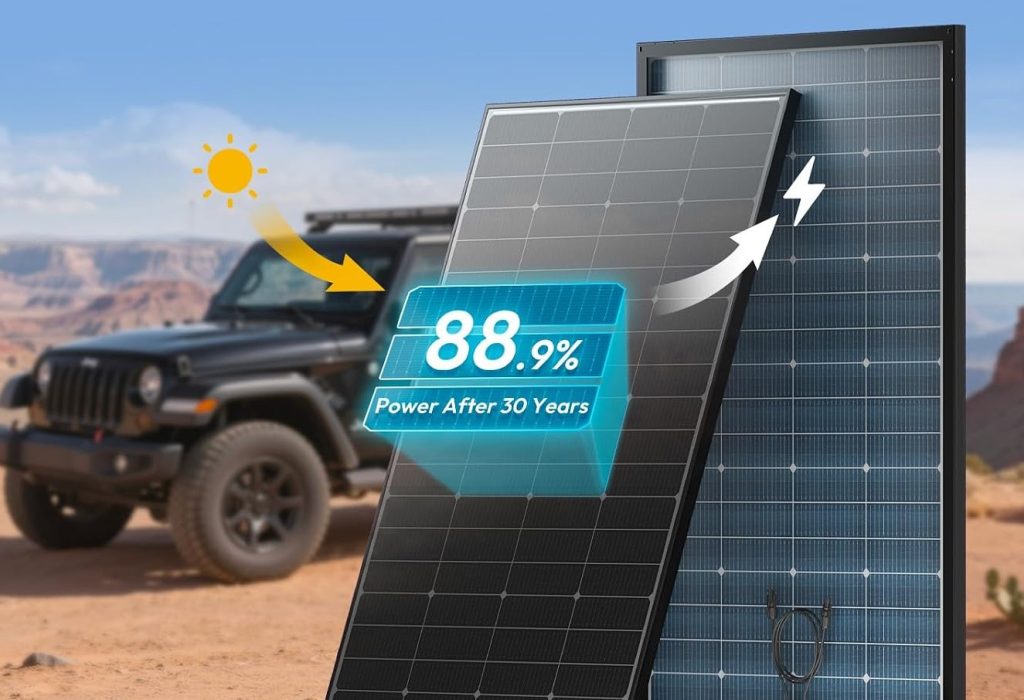
The single-panel workhorse: 4.5 over 521 ratings — and October’s top commission here ($16.79). One pool disclosure first: Amazon merges reviews across JJN’s bifacial family, so this listing’s pool also carries reports from the bigger 425W siblings — we apply the 200W numbers where reviewers state them. And those numbers are the brand’s whole story: four panels measured at 880 watts — 220 per panel, above the 200W rating; two panels on an RV roof averaging 500-700 watts through September without tilting; and even the flat-mounted, no-angle reality check of 87 watts per 100W-class panel. Bifacial glass both sides, MC4 connectors, and the honest floors quoted below: no mounting hardware in the box, sharp unfinished edges that want gloves, and a temperature coefficient one careful tester found rosier on the label than in his measurements.
- 220W measured per panel — 880W from four — above rating, documented
- bifacial glass, MC4 connectors — the rear face earns the morning/evening boost
- family-merged review pool — 425W sibling reports aboard — 200W numbers used where stated
- no hardware, sharp edges — the honest handling notes, quoted below

JJN 400W 2-Piece Bifacial Kit
The kit tier: 4.5 over 782 ratings with a $10 coupon — the deepest pool in the brand. The measurements that built it: a clamp-meter test showing 23.2V and 8.53A — 197.6W, 99% of rated output — confirmed three times over an hour at 192-198W, from a solar veteran whose two 100W panels never broke 150W combined; and a Phoenix retiree whose wheel-mounted, six-times-a-day sun-tracking rig peaked at 220W (110%) while overcast days still delivered 90-100 watts. The systems the pool builds: four panels in 2P2S feeding a 24V shop that ran full AC, compressor and power tools through a 5,000-home outage; six panels on a Class-C motorhome feeding an EcoFlow Delta Pro through stormy Idaho spring. The honest flag: these are 24V-class panels — check your controller before assuming 12V.
- 99-110% of rating, metered — the clamp-meter and tracking-rig tests
- 2P2S shop-through-outage case — AC, compressor and tools on 4 panels, documented
- motorhome + Delta Pro rig — 6 panels, a couple hours of sun per day
- 24V-class, know your system — the four-star’s 12V-only mistake, quoted

JJN 850W Bifacial Pair (2×425W)
The big-array tier: 4.6 over 55 ratings — and our honest disclosure: this one converted through our links but earned $0 commission this month; we rank it on evidence, not payout. The evidence is big-array specific: a pair rated 850W metering 867W in Tampa facing south; a Florida RV roof reading 435W flat, no angle, midday; one pair in series peaking past 800W on sunny days and still 75-100W under heavy cloud; a series-wired pair hitting 936W peak — with the owner’s caveats that full-size panels this heavy want a second set of hands. The ground-mount pro’s note: a definite boost in early morning and late sunset production versus his older monofacial arrays — the bifacial dividend, named.
- 867W metered from an 850W pair — Tampa, south-facing — 102% of rating
- morning/evening bifacial boost — the ground-mount pro’s named dividend
- 75-100W under heavy cloud — the overcast floor that keeps batteries alive
- heavy, wants two installers — the 936W owner’s handling caveat, quoted
Which JJN, which array
Three array scales, one metered habit. Size the battery you’re feeding, then buy the panels it wants.
The single-panel starter — 200W ($139.99)
CPAP backups, truck batteries, one-panel van rigs: October’s $16.79. Gloves for the edges, bolts are yours.
The two-and-four-panel systems — 400W kit ($239.99)
The deepest pool: 99-110% metered, 2P2S shops, motorhome rigs, $10 coupon. 24V-class — match the controller.
The off-grid array — 850W pair ($559.99)
Ground mounts and big power stations: 867W metered in Tampa, morning-and-evening bifacial dividend. Our $0-commission disclosure applies.
Side by side
Prices, ratings and rating counts from the brand’s affiliate feed at time of writing.
| 200W Single | 400W Kit (2×200) | 850W Pair (2×425) | |
|---|---|---|---|
| Price | $139.99 | $239.99 ($10 coupon) | $559.99 |
| Rating history | 4.5 · 521 | 4.5 · 782 | 4.6 · 55 |
| Metered output (documented) | 87-220W per panel | 192-198W per panel | 867-936W per pair |
| Best fit | Starter, battery rescue | RV, small shop, Delta-class | Ground mount, off-grid |
| Mounting hardware | Not included | Not included | Not included |
| October conversions | $16.79 | — | $0 commission |
Not the right pick if… you expect mounting hardware in the box. Every tier of this line ships panels and connectors, not brackets: the RV installer’s four-star exists specifically for that gap, and the motorhome builder had to source z-brackets and unistrut himself. Budget the rails, bolts and sealant before the panels arrive.
Not the right pick if… you’ll handle bare glass edges without gloves. The Renogy-comparing one-star is blunt: the edges are sharp and unfinished, they will almost absolutely cut you while handling — Renogy ships plastic corner protectors, JJN doesn’t. A glove drawer fixes it; knowing first prevents the trip to the sink.
Not the right pick if… your system is 12V-only and you didn’t read the spec sheet. The documented mistake: a buyer discovered his were 24V-class panels when he only uses 12V solar products. The workarounds are real — the series/parallel math the pool publishes (2×200W in series stays under a 60V cap) — but the homework is yours: check Voc against your controller before checkout, not after.
Not the right pick if… you assumed the label’s temperature coefficient. The one-star’s careful finding: measured heat performance came in poorer than the printed coefficient indicated. Phoenix and Florida reviewers still meter above rating in real sun, so the panels win anyway — but in extreme heat, expect the label’s math to flatter the output, and size the array with margin.
What verified buyers say
Six verified Amazon reviews, paraphrased and attributed — the clamp-meter tester, the retired sun-tracker, the outage-tested shop builder, the hardware realist, the Renogy-comparing one-star quoted straight, and the connector surgeon.
The meter review. First sunny test with a single 200W panel through an MPPT controller: clamp meter showed 23.2V and 8.53A — 197.6W, 99% of rated output. She knows it’s not realistic to expect full rating unless conditions are perfect — this came very close. Tested three times over an hour, consistently 192-198W. Not a fluke. Years of portable solar behind her, two 100W panels in parallel rarely over 150W combined; this one panel saves space and actually delivers.
The tracking review. Very happy with this JJN bifacial 200W: most panels are lucky to produce 70-80% of rating — this one has produced as high as 220 watts, 110%, and just under 15 amps when everything is just right; 195 watts consistently in full sun. His rig is on wheels with adjustable inclination, following the sun about six times a day (he is retired). Phoenix bonus: on several overcast days right after arrival, still 90-100 watts and just under 7 amps.
The systems review, with an update after a season. These panels deliver full wattage to storage and loads: in series/parallel for a 24V controller and inverter. Summer 2024, a power outage affecting 5,000 homes in the area — and the shop ran as if nothing happened. Full-on AC, compressor, lights, power tools, chargers; the panels pushed 15A at 24V with no problems. Panels staggered in purchase age, all performing the same. Four of these are enough.
The hardware four-star. The panels work extremely well: an average of 550-625 watts in September without tilting, and after a month on the RV, regularly 500-700 watts. Would be five stars if they came with mounting hardware — they do not, so ensure you have some before mount day. The update most buyers need spelled out: performance is not the gap; the bolts and brackets are your shopping list.
The comparison floor, quoted straight. Bought on Prime Day against Renogy 100W panels he already owns, spec labels nearly identical. Three findings: the edges are sharp and unfinished — they will almost absolutely cut you while handling, where Renogy ships plastic corner protectors (gloves fix it); the temperature performance is poorer than the label’s temperature coefficient would indicate; and his measured field behavior lagged the printed math in the heat. He wished he’d bought more Renogy instead. The floor that keeps the watts honest.
The honest big-array four-star. These work as well as the 400W panels he’s ordered before — as much as 890W in prime conditions. Two build notes from his install: he had to trim extra plastic off the connectors to unlock them, and one connector wouldn’t lock properly and got replaced. A good company to get your panels from at a fair price — the review that tells you to bring a utility knife and a spare MC4 to install day.
Three arrays these were made for
The outage-proof shop
2P2S into a 24V inverter: 5,000 homes dark, the compressor and AC still running. The four-panel system that earned its keep in one afternoon.
The motorhome roof
Six panels on z-brackets and unistrut, a couple hours of Idaho sun per day feeding a Delta Pro — full RV power through a stormy spring.
The van and the CPAP backup
One 200W panel revives a dead truck battery and keeps a CPAP power station topped off — the single-panel tier’s daily rescue work.
FAQ
Do JJN panels really produce their rated watts?
Better than most — that’s the brand’s identity. The metered evidence: a clamp-meter test at 197.6W from a 200W panel (99% of rating), confirmed three times in an hour; a tracking rig peaking at 220W (110%); a pair of 425Ws metering 867W in Tampa; a series pair peaking at 936W. The reviewer’s context matters: most panels are lucky to produce 70-80% of rating, and her previous two 100W panels never broke 150W combined. Against that baseline, JJN’s output is the exception the pool keeps measuring.
What's the point of bifacial glass?
Rear-face harvest, and the pool names its dividend precisely: a ground-mount pro sees a definite boost in early morning and late sunset production versus older monofacial arrays — low-angle light and albedo that front-only panels waste. The amplifiers the pool uses: white tarps or light ground under the array, and reflected light off concrete near the mounting spot. One RV owner notes flat roof mounting cuts the rear face’s contribution — tilt when you can.
What do I need besides the panels?
Your full mounting and wiring kit: brackets, rails or unistrut, bolts, sealant, and an MPPT controller the panel’s voltage fits. Documented add-ons from the pool: gloves, because the edges are sharp and unfinished; possibly a utility knife and a spare MC4 connector — one big-array buyer had to trim excess plastic off connectors and replace one that wouldn’t lock. Nothing in the boxes beyond panels, cables and MC4s.
12V or 24V — which system do these fit?
They’re 24V-class panels; the fit depends on your wiring and controller headroom. The pool’s worked examples: 2×200W in series gives a Voc the math-minded buyer keeps under his power station’s 60V input cap; 4×200W in 2P2S feeds a 24V controller and inverter cleanly; one 12V-only buyer bought by mistake and flagged it for the next person. The rule: read the Voc on the label, check your controller’s input limit, then choose series or parallel.
How do they hold up in heat and clouds?
Clouds: the overcast floor is documented and livable — 90-100W from a 200W panel on gray Phoenix days, and 75-100W from an 850W pair under full heavy cloud, enough to keep batteries from sleeping. Heat: one careful tester found real-world temperature performance poorer than the label’s coefficient suggests, while Florida and Phoenix reviewers still metered above rating in actual sun. Size with heat margin and you’ll be happy in both.
How was this page put together?
We are an independent review site. Specs and prices come from the brand’s official affiliate feed at the time of writing; ratings are the public Amazon rating history of each parent listing. Review summaries are paraphrased from verified Amazon customer reviews of the three products above, one-star and four-star included — every quotation is attributed to the reviewer name shown and the month it was posted. Two disclosures: the 850W pair converted through our links in October but earned $0 commission that month, and Amazon merges reviews across the bifacial family, so the 200W listing’s pool carries some 425W-sibling reports. If you buy through our links we may earn a commission; it does not change which reviews we quote or what they say.