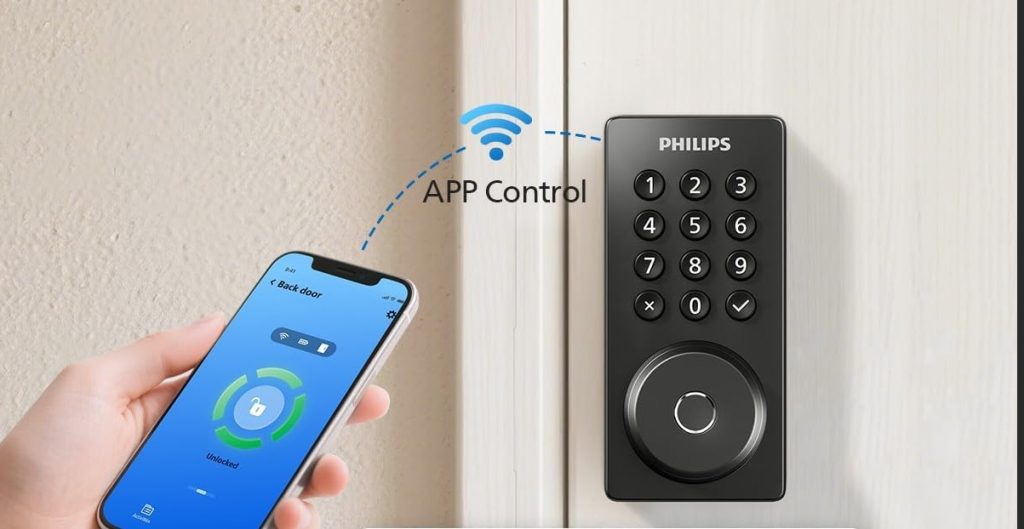

Quick answer: Philips’ smart-lock line is one platform cut three ways, and the real question is what the door needs to do when you’re not standing at it. The Wi-Fi deadbolt ($109.99, 1,248 ratings) is October’s converter — app control from anywhere, Alexa and Google, per-user code history — with the pool’s documented battery tax (8 AAs drained in weeks on Wi-Fi; Bluetooth mode fixes it) and an Android app a decade behind the hardware. The fingerprint tier ($69.99, 862 ratings) is deliberately dumb: no cloud, no hackable surface, works in power outages — the 2.5-year outdoor benchmark with a free replacement at the end. The deadbolt-plus-handle set ($115.99, 928 ratings) is the whole entry in one code system, scaled by the pool from single doors to five-lock churches. The constant across all three: support humans who replace things, fast. Buy the entry point you’ll actually use — not the sensor count.
The three-product lineup
38 listings in the US feed — the Home Access line: deadbolts, handle sets, lever sets, with and without fingerprint, with and without Wi-Fi, plus gateway hardware. These three are October’s conversion set and the three feature cuts every other listing sits between. (Honest scoping: the brand’s top October converter in our affiliate data was not in the feed — this page covers the convertible set.)
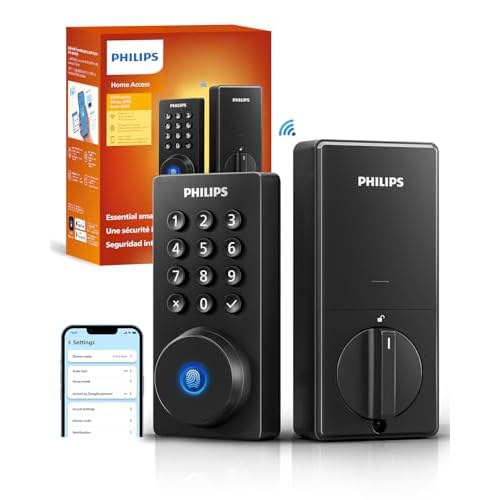
Philips Wi-Fi Smart Deadbolt
October’s converter and the catalog’s center of gravity: 4.3 over 1,248 ratings. Built-in Wi-Fi means no hub, no bridge — the app locks, unlocks, and reports status from anywhere, Alexa and Google pair natively, and per-user codes (permanent, scheduled, one-time) show a history of who came and went. The pool’s install stories are 15-to-20-minute screwdriver jobs — a 69-year-old and a 50-year-old each did it solo, replacing Yale and Schlage units. The honest costs the pool documents: eight AA batteries that devour quickly when Wi-Fi is connected (one owner burned a fresh set in 2-3 weeks, then disconnected Wi-Fi and watched the app still report 100% three weeks later via Bluetooth); an Android app that demands full login every open — no fingerprint login, on a fingerprint lock; and sun-heated installations where the keypad and fingerprint reader quit until the door cools.
- built-in Wi-Fi, no bridge — app control from anywhere; Alexa and Google native
- per-user code history — permanent, scheduled and one-time codes with who/when records
- 15-20 minute installs — documented by a 69-year-old replacing a Yale, solo
- the Wi-Fi battery tax — 8 AAs drain in weeks connected; Bluetooth mode fixes it at a cost

Philips Fingerprint Keyless Entry Door Lock
The budget tier, 4.3 over 862 ratings, and the pool’s gateway drug: fingerprint and PIN unlock with a physical touchscreen, plus the key backup — and deliberately NO Wi-Fi, NO app, NO Alexa. That absence is the tier’s honest selling point, stated by its own owners: it works during power outages and it can’t be hacked into — not a cloud device. The one-time guest passcode is generatable via a companion app without the lock itself being connected (a nuance one three-star learned the hard way: YOU CANNOT LOCK OR UNLOCK WITH THE APP on this model). Durability runs long — one owner got 2.5 years of all-weather front-door duty before the unit died, and Philips support walked him into a replacement — and the fingerprint reader kept its response speed the whole run. Watch items: the 2.5-year mortality itself, and one owner’s finish flaking off the face.
- fingerprint + PIN + key — three ways in, no cloud dependency at all
- works in power outages — the pool’s stated reason for choosing offline on purpose
- 2.5-year outdoor benchmark — fingerprint response never declined; support replaced the death
- app only generates one-time codes — no remote lock/unlock on this tier — read before buying
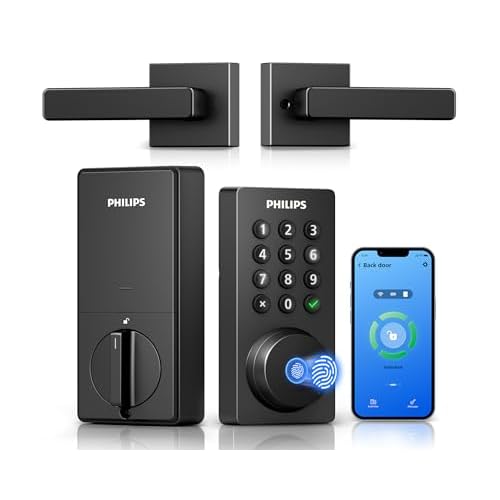
Philips WiFi Keypad Deadbolt with Handle
The complete-set tier, 4.4 over 928 ratings — the highest-rated of the three: the deadbolt plus a matching exterior handle, which solves the pool’s latch problem outright (no second keyed lock to carry a key for — one owner bought it exactly for that). Same built-in Wi-Fi and app, same code system, plus the fingerprint option and an 8-lock whole-house deployment documented by one owner — and a five-lock church install by another, where the app’s admin codes manage volunteer access. Battery placement inside, no unscrewing to change — a design detail the pool calls out unprompted. The honest notes: it’s a little plasticy inside for the price (two four-stars say so while loving it anyway), the fingerprint function died inside a week for one owner, and the condensation short-circuit case below is documented on this Wi-Fi tier specifically.
- deadbolt + matching handle — one code system for the whole entry — no second keyed lock
- 8-lock house and 5-lock church installs — the pool’s scale proof, app-managed codes
- batteries swap without unscrewing — interior compartment — the detail owners volunteer
- plasticy interior for the price — two honest four-stars; one fingerprint died in a week
Which lock, for which door
One platform, three feature cuts. The question is what the door needs to do when you’re not standing at it — and what the weather does to it while you’re away.
Remote control — Wi-Fi deadbolt ($109.99)
The anywhere tier: app lock/unlock, code history, Alexa and Google. Budget rechargeable AAs or the Bluetooth-only mode when the battery tax bites.
Simple and unhackable — fingerprint tier ($69.99)
No cloud, no app dependency, works in power outages. Fingerprint, PIN, key — and the 2.5-year outdoor benchmark with a free replacement at the end.
The whole entry — deadbolt + handle ($115.99)
One code system for both locks, no second key. Front doors, rental turnover, the 5-lock church: the complete-set tier scaled by the pool’s champions.
Side by side
Prices, ratings and rating counts from the brand’s affiliate feed at time of writing.
| Wi-Fi Smart Deadbolt | Fingerprint Lock | Keypad + Handle Set | |
|---|---|---|---|
| Price | $109.99 | $69.99 | $115.99 |
| Rating history | 4.3 · 1,248 | 4.3 · 862 | 4.4 · 928 |
| Wi-Fi / app control | Built-in, no bridge | None (one-time codes via app) | Built-in, no bridge |
| Voice assistants | Alexa + Google | No | Alexa + Google |
| Entry methods | Fingerprint, PIN, key | Fingerprint, PIN, key | Fingerprint, PIN, key |
| Batteries | 8 AA (drains on Wi-Fi) | 4 AA, offline duty | 8 AA, swap without unscrewing |
| October conversions | $11.99 | — | — |
Not the right pick if… your door bakes in the sun. Two documented heat failures: the keypad and fingerprint reader on a sun-exposed door WILL NOT WORK until it cools — kids locked out three days in a row by 3 PM — and the condensation short-circuit when a hot humid outside meets an air-conditioned interior across an ungasketed house-side board. Philips support resolved both cases (replacements, refunds), but the door kept being the problem. A storm door, an awning, or a shaded exposure is the real fix — on any smart lock, not just this one.
Not the right pick if… you want the app experience to match the hardware. The Android app is the pool’s most consistent complaint: you have to completely login each time you want to use it — no fingerprint or face ID, on a fingerprint lock, which pushes owners toward weak passwords for fast access; the login screen randomly crops to a quarter size; the Wi-Fi setup only accepts passwords of 8-12 characters (no symbols per one owner), which is its own security irony; and a Google-Home voice-code save checkbox that doesn’t remember. The lock is excellent; the app is a decade behind the bolt.
Not the right pick if… you assumed the $69.99 tier was smart. It is deliberately not — the three-star owner’s caps-lock lesson: YOU CANNOT LOCK OR UNLOCK WITH THE APP, and this particular model IS NOT COMPATIBLE WITH ALEXA OR GOOGLE. The app’s only role is generating one-time guest codes. That offline-ness is a feature to its owners (power-outage proof, unhackable, no cloud) and a dealbreaker to anyone who bought it without reading. Remote control is the $109.99 tier’s job.
Not the right pick if… battery economics will annoy you. Eight AAs that devour quickly when Wi-Fi stays connected — one owner burned a set in 2-3 weeks before disconnecting, and the fix (Bluetooth mode) costs you remote control. The pool’s practical consensus: rechargeable AAs from day one. The offline tier’s four batteries run months. If the idea of feeding a lock batteries at all offends you, a hardwired wired-security system is a different product class entirely.
Not the right pick if… you need Airbnb-grade code reliability. The pool’s rental case: a guest PIN generated to stay active until 1 PM stopped working earlier — a one-off in this pool, but a category of complaint smart locks live or die by, and Philips’ app-stability record here doesn’t yet earn that trust. The church and volunteer-code deployments in the pool run on permanent and scheduled codes, which are the stable path; short-window guest codes on the Wi-Fi tier are where the pool’s uncertainty sits.
What verified buyers say
Six verified Amazon reviews, paraphrased and attributed — the 20-minute install at 50, the Ultraloq refugee, the Wi-Fi battery drain and its fix, the 2.5-year outdoor benchmark, the five-lock church, and the condensation short-circuit.
The Wi-Fi tier’s install benchmark. A 50-year-old with some decent DIY skills — all you need is a screwdriver, took maybe twenty minutes to take the old lock off and put this one on. The app is easy, the lock functions smoothly, auto-lock is configurable from 15 seconds to two minutes — with a caveat she flags for pet and kid households: it extends the timer if the door stays open for a long period. Codes are easy to program and reviewable in the app in case you forget them, per-user for specific people. Her closing is the pool’s whole value case in one line: set-and-forget smart deadbolt for the price of a locksmith visit.
The switcher’s comparison. He replaced a Utec/Ultraloq that crapped out after less than one year — the Phillips unit is far superior, as it has a decent phone app and can also work with our Alexa. The built-in Wi-Fi means they scrapped the bridge the Ultraloq required. Smooth operation, a great record of who locked/unlocked the door via the keypad, and codes assignable per family member — on a one-time basis, for a given period of time, all from the phone regardless of location. The upgrade he wanted to be permanent: being able to secure your home is a critical function, and he says don’t take a chance — this one so far hasn’t given him one.
The tier’s most useful three-star. Bought it, installed easily, works and functions great — then burned through a fresh set of batteries in 2-3 weeks and nearly returned it. Her hunch: the WiFi connection and the app requesting details from the lock too much was draining the battery. She removed the Wi-Fi connection and turned off all lock noises — it’s been 3 weeks now and the app is still reporting 100% battery life (via Bluetooth, near the lock). The trade is stated exactly: you lose remote locking, and keep everything else. Other owners land the same place: buy rechargeable AAs, or run it offline. Eight batteries is eight batteries.
The offline tier’s durability benchmark. Installed on the front door, exposed to all types of weather and daily use, it had a good run — 2.5 years before it stopped working. What the review is really about: the fingerprint feature worked exceptionally well with no decline in response time over the whole run, and once you get used to it it’s difficult to go back to the old key. When it died, the Philips brand — with support reps Giselle and Aaron — were amazing in helping him with another door lock, which gives me confidence to know and use Philips knowing they stand behind their product. His pro tip: rechargeable batteries.
The complete-set tier at scale. He became an absolute champion for this lock: one at his own house, a second at his girlfriend’s — and then their pastor ordered five sets to overhaul the entire security setup at the church. The built-in Wi-Fi is flawless and eliminates the need for annoying external hubs or bridges. For residential use, unmatched daily convenience; for the church, a total game-changer for access control — the Philips Home Access app lets administrative staff manage who has which code when, across every door, from one place. The pool’s pattern in one review: one good lock becomes a house becomes an institution.
The Wi-Fi tier’s hard failure case, and the one to read if your door faces sun-and-AC contrast. Their unit short-circuited from moisture — and the replacement arrived along with a full refund and an offer of another unit, which is this brand’s support showing off. The diagnosis they documented: the house-side of the lock has no gasket, unlike the outside faceplate, so a hot humid outside against an air-conditioned inside creates condensation on the interior board. When one of those factors spikes, the lock shorts. The pool’s other three-stars cluster around the same water-and-weather theme: a sun-heated door where the keypad and fingerprint reader WILL NOT WORK until it cools, kids locked out three days running. Exposed-door installs need shade.
Three doors these were made for
The rental and the guest house
Wi-Fi deadbolt, per-guest codes with start and end times, the history log showing who came and went while you were away. The cat-sitter gets a one-time code; the cleaner gets Mondays. October’s $11.99 commission came through exactly this door.
The shaded family front door
Keypad-plus-handle set: kids with fingerprints instead of house keys, parents checking the lock from bed, the handle ending the second-key problem. The pool’s family installs run 8 batteries on rechargeables and swap them without unscrewing anything.
The church and the volunteer building
Five locks, one app, admin-managed codes for every volunteer — the pool’s scale story. The same architecture runs a single garage-entry door or a whole small business: the app is the key cabinet now.
FAQ
Do Philips smart locks need a bridge or hub?
No — the Wi-Fi tiers (the $109.99 deadbolt and the $115.99 handle set) have Wi-Fi built in, which is the pool’s switcher story: an Ultraloq refugee specifically values scrapping the bridge his old lock required. Alexa and Google Home pair natively. The $69.99 fingerprint tier is the deliberate exception — no Wi-Fi, no hub, no voice assistants at all, with the app only used to generate one-time guest codes. Choose by whether the door needs to be remote-controllable, not by hub phobia; both paths exist in the catalog.
How is the battery life, really?
The honest split: the Wi-Fi tiers run 8 AA batteries, and when Wi-Fi stays connected the pool documents sets dying in 2-3 weeks — one owner’s near-return turned into the fix: disconnect Wi-Fi, keep Bluetooth, and the app still reported 100% three weeks later. Sound and notification settings off help too. The offline fingerprint tier runs 4 AAs for months. The pool’s practical consensus is rechargeables from day one, and the handle set’s battery compartment swaps without unscrewing anything. Budget batteries into the ownership cost before comparing against a wired system.
What happens when a Philips lock fails?
The pool’s failure record is unusually well-documented because support replacements follow almost every one: the 2.5-year all-weather front-door death replaced free; the condensation short-circuit refunded AND replaced with an extra offer; the flaking faceplate replaced; the broken battery-terminal spring walked through by a human named Sergio; the missing part diagnosed and shipped by Kiara. The support names recur — Giselle, Aaron, IsaBella, George, Kiara, Sergio — which is itself the pattern: this brand staffs its lock line’s support desk with humans who fix things.
Are these locks good for kids and fingerprint families?
Mostly yes, with two documented exceptions. The wins: fingerprints that register reliably even for owners whose prints never register on anything (one five-star’s phrase), kids unlocking with a finger instead of carrying a key, and per-person code history for teenagers coming home alone. The exceptions: a sun-heated door where the fingerprint and keypad refuse to work until cooled — kids locked out three days running — and one owner whose fingerprint function died inside a week. Shade the door, test the reader in the first week, and the family case is the pool’s strongest.
How does installation actually go?
Faster than the reputation of smart locks: 15-20 minutes with a screwdriver, done solo by a 69-year-old replacing a Yale and a 50-year-old replacing a Schlage — both documented. Replacing an existing deadbolt means no drilling; the offline tier’s optional extra-secure drill adds about an hour. The honest install notes from the pool: the three interior screws run short (one owner left the bottom one a quarter turn loose to keep the deadbolt smooth — against the manual’s advice, mind), the exterior-to-interior cable connector is tight, and solo installers improvise a C-clamp to hold the outside half. Two people make it trivial.
How was this page put together?
We are an independent review site. Specs, prices and coupon states come from the brand’s official affiliate feed at the time of writing; ratings are the public Amazon rating history of each parent product. Review summaries are paraphrased from verified Amazon customer reviews of the three products above, one-star and three-star included — every quotation is attributed to the reviewer name shown and the month it was posted. If you buy through our links we may earn a commission; it does not change which reviews we quote or what they say.