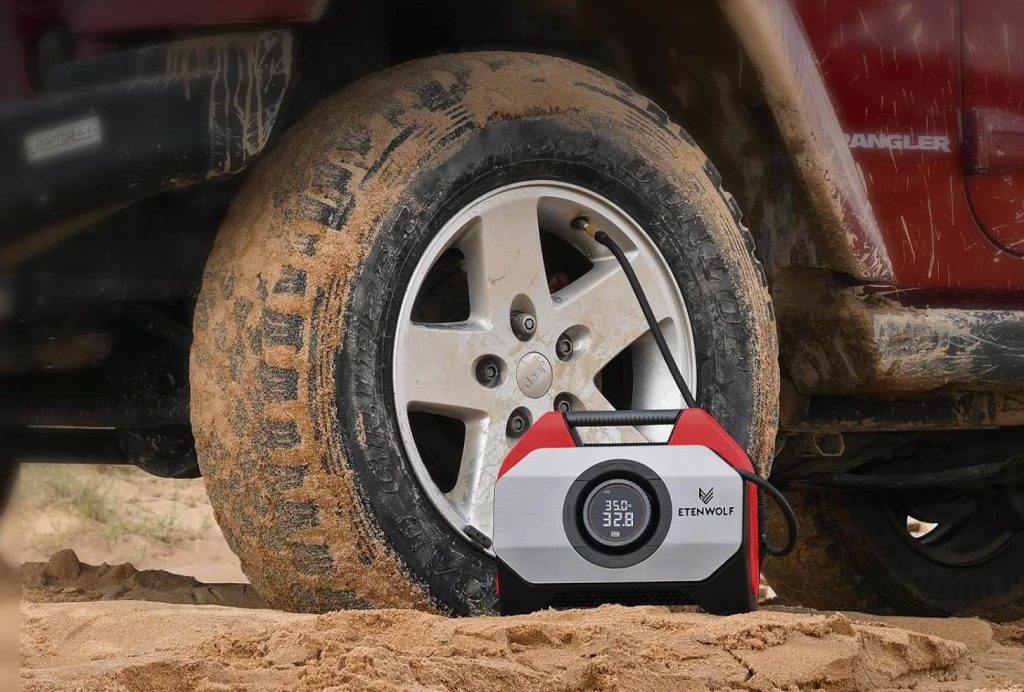

Quick answer: every product in this lineup is sold on a number, and every complaint is about a fitting. The VORTEX S6 ($129.99) is the real tyre inflator — 1.5 CFM, 100% duty cycle, 18 tyres per charge — and the most useful review of it is a buyer who discovered the hose’s knurled sleeve screws straight onto the valve stem, so you can skip the adapters entirely. The AIR 3 ($21.83) moves 13 CFM of air for mattresses and floats, and one owner found that none of its five nozzles fits an Exped properly. The T300 gauge ($7.99) is hand-calibrated to ±1 PSI and has 9,921 ratings — but the Presta adapter is not in the box and there is no button to bleed a tyre down.
The three-product lineup
Ten of the 31 products in this feed are vacuum storage bags — more than the inflators and gauges put together. The air tools are the second line, and they are the one with the review history.
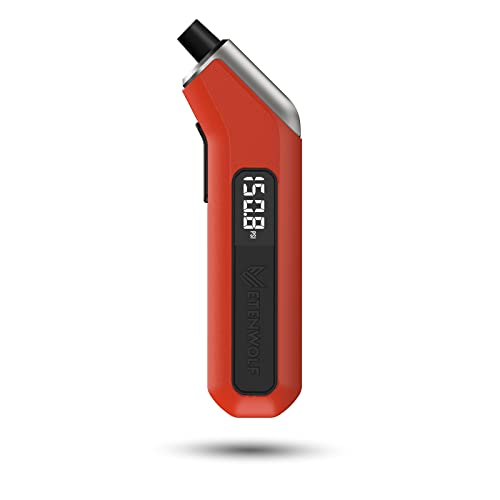
ETENWOLF T300 tire gauge
At $7.99 this is the cheapest thing on the page and the one with the deepest history: 9,921 ratings at 4.6. Each unit is hand-calibrated to ANSI B40.7 Grade 2A, which is ±1 PSI, and the spec covers 3 to 200 PSI with thermal compensation from -4 to 130°F. It runs on two AAA batteries you can buy anywhere, has an LED at the tip for finding the valve stem at night, and the listing claims you can drive a car over it without damage. Two documented gaps, both at the valve: the Presta adapter for bicycles is not included, and there is no button to release pressure, so if you overshoot you need something else to press the valve core.
- calibrated to ±1 PSI, Grade 2A — hand-calibrated per unit to ANSI B40.7 — a stated standard, not a rounded claim
- 3 to 200 PSI, -4 to 130°F — covers bikes, cars, RVs and trucks, with thermal compensation built in
- two AAA batteries — replaceable anywhere; the model that needs a jeweller’s screwdriver is the one people throw away
- no pressure-release button — overshoot and you need a key or a fingernail on the valve core

ETENWOLF AIR 3 inflator
The one people buy for mattresses and pool floats, and the specification that matters is airflow rather than pressure: 13 CFM, or 360 litres a minute, against the 1.5 CFM of a tyre inflator. That is why it fills an air mattress in about a minute and can pull the air back out in four. The 2600mAh battery is rated for sixteen sleeping pads or four 58-inch inflatable pools on a charge, and the body is small enough to hang off a backpack. It also does 600 lumens of camping light in three steps. Five nozzles are in the box — and the reviews are unanimous that five nozzles still do not guarantee the one you need.
- 13 CFM / 360 L per minute — airflow, not pressure — this is the number that fills a mattress fast
- 2600mAh, 16 pads per charge — or four 58-inch pools; also charges from any USB-C charger
- 600-lumen light, three modes — 60 / 200 / 600 lumens, so it doubles as a tent light
- cannot power on while charging — unplug before turning it on — stated in the listing, missed by many

ETENWOLF VORTEX S6 tire inflator
The serious one, and the only product here with a duty-cycle claim worth reading: 100% duty cycle, meaning all four F150 tyres from 0 to 35 PSI without a break, on a dual-cylinder pump with a dedicated cooling system. The numbers hold together — 1.5 CFM at 0 PSI, a 31-inch tyre from 30 to 35 PSI in one minute, ±1 PSI gauge accuracy, 160 PSI maximum, and a 19,200mAh battery rated for eighteen F150 tyres topped from 30 to 35. Seven presets, auto-stop with pressure memory, a 1,000-lumen light and 45W USB-C in both directions. Not for paddleboards, which the listing says outright.
- 100% duty cycle — dual cylinder plus dedicated cooling — the spec that separates it from a $40 pump
- 1.5 CFM, 18 tyres per charge — 31-inch tyre in one minute; 19,200mAh of battery behind it
- ±1 PSI gauge, 160 PSI max — auto-stop with seven presets and pressure memory
- not for SUPs — the listing excludes paddleboards — buy the AIR 3 for those instead
Three tools, three different jobs
Worth saying plainly: ten of the 31 products in this brand’s US feed are vacuum storage bags, which is more than the inflators and gauges combined. The air tools are the second line — and they are the second line with the review history, which is why they are here.
You just want to know the pressure — T300 ($7.99)
9,921 ratings at 4.6, hand-calibrated to ±1 PSI under ANSI B40.7 Grade 2A, 3 to 200 PSI, works from -4 to 130°F on two AAA batteries. Buy it with the Presta adapter if you ride a bike, and accept that there is no release button for bleeding down.
You are inflating things, not tyres — AIR 3 ($21.83)
13 CFM of airflow instead of pressure, 2600mAh, sixteen sleeping pads or four pools per charge, a 600-lumen camp light, five nozzles. It will not power on while it is charging, and the reviews are clear that five nozzles still does not mean yours is in the box.
You are inflating tyres, repeatedly — VORTEX S6 ($129.99)
100% duty cycle on a dual-cylinder pump, 1.5 CFM, 18 F150 tyres per charge, ±1 PSI gauge, 160 PSI max, 1,000-lumen light. This is the only one here that can do four tyres back to back. It is not for paddleboards, and the controls need light to operate.
Side by side
Prices, ratings and rating counts from the brand’s affiliate feed at time of writing.
| T300 gauge | AIR 3 | VORTEX S6 | |
|---|---|---|---|
| Price | $7.99 (was $14.99) | $21.83 (was $29.99) | $129.99 (was $159.99) |
| What it measures | Pressure, 3 to 200 PSI, ±1 PSI | Airflow, 13 CFM / 360 L/min | Airflow 1.5 CFM, gauge ±1 PSI |
| Power | 2 x AAA, replaceable | 2600mAh, USB-C | 19,200mAh, USB-C 45W bidirectional |
| Real-work rating | Works -4 to 130°F | 16 pads or 4 pools per charge | 18 tyres per charge; 100% duty cycle |
| Nozzles in box | Presta adapter not included | Five, none of which fit an Exped perfectly | Hose sleeve screws straight onto the valve |
| Documented weakness | No pressure-release button | Will not power on while charging | Controls unreadable in darkness; not for SUPs |
| Rating history | 4.6 · 9,921 | 4.4 · 6,890 | 4.6 · 3,155 |
Not the right pick if… you ride a bike with Presta valves and you are buying the T300. The adapter is not included — the listing says so, and the owner with two years on the gauge says so more bluntly. This matters because Presta is what road bikes and most mid-range mountain bikes use, so the one valve type a cyclist is most likely to meet is the one that needs a $6 part bought separately. Order the adapter with the gauge, or buy a gauge that ships both fittings. It is a small annoyance that becomes a real one the first time you are at the roadside with cold hands.
Not the right pick if… you want to bleed a tyre down after overshooting. There is no button on the T300 to depress the valve core, so the documented workaround is a key out of a pocket. If you are the kind of person who adds pressure then releases to target — and one reviewer describes exactly that habit — you will be doing it with your thumbnail. A separate bleed tool costs a few dollars and lives in the glovebox. The alternative is to add air in smaller increments and check between each one, which is what the auto-stop on the S6 exists to avoid.
Not the right pick if… your air mattress is an Exped. This is the most specific complaint in the entire review history and it is worth taking literally: none of the five nozzles fits Exped valves, the closest is slightly too small, and you have to hold it in place. On an Exped that turns a one-handed job into a two-handed one, which defeats the purpose of a pump you are supposed to be able to walk away from. The reviewer’s own fix was duct tape around the nozzle. If your gear is Exped, buy the pump Exped sells or accept the workaround.
Not the right pick if… you will operate the S6 in the dark. One owner’s use case is surf fishing — deflate to 14 PSI for the sand, reinflate to 29 to drive home — and his edit is not about the pump’s performance, which was fine, but about the controls: a four-quadrant wheel that you have to read to use, on a dark beach, with sand on your hands. The unit has a 1,000-lumen light but the interface itself is not illuminated in a way that solves this. Learn the wheel in daylight first, or carry a head torch.
Not the right pick if… you expect the S6 to inflate a paddleboard. The listing excludes SUPs outright, and the AIR 3 review history confirms the pattern from the other direction — one buyer wanted to use it on a paddleboard and found the attachment was not included. High-volume, low-pressure boards need a different class of pump again. If a SUP is on your list, this is a category error rather than a model choice, and neither of these two products solves it.
What verified buyers say
Six verified Amazon reviews, paraphrased and attributed — the owner who found the hose screws straight on, two years of a gauge with no bleed button, five nozzles that miss an Exped, four trailer tyres on one charge, a control wheel on a dark beach, and a repeat purchase that beats expensive dial gauges.
The single most useful review on this page, and it is a correction to the manual’s implied workflow. He found that the knurled sleeve on the unit’s own hose screws directly onto the valve stem. Not an adapter on the end of the hose — the hose itself. In his words it works on any car, it is very airtight, and there is no struggling to get an adapter seated. His recommendation is to do it that way and not use an adapter at all. Since the whole complaint pattern in this category is about which nozzle fits what, a reviewer discovering that the primary connection was there all along is exactly the information you want before you buy.
A long-term verdict rather than a first impression: accurate and durable after a couple of years in a workshop. Then the two gripes, both at the valve. First, he uses it on bike tyres and it does not work with Presta valves unless you use the adapter, which he does not consider included convenience — that is a bother. Second, when he adds extra pressure and wants to bleed down to target, there is nothing on the gauge to press the Schrader valve core with, so he digs a key out of his pocket. Neither stops him calling it a good gauge. But if you run Presta valves or you are the kind of person who overshoots and bleeds down, this is your friction.
He inflated an Exped Dura 8R mattress in about thirty seconds, was pleased that it is quieter than expected, and says deflating worked well though he would not spend battery on it. Then the specific failure: none of the nozzles really fit Expedition valves. The closest one is slightly too small, so you have to hold it in the hole. That works, and it is still faster than the inflation sack, but it is a two-handed job on a product whose whole point is that you can walk away. He wonders why the company does not make a nozzle for the most popular camping mattresses, and suggests duct tape. Five nozzles in the box, and the one everybody wants is missing.
The most useful battery number on this page because it is a real job with a real margin. Four trailer tyres, 30 PSI added to each, one charge — and he says he just made it. Eight minutes per tyre for 30 lbs. Auto shut-off worked perfectly. Noise tolerable. Recharge from empty took about three hours. His comparison is the part that matters if you have been using a corded pump that runs off the truck battery: this did four tyres without the engine running. Read the ‘just made it’ literally. The claimed eighteen F150 top-ups are 5 PSI each; adding 30 PSI to four trailer tyres is roughly the same total work, and he finished with nothing to spare.
A five-star edited down to four, which is the most honest kind of review. His use case is surf fishing: deflate to 14 PSI with Staun deflators, then inflate back to 29 PSI, about three minutes per tyre with a dial-in target. That half works exactly as advertised. The edit is about the interface: after the time change it is dark on the beach, and the inflator’s controls are a four-quadrant wheel where clockwise moves through Start, Pause and so on. In the dark, on sand, that is difficult to operate. He also found the included carrying bag failed and replaced it. The unit itself held up. If you will use this at night, bring a head torch and learn the wheel before you are standing in the surf.
A repeat purchase, which is the most reliable signal in any review system. He bought one T300 earlier and finds it more accurate and consistent than his more expensive dial-type gauges, so he bought a second and says it performs identically. The description of use is worth quoting because it explains the whole category: turn it on, select the scale, press it onto the valve. No zeroing between readings, no needle to interpret, no argument with yourself about whether that was 34 or 36. Two AAA batteries, a display you can read, and a light at the tip. That is what $8 buys here, and it is the reason this product has 9,921 ratings.
Three jobs these were bought for
The slow leak you keep meaning to fix
One tyre loses five PSI a week and the petrol station is out of the way. The documented win: an S6 takes a tyre from fully flat to 35 PSI in about two minutes, tops off the others in under a minute, and lives in the boot charged. One owner has been doing this weekly for three months. The documented catch: learn the four-quadrant control wheel before you need it in the rain.
The camping trip with four mattresses and a pool float
Thirteen CFM of airflow rather than pressure, a 2600mAh battery, and a 600-lumen light so it earns its place in the bag twice. The documented win: an Exped Dura 8R inflated in thirty seconds, sixteen sleeping pads or four pools per charge. The documented catch: hold the nozzle on, and unplug the charger before you press power.
The trailer, the boat ramp, the winter morning
Four tyres that all need 30 PSI added, no compressor, no engine running. The documented win: one charge did four trailer tyres at 30 PSI each with nothing to spare, auto shut-off held, and recharge took about three hours. The documented limit: that is the real boundary of the battery, and the manufacturer’s eighteen-tyre figure is based on 5 PSI top-ups rather than 30.
FAQ
Which nozzle fits what?
This is the question that decides every purchase in this category and the answers are scattered across three products. The S6 has a knurled sleeve on its own hose that screws directly onto a standard Schrader valve stem — one reviewer discovered this after a year and now recommends skipping the adapters entirely. The T300 needs a separate Presta adapter for bicycles, and it is not in the box. The AIR 3 ships five nozzles, and one owner found none of them fit an Exped mattress properly. Before you buy, name the valve on the thing you are inflating, then check that specific fitting is included.
What does 100% duty cycle actually mean?
That the pump is rated to run continuously without a rest. On the S6 the claim is specific — all four F150 tyres from 0 to 35 PSI back to back — and it is justified by a dual-cylinder design with a dedicated cooling system. That is the number that separates it from a $40 inflator, which typically needs a break every ten minutes to avoid cooking itself. The real-world check comes from an owner who added 30 PSI to four trailer tyres on one charge and says he just made it: the pump never needed a break, the battery did.
How many tyres will the S6 actually do on one charge?
Eighteen F150 tyres according to the listing, but read the basis: that figure is tyres topped up from 30 to 35 PSI, which is 5 PSI each. The most useful review is the owner who added 30 PSI to four trailer tyres and finished with nothing to spare — roughly the same total work as those eighteen top-ups, with no margin left. As a working estimate, plan on four to six full top-ups or one complete set of tyres from low pressure, and recharge for about three hours. If you are doing a fleet, buy two or accept a lunch break.
Is the AIR 3 or the S6 the right pump for a car?
The S6, and the distinction is airflow versus pressure. The AIR 3 moves 13 CFM at low pressure, which is what an air mattress needs; a tyre needs pressure, and the AIR 3 tops out at 0.65 PSI, which will not touch a car tyre. The S6 moves 1.5 CFM at up to 160 PSI. Put the other way round, the S6 is explicitly not for paddleboards, and the AIR 3 is not for tyres. They are not interchangeable and the price difference reflects that — $21.83 against $129.99.
Do these need an app or a phone?
No, and that is part of the appeal. The T300 is a screen, a button and a valve fitting. The AIR 3 is a power button and a mode button, with the documented quirk that it will not turn on while it is charging — you unplug it first. The S6 has seven presets and a pressure memory on a four-quadrant wheel, which is the one interface worth learning before you need it in the dark. No of these three requires a phone, an account or a firmware update, and given how many tools in this price range now do, that is a feature rather than an omission.
How was this page put together?
We are an independent review site. Specs, prices and coupon states come from the brand’s official affiliate feed at the time of writing; ratings are the public Amazon rating history of each parent product. Review summaries are paraphrased from verified Amazon customer reviews of the three products above, one-star and three-star included — every quotation is attributed to the reviewer name shown and the month it was posted. If you buy through our links we may earn a commission; it does not change which reviews we quote or what they say.