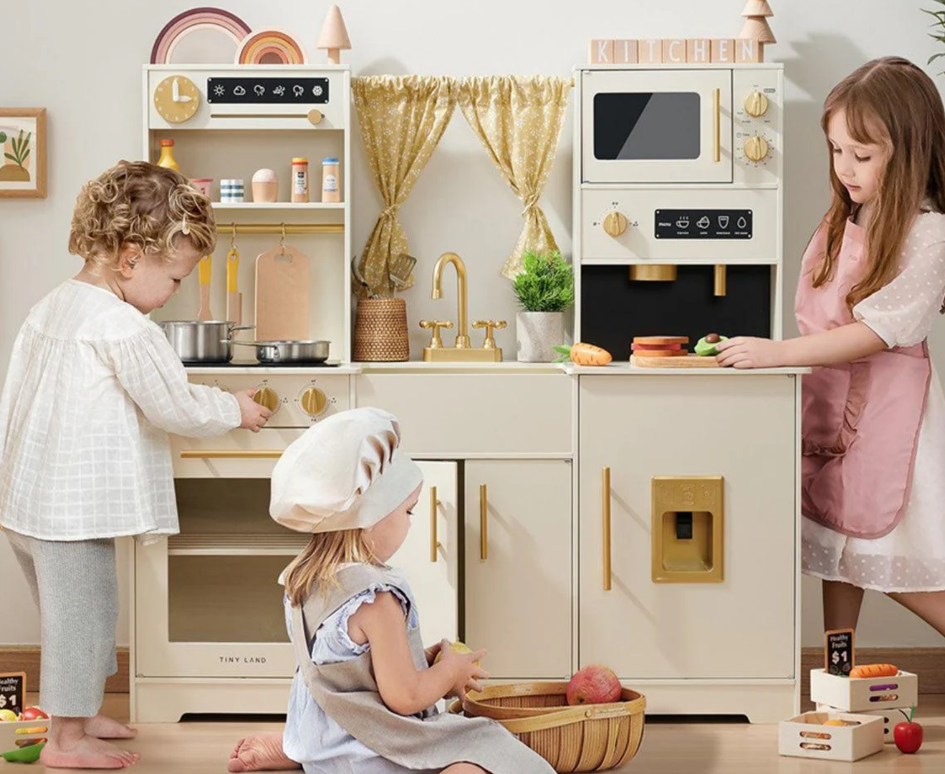

Let's be real for a second. If you've scrolled through Instagram or Pinterest lately, you've seen that playroom. You know the one: neutral tones, wooden toys everywhere, zero plastic neon garbage lying around, and a play kitchen that looks like it belongs in a French countryside cottage rather than a chaotic toddler zone.
I used to think those rooms were fake. I thought, "Sure, that looks nice, but my kid would destroy that in five minutes." Then, I became a parent to a very energetic two-year-old who treats furniture like a jungle gym, and suddenly, the quest for the "Perfect Play Kitchen" became my white whale.
Enter Tiny Land.
You've probably seen their ads. They promise Montessori-inspired, screen-free play with designs that actually complement your adult decor. But here's the million-dollar question: Is Tiny Land just another pretty face, or can it survive the chaos of real life?
I spent weeks digging through hundreds of real user reviews, analyzing complaints about broken doors, praising the customer service wins, and even chatting with parents in Reddit threads who have had these sets for years. I wanted to know the truth before I (or you) drop nearly $300 on a toy.
In this no-fluff review, we're going to break down everything: the assembly nightmare (or dream?), the durability of that MDF wood, the "clicky" knobs that kids love, and whether this brand is actually safe for your little ones. Grab your coffee (while it's still hot), and let's dive in.
Visit Tiny Land Official SiteThe "Saturday Morning Assembly" Reality Check
Let's start with the part nobody talks about until they are staring at a pile of screws and a confusing diagram: Assembly.
If you buy a Tiny Land play kitchen, do not plan on doing anything else that day. I'm serious. Based on dozens of reports from parents on Amazon and Trustpilot, you are looking at anywhere from 90 minutes to 3 hours of assembly time.
A Quick Story: My friend Sarah bought the Iconic Cream Kitchen for her daughter's third birthday. She thought, "I'm handy, I'll knock this out in an hour while the kid naps." Spoiler alert: The kid woke up early. Sarah was still on step 4, sweating, trying to figure out which side of the MDF panel faced out. The instructions? Mostly pictures. No words. If you aren't great at visual puzzles, this might test your marriage.
However, it's not all bad news. Many reviewers mentioned that once you get past the confusion of the first few steps, the rest flows logically. The pieces are heavy (a good sign of density), and when it's finally together, it feels substantial.
Pro Tip: Do NOT use a power drill unless you have a very delicate touch. Several users reported stripping the screws in the MDF because they tightened them too fast. A manual screwdriver and a lot of patience are your best friends here. Maybe bribe your partner with pizza to help hold the panels steady.
Design & Aesthetics: Why Parents Are Obsessed
Okay, let's talk about the good stuff. The reason you clicked on this article. The Look.
Tiny Land has absolutely nailed the aesthetic. In a market flooded with bright red, primary-colored plastic kitchens that clash with every piece of furniture you own, Tiny Land offers a breath of fresh air. Their signature "Iconic Cream" color with gold accents is stunning.
Reviewers consistently use words like "timeless," "elegant," and "furniture-grade." One mom on Judge.me wrote, "It blends perfectly into our home. It doesn't look like a toy; it looks like a real mini-kitchen."
But it's not just about paint. The features are genuinely cool for kids:
- The Ice Maker: There's a lever that dispenses little wooden "ice cubes" with a satisfying clatter. Kids go crazy for this. It's simple, but it sparks so much imaginative play.
- Clicky Knobs: The stove knobs actually turn and click. This tactile feedback is huge for toddler development and keeps them engaged longer than static plastic knobs.
- Running Water Faucet: Some models include a faucet detail that adds to the realism (though remember, it's pretend water!).
- Storage Galore: Despite looking sleek, these kitchens are packed with hidden storage. Cabinets, shelves, and hooks mean less clutter on the floor (theoretically).
If your main goal is to have a playroom that doesn't look like a toy store exploded, Tiny Land wins hands down. It's Instagram-ready right out of the box.
Visit Tiny Land Official SiteThe Durability Debate: Will It Survive Your Toddler?
Here is where we need to have a very honest conversation. This is the most critical part of this review.
Tiny Land products are primarily made from MDF (Medium Density Fiberboard) with a wood veneer finish. This is standard for this price point ($180-$300). It is not solid hardwood like the $800+ heirloom brands (looking at you, Pottery Barn Kids or Milton & Goose).
What does this mean for you?
MDF is dense and stable, but it is susceptible to chipping if hit hard, and it doesn't handle moisture well. More importantly, the hinges seem to be the weak point.
✅ The Good News
- Sturdy Frame: The overall structure is solid. It doesn't wobble easily once assembled.
- Great for Gentle Play: For a single child or calm siblings, it holds up beautifully for years.
- Safe Materials: Non-toxic, water-based paints and rounded edges meet US (ASTM) and EU safety standards.
- Anti-Tip Kits: Most sets come with wall anchors, which is a non-negotiable safety feature for tall units.
❌ The Bad News
- Door Fragility: Multiple reviews cite oven or fridge doors breaking off if a child leans on them or slams them repeatedly.
- MDF Chipping: If your kid uses metal toys to bang against the corners, the veneer can chip.
- Not for "Roughhousing": If your children treat furniture like a jungle gym (climbing on the sink, hanging off the door), this might not last.
- Alignment Issues: Some users reported doors not lining up perfectly due to pre-drilled hole errors.
The Verdict on Durability: If you have one gentle 3-year-old? This kitchen will likely last until they outgrow it at age 6 or 7. If you have three boys who wrestle in the living room and treat everything like a drum set? You might want to consider something heavier duty, or be prepared to do some glue-and-clamp repairs.
Customer Service: The Saving Grace
So, what happens if you fall into the "unlucky" category? What if your kitchen arrives with a cracked panel, or that infamous oven door snaps off after two months?
This is actually where Tiny Land shines brighter than almost any other competitor in this price range.
I read through hundreds of negative reviews, and the pattern was fascinating. Almost every single person who had a broken part or a missing piece reported that Tiny Land's customer service resolved it quickly.
One Trustpilot user mentioned, "Small damaged piece on the doll house... received a response immediately backing up their products." Another said, "Ivonne was extremely helpful. Customer service was a 10 out of 10."
Unlike big-box stores where you have to fight for a return or deal with automated bots, Tiny Land seems to have a human-centric approach. They frequently ship replacement parts for free. This significantly lowers the risk of buying. Yes, the product might have a flaw, but the company stands behind it.
Visit Tiny Land Official SiteIs It Truly "Montessori-Inspired"?
You see the word "Montessori" thrown around a lot these days. Does Tiny Land actually fit the bill?
Maria Montessori didn't design play kitchens, but the philosophy emphasizes independence, practical life skills, and child-sized environments.
Tiny Land checks these boxes:
- Accessibility: The shelves and counters are at a height where a 2-year-old can reach everything without help.
- Realism: By mimicking real appliances (clicking knobs, dispensing ice), they encourage realistic role-play rather than abstract fantasy.
- Order: The designated spots for dishes and food promote cleaning up and organization.
While it's not a certified "Montessori school material," it aligns perfectly with the spirit of creating a prepared environment for your child at home. It encourages them to "cook," "clean," and host tea parties independently.
Price vs. Value: How Does It Compare?
Let's talk numbers. Tiny Land kitchens usually sit between $180 and $300.
Comparison 1: The IKEA Duktig ($80)
The IKEA kitchen is legendary. It's cheap and solid. BUT, it looks like... well, an $80 IKEA product. To make it look like a Tiny Land kitchen, you have to sand it, paint it, buy new hardware, and spend 5 hours hacking it. By the time you buy the paint and new knobs, you're halfway to the price of a Tiny Land. If you value your time, Tiny Land is the better deal.
Comparison 2: KidKraft ($150-$250)
KidKraft is the biggest competitor. They are durable, but their designs often feel dated—lots of bright pinks, blues, and bulky shapes. Tiny Land wins on aesthetics and modern design. Durability is a toss-up; both use MDF, though KidKraft sometimes feels slightly heavier.
Comparison 3: Heirloom Brands ($600+)
Brands like Milton & Goose are solid wood, hand-crafted in the USA, and cost a fortune. They will last forever and can be passed down to grandchildren. Tiny Land is not this. Tiny Land is the "sweet spot" for parents who want the look of luxury without the luxury price tag, accepting that it might last 3-5 years instead of 20.
Who Should Buy Tiny Land? (And Who Should Run Away)
To make your decision easier, here is my final breakdown based on all the data.
👍 BUY IT IF:
- Aesthetics matter to you: You want a toy that looks good in your main living area or a beautifully designed playroom.
- You have 1-2 calm children: Your kids play imaginatively but aren't destroying furniture daily.
- You love interactive features: Your kid will love the ice machine and clicking knobs.
- You want good support: You want the peace of mind that if a part breaks, the company will fix it.
- You hate DIY painting: You want something beautiful straight out of the box.
👎 SKIP IT IF:
- You have "rough" players: If your kids climb on furniture or slam doors aggressively, the hinges may not survive.
- You expect solid hardwood: Remember, this is high-quality MDF, not oak or maple.
- You hate assembling furniture: Seriously, if you hate IKEA, you will hate this. It takes time.
- You expect accessories included: The photos show food and pots, but those are usually sold separately. Don't be surprised when the box only contains the furniture.
Final Verdict: Is Tiny Land Worth It?
Yes, with conditions.
Tiny Land offers one of the best price-to-beauty ratios on the market today. It transforms a playroom from a chaotic mess into a serene, inviting space. The interactive features keep kids engaged for hours, giving parents a much-needed break.
However, it is not indestructible. It requires a family that respects their furniture somewhat. If you treat it with care, and utilize their excellent customer service if things go wrong, it is a fantastic investment in your child's imaginative development.
It's not the kitchen you buy to last 50 years; it's the kitchen you buy to create magical memories for the next 5 years, all while keeping your home looking stylish.
Visit Tiny Land Official Site
Frequently Asked Questions (FAQ)
Q: Are Tiny Land toys safe for toddlers?
A: Yes. They meet US ASTM F963 and EU EN-71 safety standards. The paints are non-toxic and water-based. Just ensure you use the included anti-tip kit to secure it to the wall.
Q: How long does shipping take?
A: Most reviews indicate shipping is relatively fast (3-7 business days), and packaging is generally robust to prevent damage. However, always inspect the box upon arrival before throwing it away.
Q: Can I buy replacement parts?
A: Absolutely. Their customer service team is known for sending replacement doors, knobs, or screws free of charge if something arrives broken or wears out.
Q: What age is this suitable for?
A: Ideally ages 2 to 6. Toddlers under 2 might put small wooden ice cubes in their mouths (choking hazard), and kids over 7 might find the size a bit small.
Q: Does it come with food accessories?
A: No. The kitchen set comes with the furniture unit only. Food, pots, and pans are sold separately, which actually allows you to choose wooden or plastic accessories based on your preference.
Disclaimer: This post contains affiliate links. If you make a purchase through these links, I may earn a small commission at no extra cost to you. This helps support the blog and allows me to continue creating honest reviews like this one. All opinions are my own based on extensive research of user feedback.