
Quick answer: ECO-WORTHY is a system sold in parts, and the reviews reward buying it that way. The Cubix100 48V 100Ah battery ($999.99) is the storage endgame — stackable, UL9540, the brand’s highest-rated SKU; the 200W panel kit ($189.99) is the one-box starter circuit for trailers, barns and gardens; and the ground mount kit ($116.99) holds it all up at half the cost of purpose racks — if you bolt it down and check your panel dimensions against its rails first.
The three-piece lineup
Storage, generation, structure — the three layers of an off-grid build, each with a documented ceiling. Prices are feed values at time of writing.

ECO-WORTHY Cubix100 48V 100Ah LiFePO4 server rack battery
The purchase that makes a system out of a pile of panels: 51.2V nominal, 5.12kWh of storage in a metal server-rack case, UL9540 listed, with closed-loop inverter communication and Bluetooth/Wi-Fi monitoring. The review history’s pattern is the strongest signal a battery can send — owners quietly buying a second and third unit. One cold-weather trap the listing underplays: standard LiFePO4 will not charge below freezing; the Pro variant handles it.
- 5.12kWh per battery, stackable — owners report buying two and three
- UL9540 + built-in breaker — the safety paperwork a home install needs
- closed-loop comms + app — EG4, growatt-style inverters see real SOC
- 4.7 · 350 ratings — the brand’s most-trusted storage SKU

ECO-WORTHY 200W 12V/24V solar panel kit with 30A PWM controller
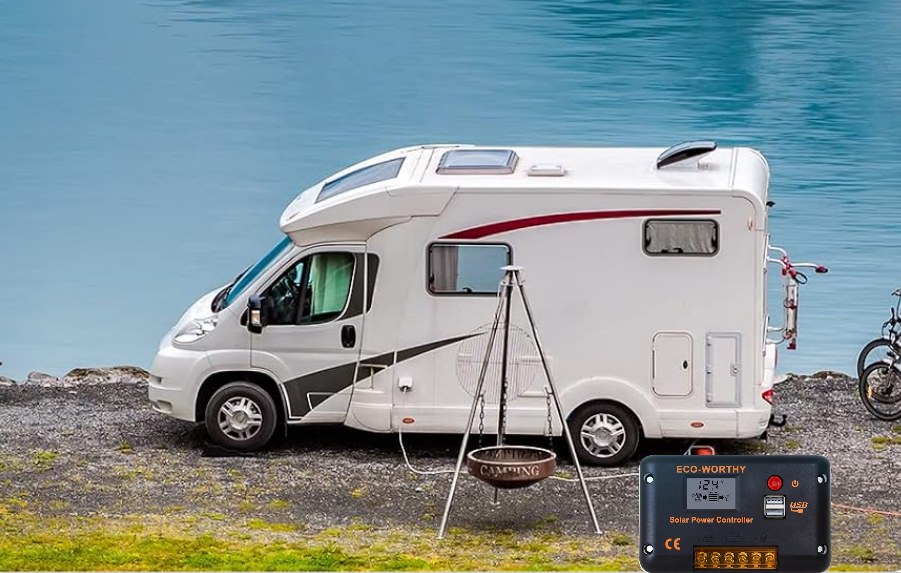
Everything for a first off-grid circuit in one box: two monocrystalline panels, a 30A PWM charge controller, mounting Z-brackets and cabling. Reviewers verify real-world roles — keeping camper batteries topped, running barn fences and lights, driving a garden irrigation pump off a 400Ah bank — and the panels themselves get quality praise above their price class. The kit’s ceiling is honest physics: PWM, not MPPT, and 200W is a taste, not a solution.
- panels + controller + brackets in one box — no third store required
- monocrystalline, beefier than the price suggests — repeated reviewer surprise
- 12V or 24V configurations — series-wire the pair for 24V
- 4.6 · 1,199 ratings — the brand’s deepest-running review history

ECO-WORTHY adjustable solar ground mount bracket kit
The structure under the panels, and the review history’s most instructive divide. On grass, in low wind, with bolts into something solid: buyers report clean installs of three 200W or four 400W panels at half the cost of purpose-built racks — one built a wheeled, mobile version. The boundary reviews are equally consistent: the legs are hinges until bolted down, the rails run inches short with clamp hardware for four-panel fills, and the supplied strut nuts can spin under torque. Budget a Unistrut hardware-store run if wind or big panels are in your plan.
- adjustable multi-piece strut frame — 4×200W / 3×300W / 2×400W configurations
- half the price of purpose-built racks — the repeated reviewer math
- documented reinforcement path — unistrut extensions fix the short rails
- 4.3 · 795 ratings — with the wind-load caveat worth reading twice
Who each ECO-WORTHY piece is for
ECO-WORTHY sells a system in pieces, and the review history reads like a build order: panels and a controller first, something to hold them second, and — when the circuit outgrows the camper battery — a real storage bank. Each piece has a documented ceiling; the buyers who are happy are the ones who knew theirs going in.
The first-circuit builder — 200W kit ($189.99)
You want one box that puts sun to work on a trailer, barn, gate or garden circuit. Reviewers verify irrigation pumps, fence chargers and lights running indefinitely. Know the ceiling on day one: PWM efficiency and 200W is a starter dose, and most owners eventually upgrade the controller.
The ground-array builder — mount kit ($116.99)
You’re placing panels on grass, dirt or a cabin’s open space instead of a roof. At half the price of purpose-built racks it’s the budget pick that works — bolted down, in reasonable wind, with the panel dimensions checked against the rails first. High-wind or four-panel builds should budget the Unistrut reinforcement its 3-star reviewers describe.
The home-backup planner — Cubix100 ($999.99)
You’ve outgrown 12V circuits and want kilowatt-hours indoors: server-rack form factor, UL9540, closed-loop inverter comms, expandable by stacking. The one hard rule from the reviews — no charging below freezing in the standard variant — decides whether you need the Pro.
Side by side
Prices and ratings from the brand’s affiliate feed at time of writing.
| Cubix100 Battery | 200W Panel Kit | Ground Mount Kit | |
|---|---|---|---|
| Role in a build | Storage bank (5.12kWh, stackable) | Generation + PWM control | Structure for ground arrays |
| Best for | Home backup, inverter pairing | Trailers, barns, irrigation | Grass/dirt installs, cabins |
| Documented ceiling | Won’t charge below 32°F | PWM inefficiency, 200W cap | Short rails; hinges until bolted |
| Expand path | Stack batteries in parallel | Series to 24V; add kits | Unistrut + better fasteners |
| Price | $999.99 | $189.99 | $116.99 |
| Rating history | 4.7 · 350 | 4.6 · 1,199 | 4.3 · 795 |
Not the right pick if… your battery lives in an unheated shed. The Cubix100’s standard LiFePO4 cells refuse to charge below freezing — one owner documented discovering this the expensive way and stepping up to the Pro variant. Cold-climate installs need the Pro, insulation, or an indoor rack location.
Not the right pick if… you expect the 200W kit to power a household. Its own 4-star reviewer says it plainly: you will outgrow this kit on day one, and PWM leaves watts on the table versus MPPT. It is a starter circuit — buy it as one, or buy more panels and an MPPT controller instead.
Not the right pick if… you’re mounting large panels or live where wind happens. The mount kit’s 3-star reviews converge: rails a few inches short for full panel fills, legs that hinge until bolted to something solid, strut nuts that can spin under torque. The reinforcement path is real but costs a hardware-store run and an afternoon.
Not the right pick if… terminal orientation and cable lengths matter to your install. A Cubix owner documented the battery’s terminals swapping sides between production batches, leaving supplied cables too short. Measure your cable run and keep spares before rack day.
Not the right pick if… you need premium-grade metal everywhere. The mount’s own fans call it “not top quality, but it does the job, and cheaply.” That sentence is the whole brand in one line — budget hardware with honest ceilings, not overbuilt gear.
What verified buyers say
Six verified Amazon reviews, paraphrased and attributed — weighted toward the boundary-setting reviews this category needs most.
The strongest thing an owner can say about storage hardware: purchased one for the setup and liked it enough to add a second. The metal server-rack case feels like quality equipment, 51.2V × 100Ah delivers 5.12kWh in a compact footprint, and Bluetooth/Wi-Fi monitoring means no more walking to the rack to check state of charge. It says more than any spec sheet could.
The workaround review that widens the product: paired it to a Bluetti Apex 300 through a modified battery cable, ran both through a near-full cycle, and the batteries keep close state of charge — capacity almost tripled. Likes the under-counter-friendly minimalist look and the basic app that shows SOC; his only gripe is the app could show time-remaining estimates. Proof the battery plays fine beyond the obvious ECO-WORTHY inverter pairing.
The listing-gap review that saves someone $900: the description did not mention that the battery will not accept charge below freezing, so an outdoor-shed install was a mistake. Caught it in time to return minus shipping and step up to the Pro version, which handles cold charging. If your battery lives where winter happens, the Pro variant is the one — this is the single most useful warning in the Cubix review pool.
The one-box verdict: panels, charge controller, mounting hardware and cables all in one shipment, no trip to three different stores. The controller is PWM, which he names plainly — basic, not fancy — but basic works, it’s easy to understand, and for the money it’s a good way to get free power flowing on a trailer or cabin. Exactly the first-kit role this SKU plays.
The working-system report: mounted on the roof of a water collector, recharging a 400Ah 12V bank that powers a 12V pump for drip irrigation across 200 square feet of uphill garden, fed from two 175-gallon tanks. Well made, holding up across seasons. Proof the kit’s real job isn’t running a house — it’s owning one small circuit completely, indefinitely, with no fuel and no extension cords.
The measure-twice review: bought two racks on the listing’s claim of three 300W panels each, and standard 39-inch-wide panels plus clamp hardware exceed the rail length by a few inches. His fix — Unistrut extensions — made the system work the way it should have out of the box; Amazon credited the extra materials after the seller passed him along. The hardware lesson transfers to every configuration: lay out your panel dimensions against the rail length before ordering.
Three builds this lineup covers
The trailer that starts every morning
Two panels leaning against the camper until roof day, a 30A controller holding the 12V systems charged: the 200W kit’s documented role, paired later with a 1000W inverter for occasional AC loads. The starter circuit that never needs a shore-power apology.
The garden that waters itself
Panel kit on a collector roof, 400Ah of battery below, a 12V pump pushing drip lines uphill across 200 square feet — Keith’s build, running unattended. This is the sweet spot where PWM’s inefficiency doesn’t matter and the kit’s simplicity becomes a feature.
The indoor rack that outgrew the camper
Cubix100 on a wheeled server rack, handles mounted, bus bars joined, closed-loop into an EG4-class inverter — and a second battery ordered within weeks. The endgame build: real kilowatt-hours, UL9540 paperwork, indoors where the freezing rule can’t bite.
FAQ
Can the Cubix100 battery power a whole house?
One battery stores 5.12kWh — enough to run essentials through an evening outage, not central air for a day. Owners scale by stacking batteries in parallel on a bus bar, and the review history’s tell is people quietly ordering seconds and thirds. Start with your inverter’s voltage (48V) and count what you actually need to run.
Will the battery work with my Bluetti / EG4 / other-brand inverter?
The documented cases say yes with caveats: a Bluetti Apex 300 pairing worked through a modified battery cable with both units keeping close state of charge, and an EG4 6000XP runs a rack natively over closed-loop comms. Odd-brand pairings should assume DIY cabling and lose closed-loop SOC reporting — the basic app still shows battery state.
Why did my battery stop charging in winter?
Standard LiFePO4 chemistry will not accept charge below freezing, and the Cubix100’s listing didn’t shout about it — one reviewer discovered it in an outdoor shed and upgraded to the Pro variant, which handles cold-charge conditions. If your install point ever sees 32°F, the Pro is the correct SKU.
MPPT vs the kit's PWM controller — how much am I leaving on the table?
A PWM controller wastes part of the panel’s potential by pulling voltage down to battery level — reviewers estimate meaningful losses on sunny days, and one 4-star reviewer lists upgrading the controller as the kit’s inevitable second purchase. For a 200W starter circuit the math favors simplicity; past ~400W, MPPT pays for itself.
Is the ground mount kit sturdy enough for real wind?
Bolted down and reinforced, yes — reviewers describe survival in storms after adding Unistrut bracing and better fasteners, roughly $115 of extra hardware in one documented case. Out of the box in open wind, the honest answer is no: the legs hinge until anchored and the rails come up short for full panel fills. Budget the reinforcement into the project.
How was this page put together?
We are an independent review site. Specs, prices and coupon states come from the brand’s official affiliate feed; review summaries are paraphrased from the public Amazon review history of each product, negative reviews included. If you buy through our links we may earn a commission — it does not change which reviews we quote or what they say.