

Quick answer: DC HOUSE is a golf-cart lithium conversion brand, and the honest story is one product with two sizes. The 48V 100Ah metal-case kit ($869.99) is the conversion: one pack replacing six lead-acid bricks, 300–400 pounds lighter, days of runtime, a real Houston-based support operation, and no printed manual. The 48V 50Ah mini kit ($639.99) is the same platform for lighter duty cycles with a thinner review pool of its own. The 18A charger ($139.99) is the verified workhorse spare — with one documented first-plug failure in the pool. Buy the amp-hours your cart actually uses.
The three-product lineup
One chemistry, one voltage, two sizes and the charger. Prices are feed values at time of writing.
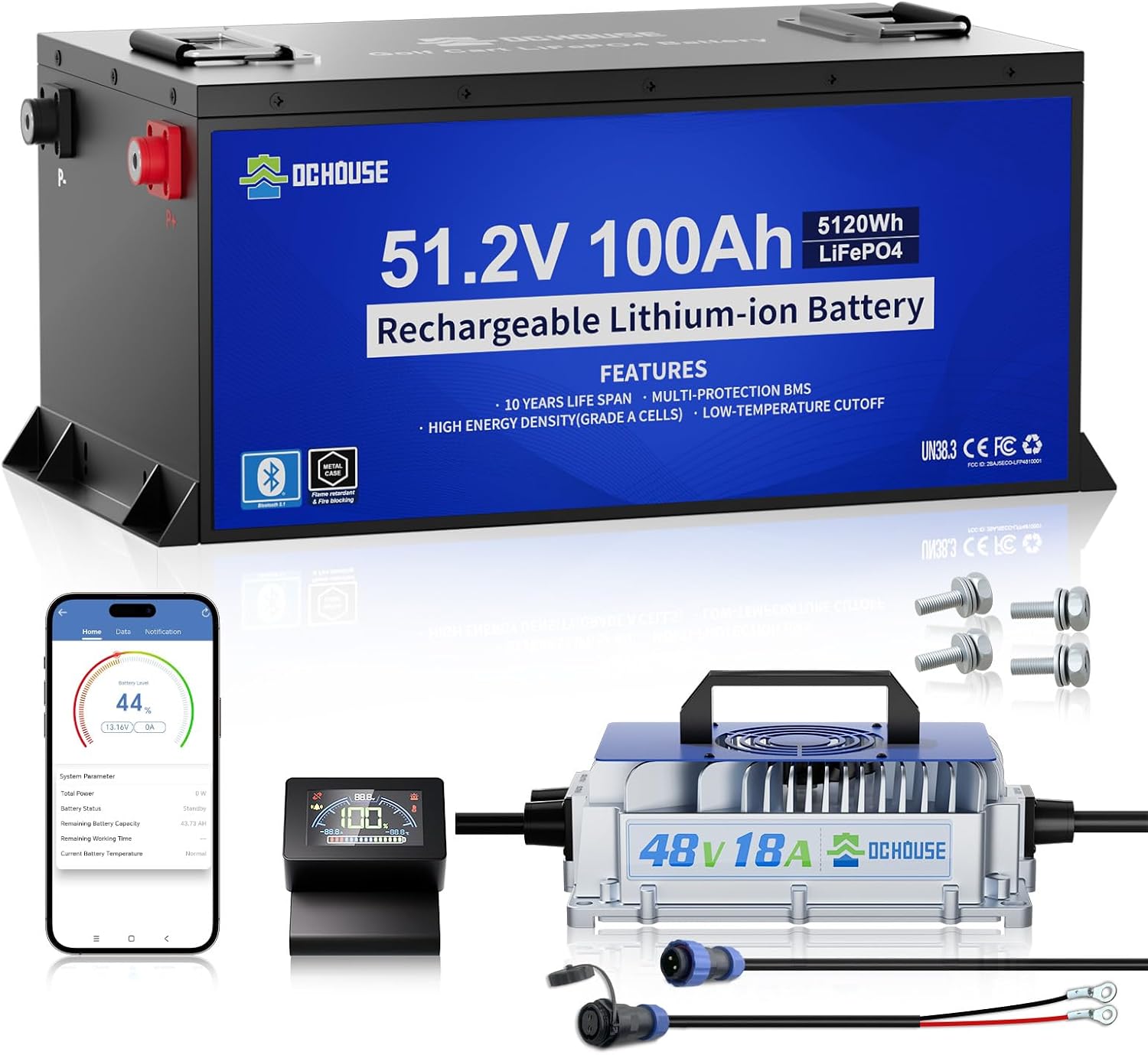
DC HOUSE 48V 100Ah metal-case battery kit
The product this brand is actually about: one lithium battery replacing six lead-acid bricks in a golf cart, with the charger in the box. The conversion math from the review pool: 300–400 pounds of weight removed, carts running three days at 80% charge where lead-acid lasted a day or two, and the total cost landing at or below a full lead-acid replacement set. Install stories run EZGO TXT, Club Car DS and 10-year-old RXV carts, all reporting the hardest part is lifting the old batteries out. The support story is the differentiator: a Houston warehouse, a phone number that answers, and warranty swaps for a defective charger handled by email. Honest caveats: no printed instructions — the knowledge lives in YouTube videos and the manual you’ll wish existed.
- replaces 6× 8V lead-acid bricks — 300–400 lbs lighter, documented across EZGO/Club Car installs
- 3 days of runtime at 80% — vs a day or two for the lead-acid it replaces
- Bluetooth monitoring + wireless gauge — state of charge visible without opening the bay
- install is DIY-with-videos — no printed manual — the pool’s one consistent complaint

DC HOUSE 48V 50Ah mini battery kit
Half the amp-hours, half the physical size, three-quarters of the price — the choice for carts that do shorter daily loops or where battery-bay space is the constraint. The review pool is small (92 ratings across the family, and this SKU’s own page is thin), so the honest guidance comes from the platform: same chemistry, same charger bundle, same metal-case build as the 100Ah, with runtime that owners of comparable DC HOUSE packs describe as “goes a very long time” on casual use. The one scraped field note for this exact SKU is practical: a Ryobi 300e owner’s advice to find “the tube video, with the white haired guy” and follow it exactly. If your usage is short loops and the $230 difference matters, this is the size that fits.
- half-size, half-weight package — for tight battery bays and lighter duty cycles
- same platform as the 100Ah — metal case, Bluetooth, bundled 18A charger
- casual-use runtime — platform owners report days between charges, not hours
- thin SKU-specific review pool — platform trust, not this listing’s own history

DC HOUSE 48V 18A lithium charger
The charger DC HOUSE bundles with its battery kits, sold alone for conversions that keep an original charger or need a second one. The pool’s installers have deployed “near a dozen” of these flawlessly across golf carts and a Ryobi riding mower; the efficiency claim (≥93%) was verified by one owner with a clamp meter and a Victron shunt showing near-18A actual output. The honest pattern: LED-only status (orange-yellow-green, no numeric gauge — the pool’s most repeated wish), small-gauge battery-side wiring (12 AWG by one owner’s measurement), a cooling fan that runs throughout the charge, and a 1-star unit that smoked and popped on first plug-in. DC HOUSE’s support reputation is what makes that last one a warranty ticket instead of a fire story.
- verified 18A actual output — clamp-meter tested by a skeptical owner — spec is real
- ~93% efficiency, quiet fan — comparable to a laptop fan, runs through the cycle
- auto-shutoff at full — fan-off is the finished signal, unplug is the ritual
- 1-in-N QC lottery documented — one smoked unit; support’s reputation is the safety net
Who each DC HOUSE product is for
This is a voltage-first brand: everything is 48V LiFePO4, and the buying decision is amp-hours and bay space.
The full-time cart — 100Ah kit ($869.99)
Daily drivers, golf rounds, neighborhood runs, property chores. One pack replaces the whole lead-acid bank, sheds 300–400 pounds, and runs for days. The conversion math is documented across every major cart platform.
The light-duty or tight-bay cart — 50Ah kit ($639.99)
Short loops, occasional use, physically small battery bays. Same platform, same charger, less runtime — and the pool’s honest note that this SKU’s own review history is thinner than the 100Ah’s.
The converter keeping an old charger — 18A charger ($139.99)
Lithium conversions that need a proper CC/CV charge profile, second bays, or a replacement for the kit charger that failed. Verified output, honest wiring critique, and one documented smoker in the pool.
Side by side
Prices and ratings from the brand’s affiliate feed at time of writing.
| 100Ah metal kit | 50Ah mini kit | 18A charger | |
|---|---|---|---|
| Job | Replace the whole lead-acid bank | Light-duty lithium conversion | Charge/maintain 48V LiFePO4 |
| Replaces | 6× 8V lead-acid, 300–400 lbs | Same, shorter runtime | Lead-acid chargers (wrong profile) |
| Best documented win | 3-day runtime at 80%, 439-ratings strong | Same platform, $230 cheaper | ~12-unit fleet, zero failures |
| Documented weakness | No printed manual | Thin SKU-specific pool | 1★ smoker; 12 AWG wiring; LED-only |
| Price | $869.99 | $639.99 | $139.99 |
| Rating history | 4.8 · 439 | 4.5 · 92 (family) | 4.5 · 92 (family) |
Not the right pick if… your cart isn’t 48V. Everything here is built for the 48V standard — 36V carts need a different product line, and half the DIY mistakes in lithium conversions start with voltage mismatches. Confirm the battery count and terminal voltage before ordering anything.
Not the right pick if… you expected a manual in the box. The pool’s most consistent complaint: no printed instructions, and the knowledge lives in YouTube videos — the “white-haired guy” Ryobi video gets name-checked. If you’re not comfortable wiring from a video, budget a golf-cart shop’s labor hour.
Not the right pick if… you can’t verify state of charge yourself. The Bluetooth gauge and wireless display are nice, but multiple owners note quirks — displays that sleep, chargers with LED-only status, no numeric gauge anywhere. If knowing exact charge percentage matters to your routine, plan a volt meter as backup.
Not the right pick if… you live where support can’t reach. DC HOUSE’s reputation is specifically a Houston office with humans who answer — but the pool also notes slow email cadence from the time difference, and one solar-config owner got no reply at all. Check the warranty path before the return window closes, not after.
Not the right pick if… you’re stacking multiple batteries without a bus bar plan. The pool’s heavy users run single packs; paralleling lithium requires matched voltages and proper fusing, and nothing in this line ships bus hardware. That’s an add-on project, not a product feature.
What verified buyers say
Six verified Amazon reviews, paraphrased and attributed — weighted toward the boundary-setting reviews this category needs most.
The conversion economics in full: six old lead-acid batteries out (90 pounds each, dirty), one DC HOUSE lithium in — roughly 400 pounds lighter, charging faster, three days of use at 80% remaining where the old packs lasted a day or two. His closing line: “Don’t hesitate.” The strongest result pattern in the pool.
A Club Car DS conversion that hit a defective charger in the kit — the email thread ended with a replacement on the way, “very easy to deal with, just a little slow due to the time difference.” What separates his 5 from his would-be 3: an American office and warehouse in Houston instead of an offshore call center, quick callbacks, and questions answered thoroughly. The support story the whole brand’s reputation runs on.
The pragmatic retiree install: no instructions in the box, so he leaned on web videos; the hard part was lifting the old batteries out and ratchet-strapping the new one in. He mounted the charger inside the bay and repurposed the old charge port hole for an AC inlet — “recharging is as simple as plugging a grounded extension cord into the cart.” The DIY path, documented.
A repeat installer across a golf-cart fleet: every unit working daily, golf carts converting to lithium “with ease of use and low costs as the prime drivers.” The volume-buyer verdict that says more than any single-owner review can.
The engineer’s audit: clamp meter and Victron shunt confirm near-18A actual output; unit runs two hours, gets “a little warm but nothing worrisome”; warranty is one year. The complaint is precise — battery-side cables around 12 AWG, smaller than he’d like. He closes by disclosing nobody paid for the review. The kind of owner you want in front of a charger.
The QC-lottery edge: plugged into the wall before ever touching a battery, and it “smoked and popped” — sent straight back. One unit, first use, total failure. Against a pool of flawless installs this is the outlier that matters: buy from a seller with easy returns, plug in on a non-flammable surface the first time, and let the one-year warranty do its job if you draw the bad unit.
Three carts this line converts
The neighborhood daily driver
Golf rounds, grocery runs, property laps. The documented win: three days per charge, 400 pounds lighter, charging from an extension cord in the garage.
The weekend chore cart
Short loops with tools and a trailer. The documented win: the 50Ah platform handles the duty cycle at $230 less, with the same Houston-backed warranty.
The Ryobi riding mower
Electric mowers with dead lead-acid or charger mismatches. The documented win: a half-size charger and a lithium pack bringing a Gen 1 back to daily duty — with a specific YouTube video to follow.
FAQ
Is the lithium conversion actually worth the money?
The pool’s math says yes, with conditions: a full six-battery lead-acid replacement costs about what this kit does, so the comparison isn’t lithium-vs-free — it’s lithium-vs-lead-acid at the same price. For that you get 300–400 pounds less weight, days instead of hours of runtime, no acid maintenance, and no annual corroded-cable surprise. The owners who regret it are the ones who bought more amp-hours than their duty cycle needs.
How hard is the install?
Mechanically simple, physically demanding, documentation-light. The pattern across installs: the hardest part is lifting 90-pound lead-acid bricks out; the new battery drops in and gets ratchet-strapped; wiring is straightforward for anyone who’s done 12V work. The consistent gap is the missing manual — everything lives in YouTube, and the community has opinions about which video. A shop can do it in an hour if you’d rather not.
Do I need to replace my old charger with the 18A unit?
Almost certainly yes, if the old one is lead-acid: lithium needs a CC/CV profile, and lead-acid chargers won’t deliver it correctly. The kits bundle the right charger, which is why the standalone 18A is mainly for conversions keeping other components or needing a second bay. The pool verified its ~18A output with instruments; the LED-only status and 12 AWG battery-side wiring are the honest critiques.
What's the QC risk, really?
Low but non-zero, and the pool documents both ends: a fleet installer with near a dozen flawless units, and one first-plug smoker. The mitigations are structural — a Houston office that answers the phone, a one-year warranty, and an email support thread that resolves with replacement parts. The ritual: first plug-in on a safe surface, inside the return window, with your order records handy.
100Ah or 50Ah for my usage?
The honest answer is measuring, not guessing: how many miles per day, terrain, and how often you tolerate charging. The 100Ah pool documents 3-mile dirt-and-hill runs consuming 10% — that math makes a 100Ah a multi-day pack for most neighborhoods. If your cart does one short loop on weekends, the 50Ah’s price difference is real money for capacity you’ll never touch. The 50’s honest caveat: its own review pool is thin — you’re trusting the platform, not the listing.
How was this page put together?
We are an independent review site. Specs, prices and coupon states come from the brand’s official affiliate feed; review summaries are paraphrased from the public Amazon review history of each product, negative reviews included. If you buy through our links we may earn a commission — it does not change which reviews we quote or what they say.